
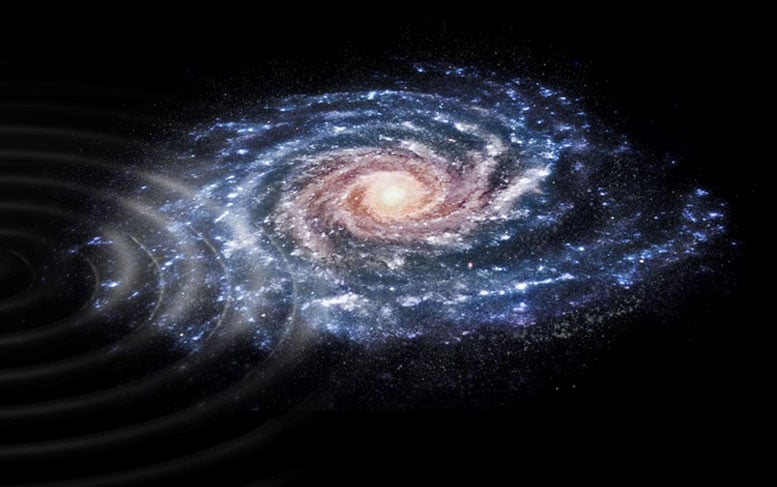
A team led by researchers from the Institute of Cosmos Sciences of the University of Barcelona (ICCUB, UB-IEEC) and the University of Groningen has discovered, through the analysis of Gaia data, sub-structures so far unknown to the Milky Way. The discovery, the result of combining the positions and speeds of six million stars on the disk of our galaxy, has been published in Nature magazine.
“We have observed forms with different morphologies, such as a spiral similar to a screw shell. The existence of these substructures has been observed for the first time thanks to the unprecedented accuracy of the data provided by the Gaia satellite, of the European Space Agency (ESA),” explains Teresa Antoja, a researcher at ICCUB (IEEC-UB) and first signing of the article. “These substructures – adds – allow us to conclude that the disk of our galaxy suffered an important gravitational disturbance now between 300 and 900 million years ago.” This is one of the first great discoveries of galactic archeology that should allow us to find out the origin and evolution of the Milky Way.
But what caused that disturbance? To obtain a response, the structure and degree of spiral load mentioned in dynamic models have been compared. This has allowed the researchers to formulate the hypothesis that the disturbance was due to the last step of the dwarf galaxy of Sagittarius near the Milky Way disk.
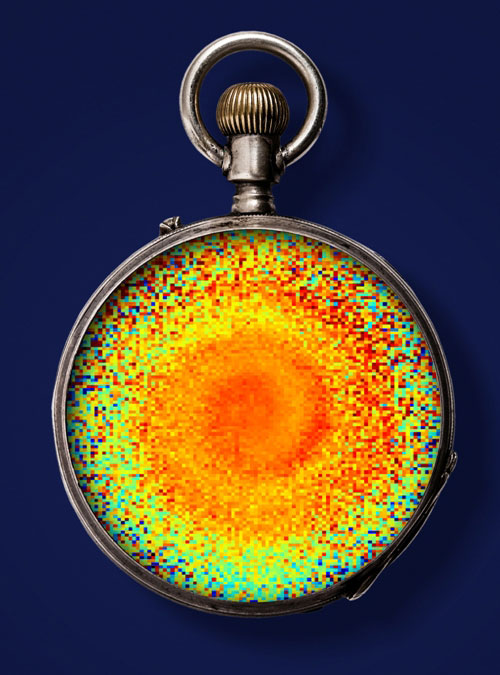
“The work establishes, in a definitive way, that the Milky Way disk is dynamically young, sensitive to disturbances and changes over time,” says Antoja. “One of the most remarkable ways that we observe,” the researcher continues, “is the spiral pattern shown by the stars near the Sun, which never before had been observed.” “In fact, the forms observed in the graphs were so evident (as opposed to the usual cases), that we came to think that it could be an error in the data,” explains Antoja. In this sense, more than one hundred European engineers and scientists, among whom the UB team plays an important role, worked for months on the tasks of verification and validation of Gaia’s data. As part of this task of verification, Mercè Romero-Gómez, a researcher at the UB, explains:
The effect of the Sagittarius galaxy on the Milky Way
In the same way that when a stone is dropped into a pond we form waves that propagate to the surface, or that when we approach a magnet to a fold of iron slime, these sorted and aligned in a certain direction, the stars of the galactic disk are sorted by responding to the gravitational attraction of a satellite gala that passes near them. Over time, the stars conserve in their orbital movement the effect of the disturbance that shook them, which is now seen as a spiral in the graphs.
According to Amina Helmi, a researcher at the University of Groningen, “we know that our galaxy is “cannibal,” and that it has been growing swallowing small galaxies, as it is currently doing with the Sagittarius galaxy.” However, the expert points out, “the mass of Sagittarius is still large enough to cause appreciable gravitational impact.” What we see now does not respond to a clash between the two galaxies, but rather a rapprochement of the galaxy of Sagittarius on the galactic disk.
First results of the new Gaia catalog
The data analyzed in this work are part of the second catalog of the Gaia mission, which was published a few months ago, on April 25, 2018. “Scientists and engineers at the UB have played a fundamental and irreplaceable role for make this data come true,” stresses Xavier Luri, director of the ICCUB and coordinator of the team that has been responsible for the development of the Gaia archive at the European level. The effort of more than 400 scientists and engineers has allowed to publish positions and precise movements for more than 1,300 million objects. Also in this second catalog -which only covers the first twenty-two months of data collection- they were able to publish the first spectroscopic data for a few million stars of the solar environment, data that allow to measure the speed of the stars in the line of vision.
Today, the Gaia satellite has accumulated more than forty-eight months of successful operations, and ESA has already approved to extend the mission until the end of 2020. Currently, it is evaluating a second extension for two years more. In the words of Carme Jordi, a researcher at the UB and member of the Gaia Science Team, the ESA advisory body for this mission, “everything suggests that this is just one of the first discoveries of an extensive set of new findings -And surprises- that hide the data of Gaia that was published on April 25, 2018: the tip of an iceberg in the study of the origin and evolution of the galaxy in which we are immersed.”
Reference: “A dynamically young and perturbed Milky Way disk” by T. Antoja, A. Helmi, M. Romero-Gómez, D. Katz, C. Babusiaux, R. Drimmel, D. W. Evans, F. Figueras, E. Poggio, C. Reylé, A. C. Robin, G. Seabroke and C. Soubiran, 19 September 2018, Nature.
DOI: 10.1038/s41586-018-0510-7
Never miss a breakthrough: Join the SciTechDaily newsletter.
Follow us on Google and Google News.