
Close Menu
    Facebook X (Twitter) Instagram
    SciTechDaily
    • Biology
    • Chemistry
    • Earth
    • Health
    • Physics
    • Science
    • Space
    • Technology
    Facebook X (Twitter) Pinterest YouTube RSS
    SciTechDaily
    Home»Technology»Breakthrough Could Lead to New Insights About Cancer Development
    Technology

    Breakthrough Could Lead to New Insights About Cancer Development

    By Yale School of Engineering & Applied ScienceJanuary 11, 2019No Comments4 Mins Read
    Facebook Twitter Pinterest Telegram LinkedIn WhatsApp Email Reddit
    Share
    Facebook Twitter LinkedIn Pinterest Telegram Email Reddit
    Innovation Brings New RNA Insights
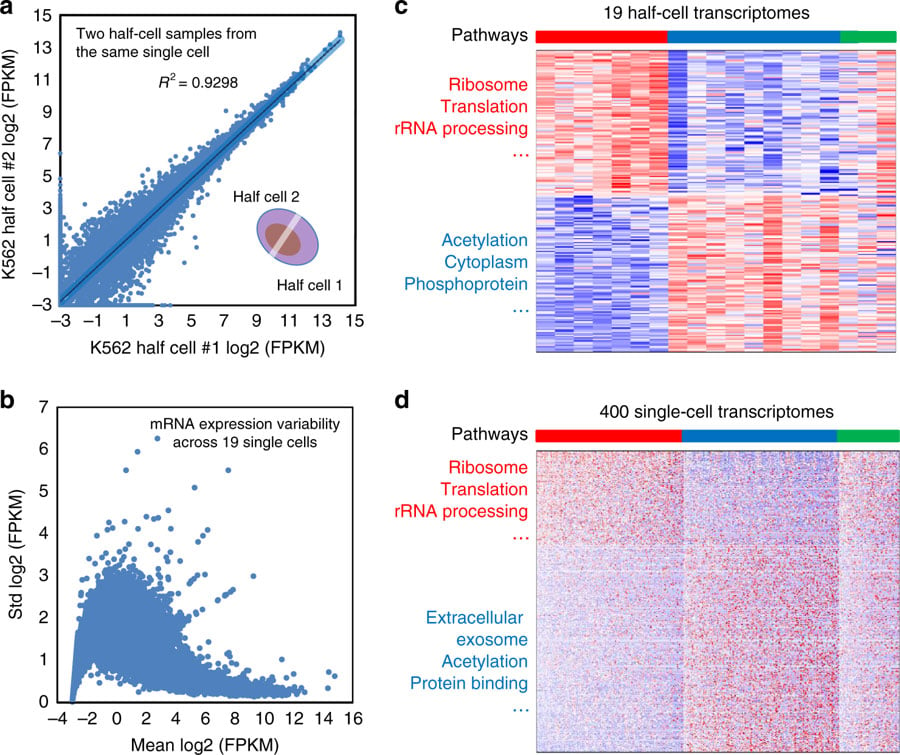
    Global profiling of mRNAs from half cells. a A single K562 cell was lysed, and two halves of the lysate were separately subjected to RNAseq. Scatter plot of normalized and log2-transformed mRNA expression levels (in FPKM units) is shown. Each circle represents one annotated mRNA. The correlation coefficient R2 is 0.930. b The standard deviations of mRNA expression across 19 successfully profiled half cells were plotted against the mean expression, using log2-transformed mRNA expression data. Each circle represents one annotated mRNA. c Consensus clusters were identified in the 19 K562 half-cell mRNA expression data. A heatmap is shown for differentially expressed genes between the red and blue clusters, with enriched pathways annotated by the DAVID pathway analysis. Each row represents one annotated gene whereas each column represents a single cell. d K562 cells were profiled using a massively parallel single-cell 3′-end RNAseq technology. A heatmap is shown for differentially expressed genes between the red and blue consensus clusters, with enriched pathways annotated by the DAVID pathway analysis. Each row represents one annotated gene whereas each column represents a single cell. Within the heatmaps, blue color indicates low expression whereas red indicates higher expression

    MicroRNAs, the tiny bits of genetic material that regulate gene expression, play a significant – but poorly understood – role in controlling the differences between individual cells. Yale researchers have developed a technology that sheds light on the workings responsible for these differences – a breakthrough that could lead to new insights about cancer development.

    Researchers at Yale were able to profile for the first time both microRNA and messenger RNA (mRNA) in the same individual cell. By doing so, they discovered new mechanisms that lead to the heterogeneity – that is, the many variations – of gene expression. The results are published today in Nature Communications.

    The research is a collaboration between the laboratories of Rong Fan, associate professor of biomedical engineering, and Jun Lu, an associate professor of genetics at the Yale Stem Cell Center.

    “Our work for the first time allowed for the direct measurement of all microRNAs and all mRNAs in single cells, which can provide direct evidence of how microRNAs control their target mRNAs,” Fan said.

    To co-sequence microRNA and mRNA from the same cell, the researchers needed to develop a new approach, since conventional methods, such as magnetic capture and gel electrophoresis, don’t work reliably at the single-cell scale. The researchers used a “half-cell genomics” approach. To do so, they physically split a single-cell lysate – that is, the liquid containing all the materials from a single cell – into two equal fractions. This is trickier than it sounds, since ensuring that all the protein-bound nucleic acid materials are fully dissociated is a complicated process.

    For the study, the researchers showed that the half-cell approach could lead to robust splitting of microRNA and mRNA from single-cell lysates and that they could perform a co-measurement of both from the same cell. In doing so, they found evidence that variability in microRNA expression alone is responsible for non-genetic cell-to-cell heterogeneity.

    The innovation could lead to unraveling numerous mysteries of the genome.

    “This work brings new opportunities to investigate how the changes in small RNA expression in single cells contribute to non-genetic cell-to-cell variability, and how miRNA expression heterogeneity contributes to the control of single-cell level mRNA expression heterogeneity,” said Nayi Wang, a former Ph.D. student in Fan’s laboratory and lead author of the study.

    The breakthrough could lead to a better understanding of cancer development, intratumor heterogeneity, and therapeutic resistance. The researchers said the next step may be to seek microRNA targets for cancer treatments.

    Reference: “Single-cell microRNA-mRNA co-sequencing reveals non-genetic heterogeneity and mechanisms of microRNA regulation” by Nayi Wang, Ji Zheng, Zhuo Chen, Yang Liu, Burak Dura, Minsuk Kwak, Juliana Xavier-Ferrucio, Yi-Chien Lu, Miaomiao Zhang, Christine Roden, Jijun Cheng, Diane S. Krause, Ye Ding, Rong Fan and Jun Lu, 9 January 2019, Nature Communications volume 10, Article number: 95 (2019).
    DOI: 10.1038/s41467-018-07981-6

    Never miss a breakthrough: Join the SciTechDaily newsletter.
    Follow us on Google and Google News.

    Biomedical Engineering Biotechnology MRNA Yale School of Engineering & Applied Science Yale University
    Share. Facebook Twitter Pinterest LinkedIn Email Reddit

    Related Articles

    New Nanofiber Dressings Dramatically Accelerate Healing and Tissue Regeneration

    New Bioprinting Technique Shows Potential for Tissue Repair and Regenerative Medicine

    New Biotech Innovation Reduces Unpredictability in Biological Circuits

    MIT Engineers Develop New Technologies to Battle Superbugs

    New Type of Fuel Cell Produces Electricity Directly from Biomass

    Engineers Convert Yeast Cells into Biofuel

    Engineers at SEAS Develop a Microelectronic Device That Mimics Functions of Real Cells

    Nanoparticle-Based System Advances Stem Cell Culture Techniques

    Using Chitosan to Remove Arsenic From Water Supplies

    Leave A Reply Cancel Reply

    • Facebook
    • Twitter
    • Pinterest
    • YouTube

    Don't Miss a Discovery

    Subscribe for the Latest in Science & Tech!

    Trending News

    JWST Finds a “Star” 100 Billion Times Brighter Than Any Star Should Be

    Scientists Find a Hidden Biological Link Across Different Forms of Autism

    Astronomers Discover a Ghostly River of Stars That Could Reveal Dark Matter

    Why Is Colorectal Cancer Rising in People Under 50? New Clues Point to the Environment

    Quantum Fluctuations Break a Crystal’s Symmetry Rules

    Why Does an Irregular Heartbeat Strike 40 Years Early in Some People?

    Scientists Reveal How ADHD Could Fuel Creative Thinking

    Scientists Find Just 3 Minutes of Sprinting Can Transform Blood Chemistry

    Follow SciTechDaily
    • Facebook
    • Twitter
    • YouTube
    • Pinterest
    • Newsletter
    • RSS
    SciTech News
    • Biology News
    • Chemistry News
    • Earth News
    • Health News
    • Physics News
    • Science News
    • Space News
    • Technology News
    Recent Posts
    • This Grain-of-Rice-Sized “Rainbow” Chip Could Transform 6G Communications
    • Physicists Discover Time Crystals Can Communicate Across a Semiconductor
    • Scientists Finally Solve a 20-Year Mystery About Diamond Melting
    • Common Vape Flavor May Disrupt Early Human Development
    • Ultra-Processed Foods Linked to 30% Higher Prostate Cancer Risk
    Copyright © 1998 - 2026 SciTechDaily. All Rights Reserved.
    • Science News
    • About
    • Contact
    • Editorial Board
    • Privacy Policy
    • Terms of Use

    Type above and press Enter to search. Press Esc to cancel.