
Close Menu
    Facebook X (Twitter) Instagram
    SciTechDaily
    • Biology
    • Chemistry
    • Earth
    • Health
    • Physics
    • Science
    • Space
    • Technology
    Facebook X (Twitter) Pinterest YouTube RSS
    SciTechDaily
    Home»Biology»New Study Solves Longstanding Nanowire Mystery
    Biology

    New Study Solves Longstanding Nanowire Mystery

    By Bill Hathaway, Yale UniversityApril 4, 20191 Comment2 Mins Read
    Facebook Twitter Pinterest Telegram LinkedIn WhatsApp Email Reddit
    Share
    Facebook Twitter LinkedIn Pinterest Telegram Email Reddit

    Deep in the ocean or underground, where there is no oxygen, Geobacter bacteria “breathe” by projecting tiny protein filaments called “nanowires” into the soil, to dispose of excess electrons resulting from the conversion of nutrients to energy.Longstanding Nanowire Mystery
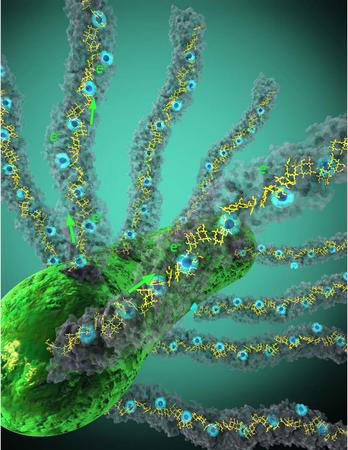
    These nanowires enable the bacteria to perform environmentally important functions such as cleaning up radioactive sites and generating electricity. Scientists have long known that Geobacter make conductive nanowires – 1/100,000 the width of a human hair – but to date no one had discovered what they are made of and why they are conductive.

    A new study by researchers at Yale, University of Virginia and the University of California at Irvine published April 4 in the journal Cell reveals a surprise: the protein nanowires have a core of metal-containing molecules called hemes.

    Previously nobody suspected such a structure. Using high-resolution cryo-electron microscopy, the researchers were able to see the nanowire’s atomic structure and discover that hemes line up to create a continuous path along which electrons travel.

    “This study solves a longstanding mystery of how nanowires move electrons to minerals in the soil,” said lead author Nikhil Malvankar, assistant professor of molecular biophysics and biochemistry at Yale and a faculty member at the Microbial Sciences Institute.

    “It is possible we could use these wires to connect cells to electronics to build new types of materials and sensors.”

    Edward Egelman of Virginia and Allon Hochbaum of UC-Irvine are other senior authors. Fengbin Wang of Virginia and Yale’s Yangqi Gu and are co-first authors. Other authors are Yale’s Patrick O’Brien, Sophia Yi, Sibel Ebru Yalcin, Vishok Srikanth, Cong Shen, Dennis Vu and UC Irvine’s Nicole Ing.

    Reference: “Structure of Microbial Nanowires Reveals Stacked Hemes that Transport Electrons over Micrometers” by Fengbin Wang, Yangqi Gu, J. Patrick O’Brien, Sophia M. Yi, Sibel Ebru Yalcin, Vishok Srikanth, Cong Shen, Dennis Vu, Nicole L. Ing, Allon I. Hochbaum, Edward H. Egelman and Nikhil S. Malvankar, 4 April 2019, Cell.
    DOI:10.1016/j.cell.2019.03.029

    Never miss a breakthrough: Join the SciTechDaily newsletter.
    Follow us on Google and Google News.

    Bionanotechnology Biotechnology Nanoscience Nanowires Popular Yale University
    Share. Facebook Twitter Pinterest LinkedIn Email Reddit

    Related Articles

    Yale Scientists Reprogram Genetic Code To Create Revolutionary Synthetic Organism

    Revolutionizing Clean Energy? Yale Scientists Discover How Bacteria “Breathe” Minerals

    Cheating Death: Yale Scientists Restore Cell, Organ Function in Pigs After Death

    Surprising Bacterial Nanowire Discovery May Lead to Living and Self-Repairing Electrical Circuits

    “DNA-Origami” Allows Scientists to Study Minute Protein Interactions

    Yale Develops New Gene Editing Strategy to Correct Mutations

    Nanoparticle-Based System Advances Stem Cell Culture Techniques

    Berkeley Lab Reports Direct Observation of Oriented Attachment in Nanocrystal Growth

    Yale Neurologists Discover the Source of Diabetic Neuropathy Pain

    1 Comment

    1. John on April 5, 2019 4:50 pm

      Refine, Experiment, ON Nuclear waste 250 tons to Recycle wasted fuel

      Reply
    Leave A Reply Cancel Reply

    • Facebook
    • Twitter
    • Pinterest
    • YouTube

    Don't Miss a Discovery

    Subscribe for the Latest in Science & Tech!

    Trending News

    Wasp Colonies Explode Into Violence After Losing Their Queen

    Scientists Create “Living Plastic” That Self-Destructs in Just Six Days

    Your Blood May Carry a 700-Million-Year-Old Secret

    Scientists Discover Some “Zombie Cells” May Actually Help You Live Longer

    Earth May Be Seeding Venus With Life, According to New Research

    What Scientists Found Inside a 117-Year-Old Woman Reveals New Clues to Long Life

    Scientists Discover Mysterious Creature Living in the Great Salt Lake – and It Exists Nowhere Else on Earth

    It’s Alive? Surprising Discovery Changes What We Know About Fog

    Follow SciTechDaily
    • Facebook
    • Twitter
    • YouTube
    • Pinterest
    • Newsletter
    • RSS
    SciTech News
    • Biology News
    • Chemistry News
    • Earth News
    • Health News
    • Physics News
    • Science News
    • Space News
    • Technology News
    Recent Posts
    • A Psychologist Explains Why 40% of People Are Avoiding the News
    • Scientists Discover Alzheimer’s-Linked Proteion’s Surprising Role in Making Memories Last
    • Vitamin D Drug Shows Surprising Promise Against One of the Deadliest Cancers
    • Scientists Crack Major Ammonia Problem With a Platinum Catalyst Breakthrough
    • MIT Engineers Solve a Major Lidar Problem That Has Stumped Researchers for Years
    Copyright © 1998 - 2026 SciTechDaily. All Rights Reserved.
    • Science News
    • About
    • Contact
    • Editorial Board
    • Privacy Policy
    • Terms of Use

    Type above and press Enter to search. Press Esc to cancel.