
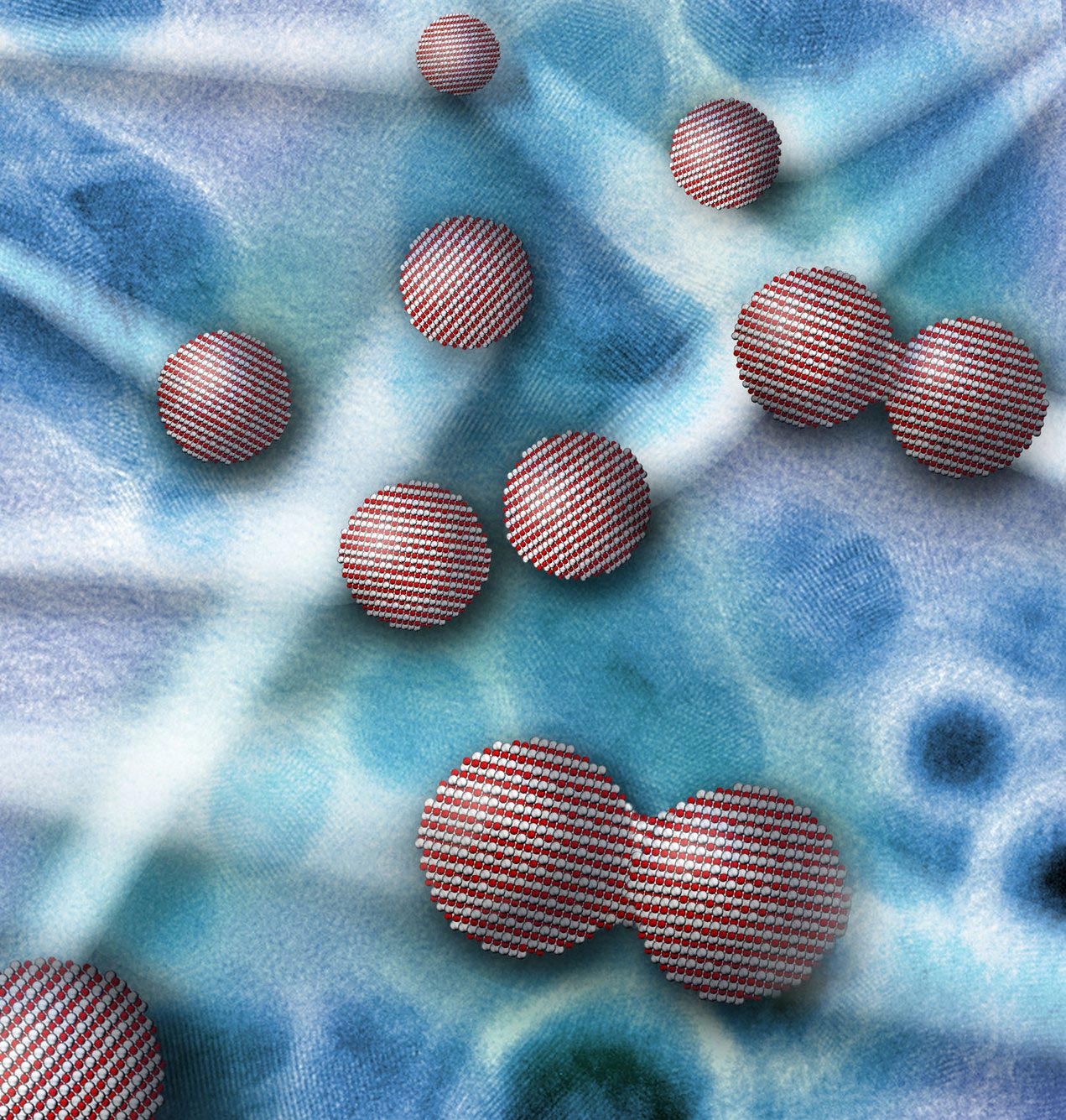
A team of scientists at the Lawrence Berkeley National Laboratory have reported the first direct observation of “jump-to-contact” between nanoparticles, the critical step in oriented attachment and the key to biomineralization.
Through biomineralization, nature is able to produce such engineering marvels as mother of pearl, or nacre, the inner lining of abalone shells renowned for both its iridescent beauty and amazing toughness. Key to biomineralization is the phenomenon known as “oriented attachment,” whereby adjacent nanoparticles connect with one another in a common crystallographic orientation.
While the importance of oriented attachment to biomineral properties long has been recognized, the mechanism by which it occurs has remained a mystery. With a better understanding of oriented attachment it should be possible to synthesize new materials with remarkable structural properties. To that end, a team of researchers with the U.S. Department of Energy (DOE)’s Lawrence Berkeley National Laboratory (Berkeley Lab) have reported the first direct observation of what they have termed “jump-to-contact,” the critical step in oriented attachment.
This electron microscopy movie shows the early stage of nanocrystal growth. Nanoparticles make transient contact at many points and orientations until their lattices are perfectly matched. The particles then make a sudden jump-to-contact to form attached aggregates. Credit: Movie courtesy of Jim DeYoreo
“The direct observation of the translational and rotational accelerations associated with the jump-to-contact between nanoparticles enabled us to calculate the forces that drive oriented attachment,” said Jim DeYoreo, a scientist with the Molecular Foundry, a DOE nanoscience center at Berkeley Lab where this research took place. “This gives us a basis for testing models and simulations that could open the door to using oriented attachment in the synthesis of unique new materials.”
DeYoreo is the corresponding author of a paper in the journal Science that describes this research titled “Direction-specific interactions control crystal growth by oriented attachment.” Co-authoring this paper were Dongsheng Li, Michael Nielsen, Jonathan Lee, Cathrine Frandsen and Jillian Banfield.
Ever since a study in 2000 led by co-author Banfield revealed the existence of nanoparticle oriented attachment, it has become widely recognized that the phenomenon is an important mechanism of crystal growth in many natural and biomimetic materials, as well as in the synthesis of nanowires.
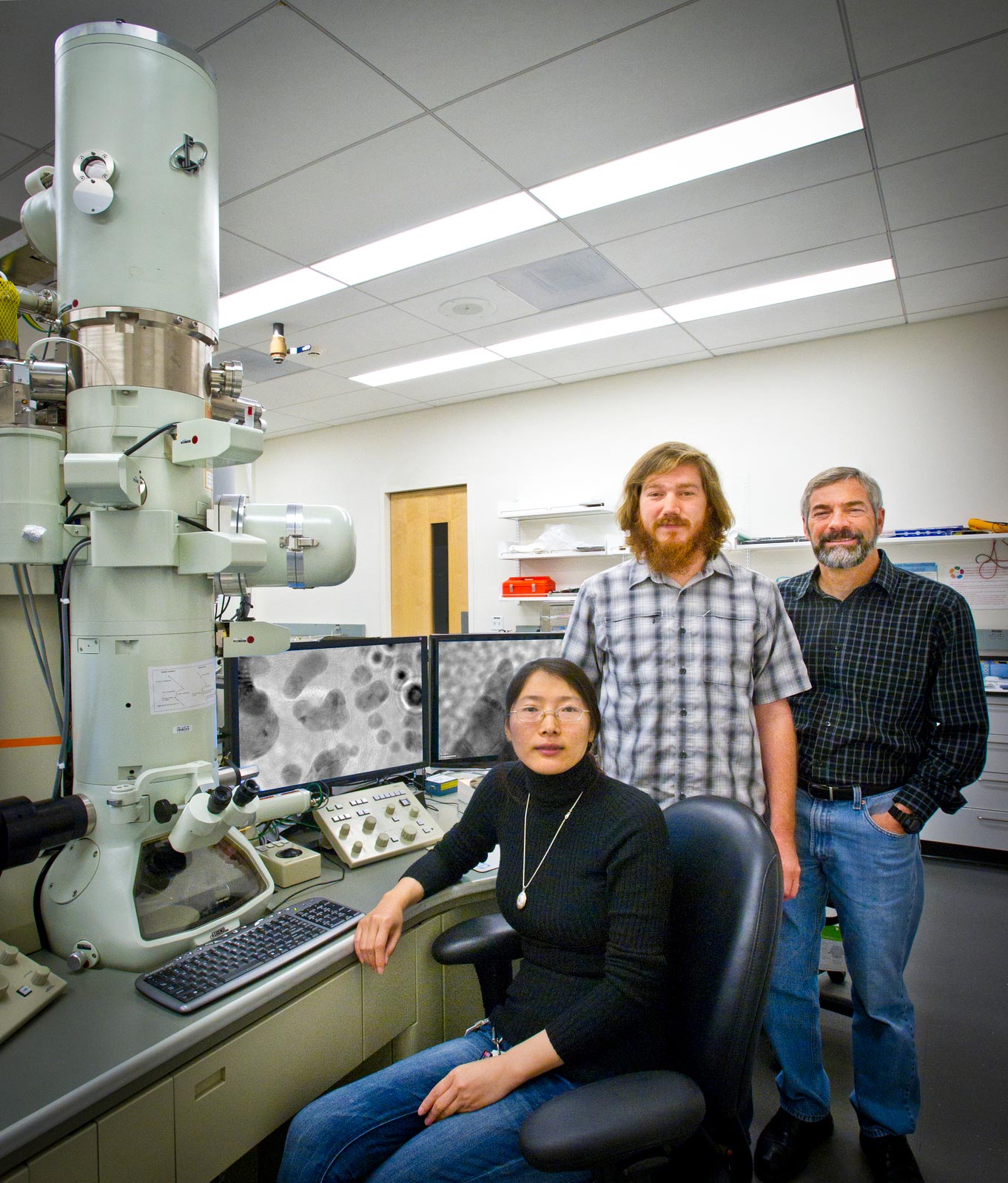
“Such nanocrystal systems often exhibit complex forms ranging from quasi-one dimensional chains to three-dimensional hierarchical superstructures, but typically diffract as a single crystal, implying that the primary particles underwent alignment during growth,” says Li, first author of the Science paper and member of DeYoreo’s research group. “When particle alignment is accompanied by coalescence, this growth is characterized as oriented attachment, however, the pathway by which nanoparticles become aligned and attached has been poorly understood.”
To learn more about the interactions and forces that drive oriented attachment, the Berkeley researchers studied the early crystal growth of iron oxide nanoparticles. Iron oxides are abundant in Earth’s crust and play an important role in the biogeochemical processes that shape near-surface environments. Using a silicon liquid cell mounted within a high-resolution transmission electron microscope at the Molecular Foundry, the research team recorded images with sufficient resolution to track nanoparticle orientations throughout the growth of the crystals.
“We observed the particles undergoing continuous rotation and interaction until they found a perfect lattice match at which point a sudden jump-to-contact occurred over a distance of less than one nanometer,” DeYoreo says. “This jump-to-contact is followed by lateral atom-by-atom additions initiated at the contact point. The measured translational and rotational accelerations show that strong, highly-direction-specific interactions drive crystal growth via oriented attachment.”
The information gained from this investigation into the oriented attachment of iron oxide nanoparticles should be applicable not only to the future synthesis of biomimetic materials, but also to environmental restoration efforts. Scientists now know that mineralization in natural environments often proceeds through particle-particle attachment events and plays an important part in the sequestration of contaminants. Understanding the forces behind oriented attachment should also advance the development of branched or tree-like semiconductor nanowires, structures in which one or more secondary nanowires grow radially from a primary nanowire.
“Branched semiconductor nanowires are being pursued for applications in photocatalysis, photovoltaics, and nanoelectronics because of their large surface areas, small diameters, and ability to form natural junctions,” DeYoreo says. “An understanding of the underlying mechanisms that control nanowire branching should help materials scientists develop more effective strategies for producing these materials.”
Reference: “Direction-Specific Interactions Control Crystal Growth by Oriented Attachment” by Dongsheng Li, Michael H. Nielsen, Jonathan R. I. Lee, Cathrine Frandsen, Jillian F. Banfield and James J. De Yoreo, 25 May 2012, Science.
DOI: 10.1126/science.1219643
This research was primarily supported by the DOE Office of Science.
Never miss a breakthrough: Join the SciTechDaily newsletter.
Follow us on Google and Google News.