
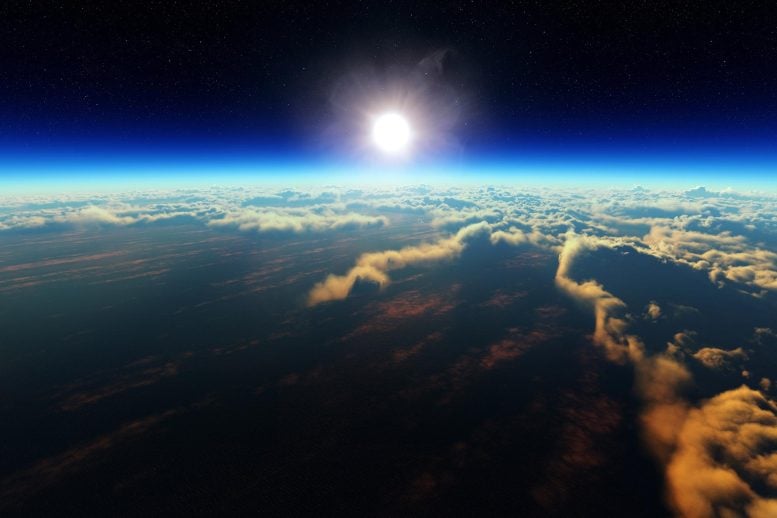
Scientists at Newcastle University have developed a new “super” biofilm using a key component from Earth’s stratosphere. By using Bacillus stratosphericu, bacteria normally found 20 miles (30 kilometers) above Earth, they were able to create a biofilm with an electrical output of 200 Watts per cubic meter.
Bacteria normally found 30 km above the earth have been identified as highly efficient generators of electricity.
Bacillus stratosphericus – a microbe commonly found in high concentrations in the stratosphere orbiting the earth – is a key component of a new ‘super’ biofilm that has been engineered by a team of scientists from Newcastle University.
Isolating 75 different species of bacteria from the Wear Estuary, Country Durham, UK, the team tested the power generation of each one using a Microbial Fuel Cell (MFC).
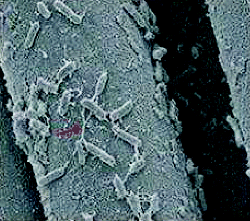
By selecting the best species of bacteria, a kind of microbial “pick and mix”, they were able to create an artificial biofilm, doubling the electrical output of the MFC from 105 Watts per cubic meter to 200 Watts per cubic meter.
While still relatively low, this would be enough power to run an electric light and could provide a much needed power source in parts of the world without electricity.
Among the ‘super’ bugs was B. Stratosphericus, a microbe normally found in the atmosphere but brought down to earth as a result of atmospheric cycling processes and isolated by the team from the bed of the River Wear.
Publishing their findings today in the American Chemical Society’s Journal of Environmental Science and Technology, Grant Burgess, Professor of Marine Biotechnology at Newcastle University, said the research demonstrated the “potential power of the technique.”
“What we have done is deliberately manipulate the microbial mix to engineer a biofilm that is more efficient at generating electricity,” he explains.
“This is the first time individual microbes have been studied and selected in this way. Finding B.Stratosphericus was quite a surprise but what it demonstrates is the potential of this technique for the future – there are billions of microbes out there with the potential to generate power.”
The use of microbes to generate electricity is not a new concept and has been used in the treatment of wastewater and sewage plants.
Microbial Fuel Cells, which work in a similar way to a battery, use bacteria to convert organic compounds directly into electricity by a process known as bio-catalytic oxidation.
A biofilm – or ‘slime’ – coats the carbon electrodes of the MFC and as the bacteria feed, they produce electrons that pass into the electrodes and generate electricity.
Until now, the biofilm has been allowed to grow unchecked but this new study shows for the first time that by manipulating the biofilm you can significantly increase the electrical output of the fuel cell.
Funded by the Engineering and Physical Sciences Research Council (EPSRC), the Biotechnology and Biological Sciences Research Council (BBSRC), and the Natural Environment Research Council (NERC), the study identified a number of electricity-generating bacteria.
As well as B. Stratosphericus, other electricity-generating bugs in the mix were Bacillus altitudinis – another bug from the upper atmosphere – and a new member of the phylum Bacteroidetes.
Newcastle University is recognized as a world leader in fuel cell technology. Led by Professor Keith Scott, in the University’s School of Chemical Engineering and Advanced Materials, the team played a key role in the development of a new lithium/air powered battery two years ago. Professor Scott says this latest fuel cell research can take the development of MFCs to a new level.
Reference: “Enhanced Electricity Production by Use of Reconstituted Artificial Consortia of Estuarine Bacteria Grown as Biofilms” by Jinwei Zhang, Enren Zhang, Keith Scott and J. Grant Burgess, 21 February 2012, ACS Journal of Environmental Science & Technology.
DOI: 10.1021/es2020007
Never miss a breakthrough: Join the SciTechDaily newsletter.
Follow us on Google and Google News.
1 Comment
Definitely a fascinating article, but using “Bacteria from Space” in the title is somewhat misleading. Space starts at an altitude of 100km.