
Close Menu
    Facebook X (Twitter) Instagram
    SciTechDaily
    • Biology
    • Chemistry
    • Earth
    • Health
    • Physics
    • Science
    • Space
    • Technology
    Facebook X (Twitter) Pinterest YouTube RSS
    SciTechDaily
    Home»Health»Researchers Develop Thermo-Responsive Protein Hydrogel for Use in Biomedicine
    Health

    Researchers Develop Thermo-Responsive Protein Hydrogel for Use in Biomedicine

    By NYU Tandon School of EngineeringSeptember 17, 2019No Comments3 Mins Read
    Facebook Twitter Pinterest Telegram LinkedIn WhatsApp Email Reddit
    Share
    Facebook Twitter LinkedIn Pinterest Telegram Email Reddit
    Steps to a Hydrogel that Can Deliver Drugs
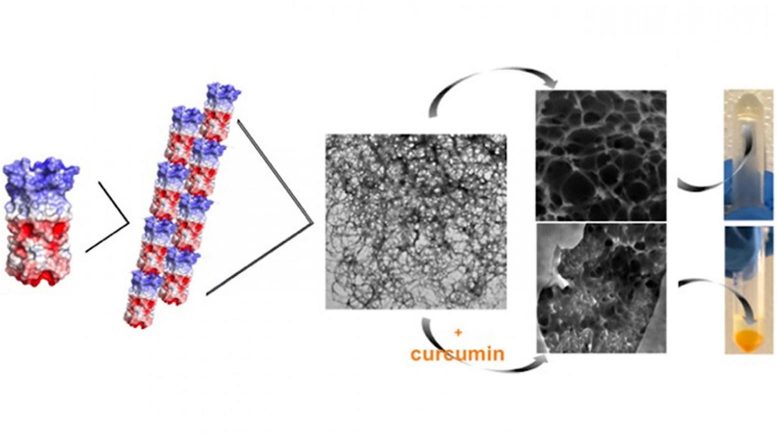
    An illustration of how an engineered Q protein self-assembles to form fiber-based hydrogels at low temperature. These hydrogels have a porous microstructure that allows them to be used for drug delivery applications. Credit: NYU Tandon

    NYU Tandon-led team crosses barrier needed to deliver drugs at the cellular level and to engineer tissue.

    Imagine a perfectly biocompatible, protein-based drug delivery system durable enough to survive in the body for more than two weeks and capable of providing sustained medication release. An interdisciplinary research team led by Jin Kim Montclare, a professor of biomolecular and chemical engineering at the NYU Tandon School of Engineering, has created the first protein-engineered hydrogel that meets those criteria, advancing an area of biochemistry critical not only to the future of drug delivery, but tissue engineering and regenerative medicine.

    Hydrogels are three-dimensional polymer networks that reversibly transition from solution to gel in response to physical or chemical stimuli, such as temperature or acidity. These polymer matrices can encapsulate cargo, such as small molecules, or provide structural scaffolding for tissue engineering applications. Montclare is the lead author of a new paper in the journal Biomacromolecules, which details the creation of a hydrogel comprised of a single protein domain that exhibits many of the same properties as synthetic hydrogels. Protein hydrogels are more biocompatible than synthetic ones, and do not require potentially toxic chemical crosslinkers.

    “This is the first thermo-responsive protein hydrogel based on a single coiled-coil protein that transitions from solution to gel at low temperatures through a process of self-assembly, without the need for external agents,” said Montclare. “It’s an exciting development because protein-based hydrogels are much more desirable for use in biomedicine.”

    The research team conducted experiments encapsulating a model small molecule within their protein hydrogel, discovering that small molecule binding increased thermostability and mechanical integrity and allowed for release over a timeframe comparable to other sustained-release drug delivery vehicles. Future work will focus on designing protein hydrogels tuned to respond to specific temperatures for various drug delivery applications.

    ###

    Montclare’s co-authors from NYU Tandon include recent doctoral graduate Lindsay K. Hill; graduate student Michael Meleties; postdoctoral researcher Priya Katyal; Xuan Xie and Che-Fu Liu, both former research scientists in Montclare’s lab; and undergraduate students Erika Delgado-Fukushima and Teeba Jihad. The team also includes researchers from the State University of New York Downstate Medical Center, City College of New York, the Center for Advanced Imaging Innovation and Research at the NYU School of Medicine, the Simons Foundation’s Flatiron Institute Center for Computational Biology, the NYU Center for Genomics and Systems Biology, and the NYU Courant Institute for Mathematical Sciences.

    Reference: “Thermoresponsive Protein-Engineered Coiled-Coil Hydrogel for Sustained Small-Molecule Release” by Lindsay K. Hill, Michael Meleties, Priya Katyal, Xuan Xie, Erika Delgado-Fukushima, Teeba Jihad, Che-Fu Liu, Sean O’Neill, Raymond S. Tu, P. Douglas Renfrew, Richard Bonneau, Youssef Z. Wadghiri and Jin Kim Montclare, 29 July 2019, Biomacromolecules.
    DOI: 10.1021/acs.biomac.9b00107

    Never miss a breakthrough: Join the SciTechDaily newsletter.
    Follow us on Google and Google News.

    Biomedicine NYU Tandon School of Engineering
    Share. Facebook Twitter Pinterest LinkedIn Email Reddit

    Related Articles

    What Is the Origin of COVID-19 Variants Like Omicron?

    Scientists Discover the Mode of Action of Essential Proteins Involved in Cancer and Alzheimer’s Disease

    FDA-Approved Compound Prevents Breast Cancer Cells From Spreading

    Bioengineers Develop Hybrid Hydrogel System to Help Heal Bones

    Radiation Study Using Human Gut-on-a-Chip Provides Hope for the Future

    New Technique Could Help Heal Heart Damage After a Heart Attack

    New Study Paves the Way to a Greater Understanding of Male Infertility

    Beating Heart Patch Repairs Damage Caused by Heart Attack

    Study Shows MRI Detects Early Signs of Schizophrenia

    Leave A Reply Cancel Reply

    • Facebook
    • Twitter
    • Pinterest
    • YouTube

    Don't Miss a Discovery

    Subscribe for the Latest in Science & Tech!

    Trending News

    This Copper Drug Clears Alzheimer’s Brain Toxins and Boosts Memory

    Adults Over 65 Lost Massive Amounts of Weight With Ozempic

    How Flocking Birds “Defy” One of Physics’ Most Fundamental Laws

    Physicists Create a New Kind of Schrödinger’s Cat State From Exotic Quantum Building Blocks

    Your Diet Could Be Missing the Key Ingredient for Heart Protection

    Researchers Warn Widely Prescribed Blood Pressure Drugs Could Be Harming Diabetic Kidneys

    James Webb Spots Something Strange Between Day and Night on an Alien Planet

    How Ancient People Moved a 6-Ton Stone 700 Kilometers to Stonehenge

    Follow SciTechDaily
    • Facebook
    • Twitter
    • YouTube
    • Pinterest
    • Newsletter
    • RSS
    SciTech News
    • Biology News
    • Chemistry News
    • Earth News
    • Health News
    • Physics News
    • Science News
    • Space News
    • Technology News
    Recent Posts
    • Scientists Uncover Cause of Inflammatory Bowel Disease Solving Decades-Old Mystery
    • The Surprising Reason Swimming Could Be Better for Your Heart Than Running
    • Could Vitamin C Be the Secret to Keeping Your Brain Younger?
    • The Surprising Fix for Robot Traffic Jams
    • Near Absolute Zero, This Transistor Starts Acting Like a Brain Cell
    Copyright © 1998 - 2026 SciTechDaily. All Rights Reserved.
    • Science News
    • About
    • Contact
    • Editorial Board
    • Privacy Policy
    • Terms of Use

    Type above and press Enter to search. Press Esc to cancel.