
Close Menu
    Facebook X (Twitter) Instagram
    SciTechDaily
    • Biology
    • Chemistry
    • Earth
    • Health
    • Physics
    • Science
    • Space
    • Technology
    Facebook X (Twitter) Pinterest YouTube RSS
    SciTechDaily
    Home»Health»FDA-Approved Compound Prevents Breast Cancer Cells From Spreading
    Health

    FDA-Approved Compound Prevents Breast Cancer Cells From Spreading

    By Gale Smith, Houston Methodist Research InstituteMarch 22, 2018No Comments3 Mins Read
    Facebook Twitter Pinterest Telegram LinkedIn WhatsApp Email Reddit
    Share
    Facebook Twitter LinkedIn Pinterest Telegram Email Reddit
    FDA-Approved Compound Prevents Breast Cancer Cells From Communicating
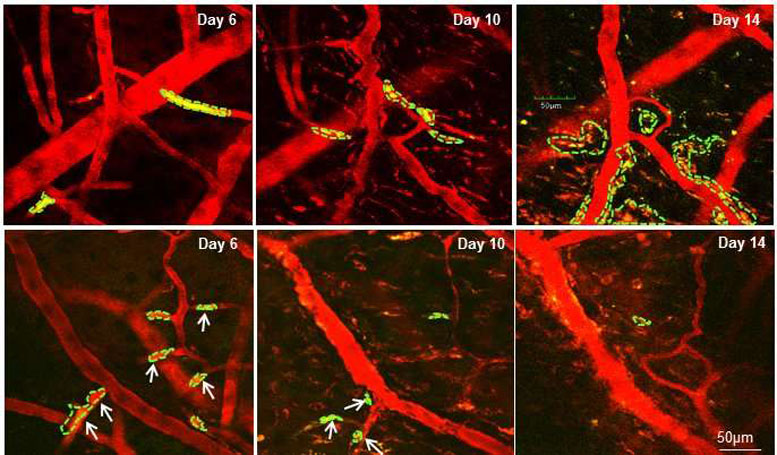
    Microscope images show tumor cells in a mouse brain at different days. Tumor cells are indicated as green dash lines. The blood vessels become leaky after day 6. In the upper panel, tumor cells formed colonization at day 14, while in the lower panel, when the mouse was treated with the compound edelfosine, most of the tumor cells disappeared at day 10 and failed to form colonization at day 14. Credit: Houston Methodist

    Researchers at Houston Methodist used computer modeling to find an existing investigational drug compound for leukemia patients to treat triple-negative breast cancer once it spreads to the brain.

    The Houston Methodist researchers culled through thousands of existing drugs to see if they could identify a compound that would prevent cancer cells from spreading, or metastasizing. They discovered edelfosine, which has been FDA-approved as an investigational leukemia treatment, and has also been used in clinical research for primary brain tumors.

    In the March 22 online issue of Cancer Research, scientists explained how they injected triple-negative breast cancer stem cells from patients into mice. After treating them with this compound, the cancer stem cells did not grow once they metastasized to the brain.

    “This compound stopped the cancer cells from communicating with brain cells as they traveled from the breast to the brain. Repurposing a drug compound to prevent the spread of cancer could be a game-changer in the prevention and treatment of metastatic brain disease,” said Stephen T. Wong, Ph.D., P.E., chair of the systems medicine and bioengineering at Houston Methodist Research Institute and one of the corresponding authors.

    Triple-negative patients usually have shorter survival time after diagnosis of brain metastasis, suggesting that these tumor cells adapt much more readily once they’ve moved to the brain. Triple-negative remains the most challenging type of breast cancer to treat, and tends to show more traits possessed by cancer stem cells than other breast cancer subtypes.

    “Viable treatment options for brain metastases are still an unmet need,” said Hong Zhao, M.D., Ph.D., assistant professor of systems medicine and bioengineering at Houston Methodist Research Institute and co-corresponding author. “Since edelfosine is already FDA-approved, we want to try and move this compound into a phase II clinical study for metastatic brain cancer in the next few years.”

    Bringing a new drug to market can cost billions of dollars and take up to 17 years. This isn’t the first time Wong and his lab have explored repurposed drugs for breast cancer. In 2011, they applied big data mathematical and bioinformatics models to screen for existing FDA-approved medications that might be effective against cancer stem cells. In collaborating with the Houston Methodist Cancer Center, they identified the anti-malarial drug chloroquine as a potential cancer stem cell killer. A few years ago, the group discovered another existing compound that improved blood flow in damaged hearts, also proved to be effective in treating locally advanced or metastatic triple-negative when combined with chemotherapy. Both drugs are currently in clinical trials.

    Wong and his lab want to see if edelfosine could be incorporated into future clinical research focused on other tumor sites such as lung, ovarian and pancreatic cancers.

    Reference: “Targeting Brain-Adaptive Cancer Stem Cells Prohibits Brain Metastatic Colonization of Triple-Negative Breast Cancer” by Ding Ren, Xiaoping Zhu, Ren Kong, Zhen Zhao, Jianting Sheng, Jiang Wang, Xiaoyun Xu, Jiyong Liu, Kemi Cui, Xiang H.-F. Zhang, Hong Zhao, Stephen T.C. Wong, 12 April 2018, Cancer Research.
    DOI: 10.1158/0008-5472.CAN-17-2994

    Never miss a breakthrough: Join the SciTechDaily newsletter.
    Follow us on Google and Google News.

    Biomedical Engineering Biomedicine Cancer Houston Methodist Research Institute Medicine
    Share. Facebook Twitter Pinterest LinkedIn Email Reddit

    Related Articles

    New Super-Charged Treatment Boosts T-Cell Therapy

    Bioengineers Develop Hybrid Hydrogel System to Help Heal Bones

    Radiation Study Using Human Gut-on-a-Chip Provides Hope for the Future

    New Technique Could Help Heal Heart Damage After a Heart Attack

    Beating Heart Patch Repairs Damage Caused by Heart Attack

    Yale Researchers Discover New Cancer Cell Vulnerability

    Therapeutic Cancer Vaccine Begins Human Clinical Trials

    New Drug Candidate Kills Cancer Cells Better Than Cisplatin

    Protein NLRP12 Protects Against Colon Cancer

    Leave A Reply Cancel Reply

    • Facebook
    • Twitter
    • Pinterest
    • YouTube

    Don't Miss a Discovery

    Subscribe for the Latest in Science & Tech!

    Trending News

    First-of-Its-Kind Discovery: Homer’s Iliad Found Embedded in a 1,600-Year-Old Egyptian Mummy

    Beyond Inflammation: Scientists Uncover New Cause of Persistent Rheumatoid Arthritis

    A Simple Molecule Could Unlock Safer, Easier Weight Loss

    Scientists Just Built a Quantum Battery That Charges Almost Instantly

    Researchers Unveil Groundbreaking Sustainable Solution to Vitamin B12 Deficiency

    Millions of People Have Osteopenia Without Realizing It – Here’s What You Need To Know

    Researchers Discover Boosting a Single Protein Helps the Brain Fight Alzheimer’s

    World-First Study Reveals Human Hearts Can Regenerate After a Heart Attack

    Follow SciTechDaily
    • Facebook
    • Twitter
    • YouTube
    • Pinterest
    • Newsletter
    • RSS
    SciTech News
    • Biology News
    • Chemistry News
    • Earth News
    • Health News
    • Physics News
    • Science News
    • Space News
    • Technology News
    Recent Posts
    • After Decades, MIT Researchers Capture the First 3D Atomic View of a Mysterious Material
    • Your Favorite Fishing Spot Is Turning Brown – and the Fish Are Changing
    • 380-Million-Year-Old Fish Fossil Reveals Secrets of Life’s First Steps Onto Land
    • Mezcal “Worm” in a Bottle Mystery: DNA Testing Reveals a Surprise
    • Scientists Turn Red Lettuce Green, Unlocking Hidden Nutrients
    Copyright © 1998 - 2026 SciTechDaily. All Rights Reserved.
    • Science News
    • About
    • Contact
    • Editorial Board
    • Privacy Policy
    • Terms of Use

    Type above and press Enter to search. Press Esc to cancel.