

Close Menu
    Facebook X (Twitter) Instagram
    SciTechDaily
    • Biology
    • Chemistry
    • Earth
    • Health
    • Physics
    • Science
    • Space
    • Technology
    Facebook X (Twitter) Pinterest YouTube RSS
    SciTechDaily
    Home»Physics»Bypassing Moore’s Law With High-Speed Photonic Computers
    Physics

    Bypassing Moore’s Law With High-Speed Photonic Computers

    By American Institute of PhysicsSeptember 24, 2019No Comments3 Mins Read
    Facebook Twitter Pinterest Telegram LinkedIn WhatsApp Email Reddit
    Share
    Facebook Twitter LinkedIn Pinterest Telegram Email Reddit

    Artistic Illustration of Photonic Computer

    PAXEL, a new type of photonic integrated circuit device that uses a novel computing architecture, shows promise for high-speed, energy-efficient computing.

    A group of researchers in Japan has developed a new type of processor known as PAXEL, a device that can potentially bypass Moore’s Law and increase the speed and efficiency of computing. PAXEL, which stands for photonic accelerator, is placed at the front end of a digital computer and optimized to perform specific functions but with less power consumption than is needed for fully electronic devices.

    Metal-oxide semiconductor field-effect transistors are the basis for most integrated electronic circuits, but they are limited by Moore’s Law, which says the number of microprocessor chips on a single electronic circuit will double every two years. There is an inherent limit to this, though, based on the way the size of the microprocessor chips relates to the quantum mechanical nature of electrons.

    It is possible to partially overcome Moore’s Law problem by using parallel processing, in which multiple processors carry out simultaneous computations. This approach does not work for every application, however.
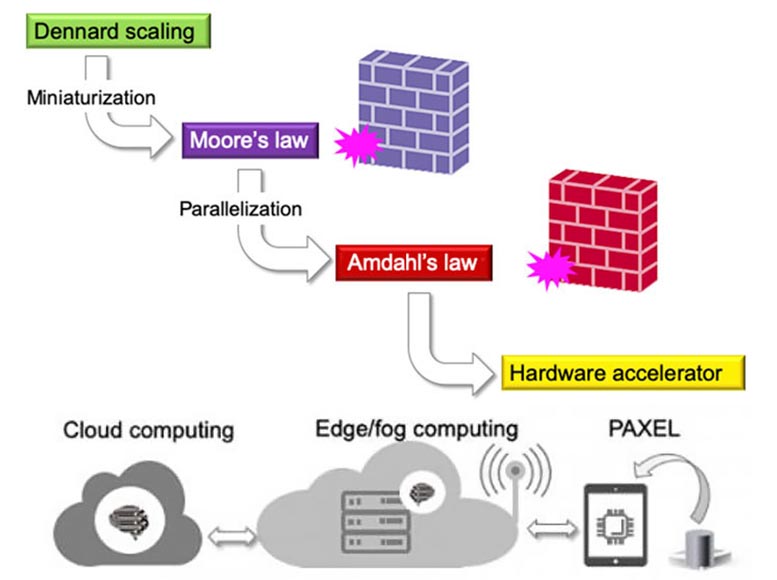
    Evolution and Bottlenecks of Electronic Integrated Circuits for Digital Computing
    Researchers in Japan have developed a type of processor called PAXEL, a device that can potentially bypass Moore’s Law and increase the speed and efficiency of computing. In APL Photonics, the researchers looked at using light for the data transport step in integrated circuits, since photons are not subject to Moore’s Law. Instead of integrated electronic circuits, much new development now involves photonic integrated circuits. The PAXEL accelerator takes this approach and uses power-efficient nanophotonics. This image shows the evolution and bottlenecks of electronic integrated circuits for digital computing, and cloud versus fog computing and use of PAXEL devices. Credit: Ken-ichi Kitayama

    In a paper in APL Photonics, from AIP Publishing, the researchers looked at another technique to use light for the data transport step in integrated circuits, since photons are not subject to Moore’s Law. Instead of integrated electronic circuits, much new development now involves photonic integrated circuits (PICs). The PAXEL accelerator takes this approach and uses power-efficient nanophotonics, which are very small PICs.

    Nanophotonics, such as those used in PAXEL, operate at the speed of light and can carry out computations in an analog fashion, with data mapped onto light intensity levels. Multiplications or additions are then performed by varying light intensity. The investigators considered different PAXEL architectures for a variety of uses including artificial neural networks, reservoir computing, pass-gate logic, decision-making and compressed sensing.

    One particularly interesting application of PAXEL is in so-called fog computing. This is like cloud computing but uses computational resources (servers) near the “ground” where the originating event occurs. A compact PAXEL attached to a tablet or other hand-held device could detect signals and transmit the information through a 5G wireless link to nearby fog computing resources for data analysis.

    Applications of this new technology are expected in a wide array of areas including medical and veterinary point-of-care testing, diagnostics, drug and food testing, and biodefense. As more of our household and business devices are connected through the web, better computing capacity, including data transport with higher energy efficiency, will be needed. Advances such as PAXEL are expected to help meet these needs.

    Reference: “Novel frontier of photonics for data processing: Photonic accelerator” by Ken-ichi Kitayama, Masaya Notomi, Makoto Naruse, Koji Inoue, Satoshi Kawakami and Atsushi Uchida, 24 September 2019, APL Photonics.
    DOI: 10.1063/1.5108912

    Never miss a breakthrough: Join the SciTechDaily newsletter.
    Follow us on Google and Google News.

    American Institute of Physics Computer Science Computers Optics
    Share. Facebook Twitter Pinterest LinkedIn Email Reddit

    Related Articles

    Shattering the Thermodynamic Limits: New Framework Reshapes Computing

    “Classified Knots”: Optical Framed Knots Used to Encode Information

    The Information Catastrophe: Digital Content on Track to Equal Half Earth’s Mass by 2245

    Faster, More Secure Communications Using Structured Light in Quantum Protocols

    New Designs for Optical Tools Inspired by Kaleidoscope Mirror Symmetry

    Miniaturizing Medical Imaging, Sensing Technology Is a “Big Deal”

    Gamma Ray Lens Created Using Amplifying Effect of Virtual Electron-Positron Pairs

    First Universal Quantum Network Prototype Operational

    Yale Physicists Take Significant Step in the Development of Quantum Computing

    Leave A Reply Cancel Reply

    • Facebook
    • Twitter
    • Pinterest
    • YouTube

    Don't Miss a Discovery

    Subscribe for the Latest in Science & Tech!

    Trending News

    Monster Storms on Jupiter Unleash Lightning Beyond Anything on Earth

    Scientists Create “Liquid Gears” That Spin Without Touching

    The Simple Habit That Could Help Prevent Cancer

    Millions Take These IBS Drugs, But a New Study Finds Serious Risks

    Scientists Unlock Hidden Secrets of 2,300-Year-Old Mummies Using Cutting-Edge CT Scanner

    Bread Might Be Making You Gain Weight Even Without Eating More Calories

    Scientists Discover Massive Magma Reservoir Beneath Tuscany

    Europe’s Most Active Volcano Just Got Stranger – Here’s Why Scientists Are Rethinking It

    Follow SciTechDaily
    • Facebook
    • Twitter
    • YouTube
    • Pinterest
    • Newsletter
    • RSS
    SciTech News
    • Biology News
    • Chemistry News
    • Earth News
    • Health News
    • Physics News
    • Science News
    • Space News
    • Technology News
    Recent Posts
    • New Brain Discovery Challenges Long-Held Theory of Teenage Brain Development
    • Sharks Are Overheating as Warming Oceans Push Them to the Edge
    • Scientists Discover Plants “Scream” – We Just Couldn’t Hear Them Until Now
    • 25-Year Study Uncovers Hidden Paths and Early Warning Signs of Blood Cancer
    • Not Just Snoring – New Research Reveals Sleep Apnea May Be Damaging Your Muscles
    Copyright © 1998 - 2026 SciTechDaily. All Rights Reserved.
    • Science News
    • About
    • Contact
    • Editorial Board
    • Privacy Policy
    • Terms of Use

    Type above and press Enter to search. Press Esc to cancel.