
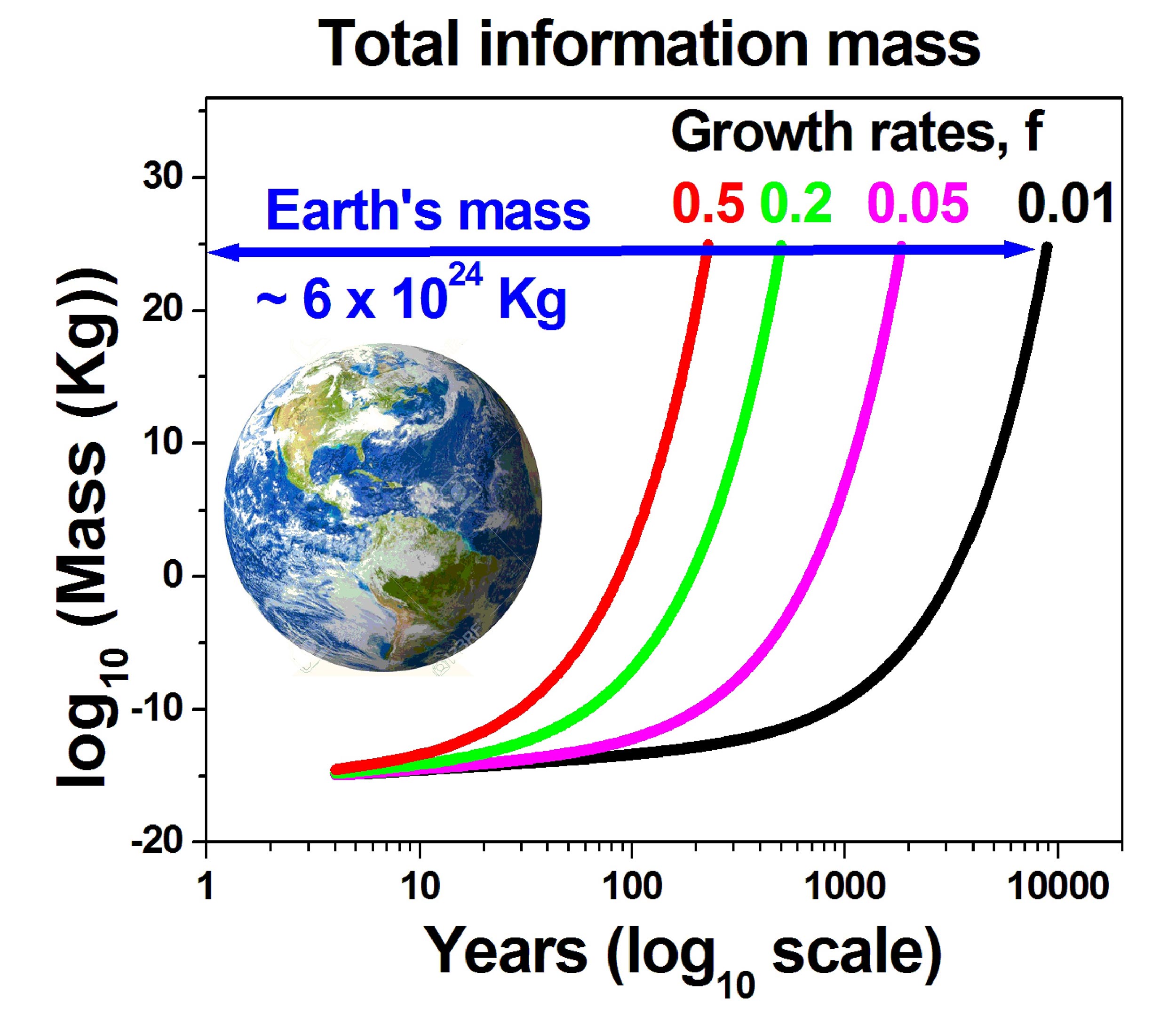
If verified, the mass-energy-information equivalence principle will show that information is a physical, dominant, fifth state of matter, and digital bits will outnumber atoms on Earth — it’s just a matter of time.
As we use resources, such as coal, oil, natural gas, copper, silicon and aluminum, to power massive computer farms and process digital information, our technological progress is redistributing Earth’s matter from physical atoms to digital information — the fifth state of matter, alongside liquid, solid, gas and plasma.
Eventually, we will reach a point of full saturation, a period in our evolution in which digital bits will outnumber atoms on Earth, a world “mostly computer simulated and dominated by digital bits and computer code,” according to an article published in AIP Advances, by AIP Publishing.
It is just a matter of time.
“We are literally changing the planet bit by bit, and it is an invisible crisis,” author Melvin Vopson said.
Vopson examines the factors driving this digital evolution. He said the impending limit on the number of bits, the energy to produce them, and the distribution of physical and digital mass will overwhelm the planet soon.
For example, using current data storage densities, the number of bits produced per year and the size of a bit compared to the size of an atom, at a rate of 50% annual growth, the number of bits would equal the number of atoms on Earth in approximately 150 years.
It would be approximately 130 years until the power needed to sustain digital information creation would equal all the power currently produced on planet Earth, and by 2245, half of Earth’s mass would be converted to digital information mass.
“The growth of digital information seems truly unstoppable,” Vopson said. “According to IBM and other big data research sources, 90% of the world’s data today has been created in the last 10 years alone. In some ways, the current COVID-19 pandemic has accelerated this process as more digital content is used and produced than ever before.”
Vopson draws on the mass-energy equivalence in Einstein’s theory of general relativity; the work of Rolf Landauer, who applied the laws of thermodynamics to information; and the work of Claude Shannon, the inventor of the digital bit.
In 2019, Vopson formulated a principle that postulates that information moves between states of mass and energy just like other matter.
“The mass-energy-information equivalence principle builds on these concepts and opens up a huge range of new physics, especially in cosmology,” he said. “When one brings information content into existing physical theories, it is almost like an extra dimension to everything in physics.”
Reference: “The information catastrophe” by Melvin M. Vopson, 11 August 2020, AIP Advances.
DOI: 10.1063/5.0019941
Never miss a breakthrough: Join the SciTechDaily newsletter.
Follow us on Google and Google News.
12 Comments
Never heard of Vopson, but his ideas seem specious.
That’s pure BS. This “catastrophic” information theory has a wrong premise. Information bits doesn’t have any mass or energy. The ones that have such features are the bits’ carriers, mostly electrons’ mass and energy.
There is an old Physics’ law called the law of conservation of energy which states that the total energy of an isolated system remains constant; it is said to be conserved over time.
What we are transforming in information bits is the same mass and energy that comes from earth mass and energy. So, we only are transforming the same mass and energy that already exist. We are not creating anything from thin air. This is without any math or physic formulae or anything else, pure, simple and plain reasoning.
How can there be more bits of information than atoms to store them?
I am not a Physicist nor will I ever think that I am smarter than one. When I want to know something about Physics and Science then I will learn it from a Physicist or a Scientist, NOT some Idiot commenting on a subject he knows absolutely NOTHING about.
This is very thought provoking theory. In the same vien as Moore’s law. We know absolute physical realities will curtail information storage. I personally suspect information production per person will level off well before we approach these levels. But perhaps humanity will become like the borg and assimilate all matter in the universe for our exponentially growing number of tiktok and funny cat videos.
The bulls#!t catastrophe: failing to understand exponential curves can’t hold forever
This is a big load of BS. I just regret wasting my time even reading it, it is not congruent with or true to the spirit of physics, science, or even common sense.
Also alarms bell ring when only one individual’s name is mentioned, hypothesising something that has admittedly not even been experimentally verified at all.
Also, fact check on the “fifth state of matter”. A quick Wikipedia search and the ability to count will show you there are roughly 20 accepted states, with more variations of certain states.
Hi
Hi Im a chemical physicist. They say most problems dont take a rocket scientist and neither does this one. The first time I saw this reported I thought it was a pretty funny putup. Now I see it again and see some of the sceptical remarks, it seems it does require a comment. This is a great problem for junior high science students. The units if information are not related to mass but the proposition is worth dissembling. At first I thought about using the two laws of thermo since information is just the negative log of entropy. But that bring in logrhythms which are not really satisfying to 8th graders or even myself. Its better to have an analogy. So lets say back in time every one had to have a donky to ride to deliver a message. Now since population was growing and roads were being built and messages were increasing we could show after long enough there would be more donkeys than atoms in the universe. Ok so thats more or less satisfying. But another example is better. Since a bit if informatiin is just the answer to a yes/no question, lets say I can transfer a bit with a photon out into space where far out there is a planet where they receive the photon and send it back so information is stored in a big shift register. So yes can be right polarized and left polarized photon is no so I can send data or programs to process data in a big loop. So all that information weighs … nothing. Even assuming mass has to be employed to store information is necessary, even one atom is like a couple Angstroms that is ten zeros out from 1 meter. But Planks constant gives us l8ke another 24 zeros at least. So even if distans or mass were needed there is almost an infinite amount of information capacity available in one atom. As a senior experimental quantum scientist I have to say the most amazing result in my lifetime is the best estimate of the energy of time space itself with nothing in it, what we call the eigenvalue of the vacuum, has like 100 zeros. Within time space where there is nothing, no mass or atoms there is plenty of energy to store information. Thats the ball game to watch. In that case its not more donkeys again… is it? When you see this theory again you can Hee-haa it like me!
Cheers
red
This idea is foolish. The energy and mass already exists. Information only reorders existing mass and energy. Just plain stupid.
Octavio !!! Completely agree with you my friend . Would like to some real hard evidence concerning this theory . Thanks for your response .
The theory seems ignorant of several key points. First, today bits are stored in hardware requiring many, many atoms to store each each single bit. Second, we won’t store all data infinitely. Finally, new storage protocols and technologies will reduce the amount of space and energy required to store data. This is just a doomsdayer trying to find followers.
In the future, when new technologies arrive which allow the storage of more than one bit per atom they will also bring much lower energy requirements.
Who suggested this complete nonsense. We’re talking about electrons which have perhaps an infetesimal amount of mass. They have no known components or substructure. Also the way they describe the storage of data is flawed. Most data is not stored, most data that is stored, quickly becomes irrelevant and is purged. New technologies enable us to more efficiently transmit and store data. Finally quantum computing will allow us to exponentially reduce the size of data transmission and storage with single subatomic particles that can exist in multiple states simultaneously (quantum superpositioning).
This is more fallacious nonsense in a sea a fallacious nonsens.