
Close Menu
    Facebook X (Twitter) Instagram
    SciTechDaily
    • Biology
    • Chemistry
    • Earth
    • Health
    • Physics
    • Science
    • Space
    • Technology
    Facebook X (Twitter) Pinterest YouTube RSS
    SciTechDaily
    Home»Physics»Miniaturizing Medical Imaging, Sensing Technology Is a “Big Deal”
    Physics

    Miniaturizing Medical Imaging, Sensing Technology Is a “Big Deal”

    By American Institute of PhysicsSeptember 17, 2019No Comments3 Mins Read
    Facebook Twitter Pinterest Telegram LinkedIn WhatsApp Email Reddit
    Share
    Facebook Twitter LinkedIn Pinterest Telegram Email Reddit
    Microchip to Diagnose Eye for Disease
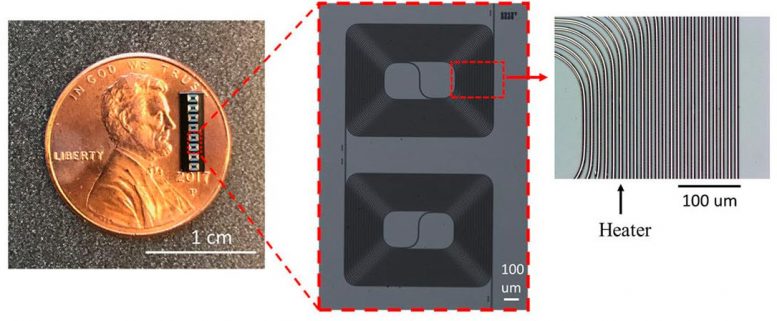
    Scientists have used a microchip to map the back of the eye for disease diagnosis. The interference technology used in the microchip has been around for a little while. This is the first time technical obstacles have been overcome to fabricate a miniature device able to capture high-quality images. Credit: Columbia University

    High-quality medical images produced using a microchip prove researcher’s fabrication method can be used to miniaturize sensing, imaging, and optical communication systems.

    Scientists in Christine Hendon’s and Michal Lipson’s research groups at Columbia University, New York, have used a microchip to map the back of the eye for disease diagnosis.

    The interference technology, like bat sonar but using light instead of sound waves, used in the microchip has been around for a little while. This is the first time that technical obstacles have been overcome to fabricate a miniature device able to capture high-quality images.

    Ophthalmologists’ current optical coherence tomography (OCT) devices and surveyors’ light detection and ranging (LIDAR) machines are bulky and expensive. There is a push for miniaturization in order to produce cheap handheld OCT and LIDAR small enough to fit into self-driving cars.

    In AIP Photonics, by AIP Publishing, the team demonstrates their microchip’s ability to produce high-contrast OCT images 0.6 millimeters deeper in human tissue.

    “Previously, we’ve been limited, but using the technique we developed in this project, we’re able to say we can make any size system on a chip,” said co-author Aseema Mohanty. “That’s a big deal!”

    Author Xingchen Ji is similarly excited and hopes the work receives industry funding to develop a small, fully integrated handheld OCT device for affordable deployment outside of a hospital in low-resource settings. Clearly seeing the advantages of miniaturization in interference technologies, both the National Institute of Health and the U.S. Air Force funded Ji’s project.

    Central to the chip-scale interferometer is the fabrication of the tunable delay line. A delay line calculates how light waves interact, and by tuning to different optical paths, which are like different focal lengths on a camera, it collates the interference pattern to produce a high-contrast 3D image.

    Ji and Mohanty coiled a 0.4-meter Si3N4 delay line into a compact 8mm2 area and integrated the microchip with micro-heaters to optically tune the heat-sensitive Si3N4.

    “By using the heaters, we achieve delay without any moving parts, so providing high stability, which is important for the image quality of interference-based applications,” said Ji.

    But with components tightly bent in a small space, it’s hard to avoid losses when changing the physical size of the optical path. Ji previously optimized fabrication to prevent optical loss. He applied this method alongside a new tapered region to accurately stitch lithographic patterns together – an essential step for achieving large systems. The team demonstrated the tunable delay line microchip on an existing commercial OCT system, showing that deeper depths could be probed while maintaining high-resolution images.

    This technique should be applicable to all interference devices, and Mohanty and Ji are already starting to scale LIDAR systems, one of the biggest photonic interferometry systems.

    ###

    Reference:  “On-chip Tunable Photonic Delay Line,” is authored by Xingchen Ji, Xinwen Yao, Yu Gan, Aseema Mohanty, Mohammad A. Tadayon, Christine P. Hendon and Michal Lipson, 17 September 2019, APL Photonics.
    DOI: 10.1063/1.5111164

    Never miss a breakthrough: Join the SciTechDaily newsletter.
    Follow us on Google and Google News.

    American Institute of Physics Biotechnology Columbia University Ophthalmology Optics
    Share. Facebook Twitter Pinterest LinkedIn Email Reddit

    Related Articles

    Twistoptics: A New, Efficient Way to Control Optical Nonlinearity

    Switching Nanolight On and Off: A New Way to Program Light on an Ultra-Small Scale

    First Nanomaterial Developed That Demonstrates “Photon Avalanching” – Extreme Nonlinear Optical Behavior and Efficiency

    More Powerful, Versatile Ultrafast Laser Pulse Created for Engineering and Biomedicine Applications

    Brain-Inspired Organic Memory Devices for Flexible, Wearable, Personalized Computing

    New Way to Control the Phase of Light Using Atomically Thin Materials Enables Quantum and Neural Circuits

    Faster, More Secure Communications Using Structured Light in Quantum Protocols

    New Designs for Optical Tools Inspired by Kaleidoscope Mirror Symmetry

    Bypassing Moore’s Law With High-Speed Photonic Computers

    Leave A Reply Cancel Reply

    • Facebook
    • Twitter
    • Pinterest
    • YouTube

    Don't Miss a Discovery

    Subscribe for the Latest in Science & Tech!

    Trending News

    Millions Take These IBS Drugs, But a New Study Finds Serious Risks

    Scientists Unlock Hidden Secrets of 2,300-Year-Old Mummies Using Cutting-Edge CT Scanner

    Bread Might Be Making You Gain Weight Even Without Eating More Calories

    Scientists Discover Massive Magma Reservoir Beneath Tuscany

    Europe’s Most Active Volcano Just Got Stranger – Here’s Why Scientists Are Rethinking It

    Alzheimer’s Symptoms May Start Outside the Brain, Study Finds

    Millions Take This Popular Supplement – Scientists Discover a Concerning Link to Heart Failure

    The Universe Is Expanding Too Fast and Scientists Can’t Explain Why

    Follow SciTechDaily
    • Facebook
    • Twitter
    • YouTube
    • Pinterest
    • Newsletter
    • RSS
    SciTech News
    • Biology News
    • Chemistry News
    • Earth News
    • Health News
    • Physics News
    • Science News
    • Space News
    • Technology News
    Recent Posts
    • Simple Blood Test May Predict Alzheimer’s Years Before Brain Scans Show Signs
    • Scientists Say Adding This Unusual Seafood to Your Diet Could Reverse Signs of Aging
    • U.S. Waste Holds $5.7 Billion Worth of Crop Nutrients
    • Scientists Say a Hidden Structure May Exist Inside Earth’s Core
    • Doctors Surprised by the Power of a Simple Drug Against Colon Cancer
    Copyright © 1998 - 2026 SciTechDaily. All Rights Reserved.
    • Science News
    • About
    • Contact
    • Editorial Board
    • Privacy Policy
    • Terms of Use

    Type above and press Enter to search. Press Esc to cancel.