
Insights and technology gleaned from creating a carbon-measuring instrument for Earth climate studies is being leveraged to build another that would remotely profile, for the first time, water vapor up to nine miles above the Martian surface, along with wind speeds and minute particles suspended in the planet’s atmosphere.
Scientists Jim Abshire and Scott Guzewich, both at NASA’s Goddard Space Flight Center in Greenbelt, Maryland, have won NASA technology-development funding to build and demonstrate a small prototype atmospheric lidar for a future lander on Mars, and possibly Titan, Saturn’s largest moon and the only to have a dense atmosphere.
Selected for further development by the agency’s Planetary Instrument Concepts for the Advancement of Solar System Observations (PICASSO) program, the concept traces its heritage to other similar-type instruments originally conceived through Goddard’s Internal Research and Development (IRAD) program. Another IRAD-supported technology, a Raman mass spectrometer, also received PICASSO funding.
Understanding the Boundary Layer
Abshire and Guzewich are particularly interested in obtaining measurements of Mars’s boundary layer, an atmospheric section that begins at the surface and can extend as high as nine miles above, depending on the time of day. Because this layer is difficult to measure from orbit, the team wants to deploy the lidar on a lander or rover that would directly gather around-the-clock data from the surface up — data that could reveal how conditions change over time and altitude.
This layer is important because it controls the transfer of heat, momentum, dust, and water and can reveal greater insights about the planet’s modern climate, including the stability of its ice caps, how wind shapes the landscape, and how dust is lifted and transported. Furthermore, scientists can use this data to validate and improve general circulation models, Guzewich said.
“From a human spaceflight perspective, this layer is also critical for operations,” Abshire said. “This is the environment in which landed missions will operate.”
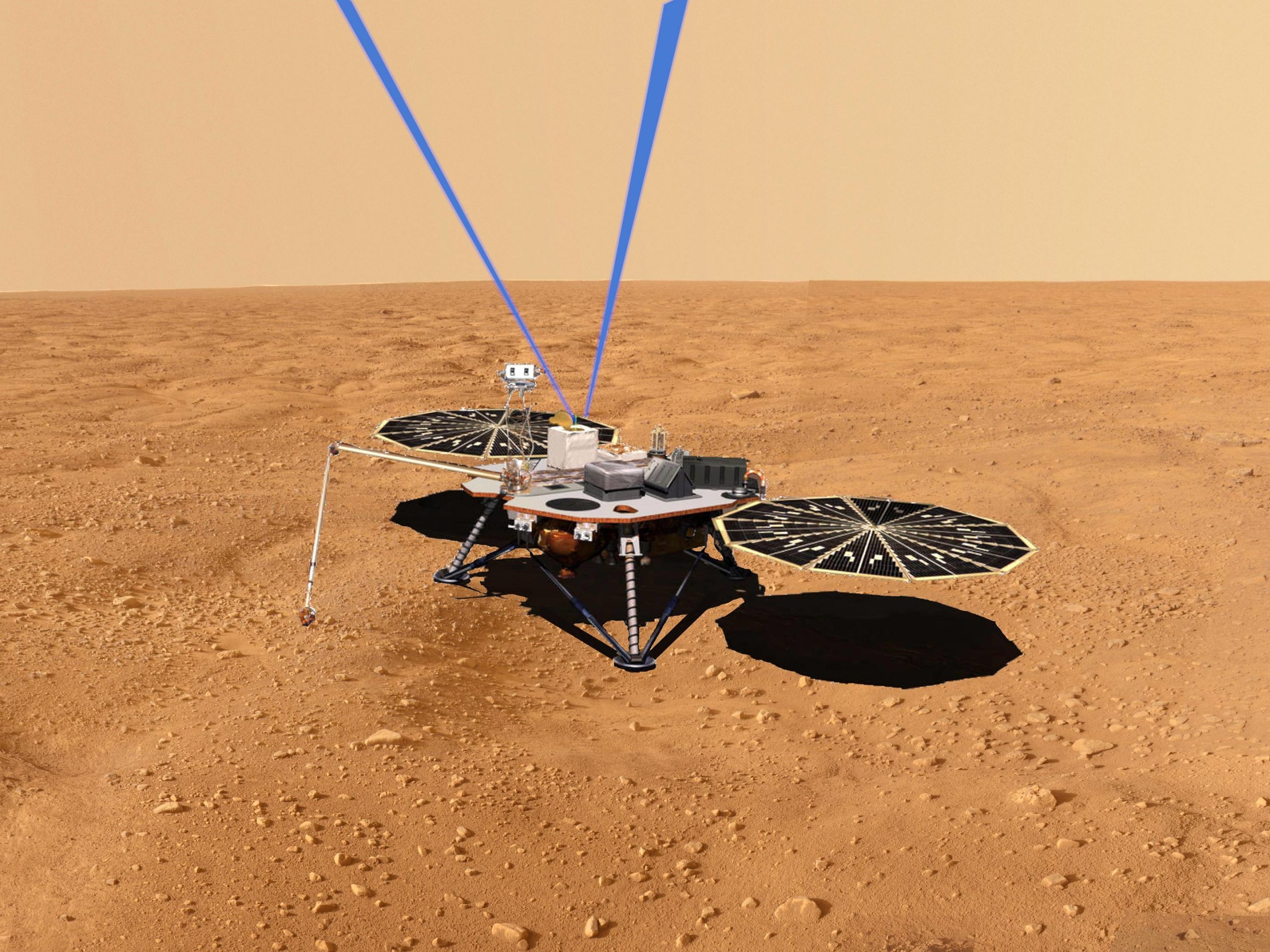
NASA has landed atmospheric lidars before, successfully measuring winds as well as aerosols, including dust and ice, but this particular instrument would provide the missing element — direct measurements of water vapor in vertical columns above the surface.
“We’re motivated by science questions,” Guzewich said. “We want to measure water vapor and winds at the same time. The whole point is understanding water and how it’s being moved around through the atmosphere. We know where the water is, we just don’t know how it moves.”
To find out, the lidar would bounce a laser light tuned to 1911 nanometers — a specific wavelength in the near-infrared band ideal for detecting water vapor — into the sky and then analyze the reflected light or signal to learn more about the atmospheric dynamics occurring from the surface to nine miles above the surface. Equipped with a sesame seed-sized, already developed infrared detector, the instrument would be able to sense the returning signal at a single-photon level, providing unprecedented resolution.
IRAD Heritage
“Our approach for profiling atmospheric water vapor and winds using a lidar at 1911 nanometers is new,” Abshire said.
However, he and his colleagues have vast experience developing atmospheric lidar instruments. For Earth science, they built the Co2 Sounder lidar tuned to 1572 nanometers, which is effective for measuring carbon dioxide in the atmosphere. The new lidar also traces its heritage to the Mars Lidar for Global Climate Measurements from Orbit, which Abshire envisioned as an on-orbit instrument to measure wind speeds.
The challenge is producing an instrument that is robust, practical, yet small enough to fit onto a rover. “Our challenge is to show that we can do this. Fortunately, we can rely on the unique capabilities of Goddard, Abshire said. “We have great capabilities in lidar, space lasers, and detectors. There really is no other place that combines all this capability and expertise.”
Raman-Mass Spectrometer
Goddard Principal Investigator Andrej Grubisic also won a three-year PICASSO award to advance RAMS, short for RAman-Mass Spectrometer. Raman spectroscopy and mass spectrometry are two common analytical chemistry techniques for determining sample composition through identification of individual molecules and specific minerals. With his PICASSO award, Grubisic said he and the RAMS team plan to demonstrate a hybrid instrument that would be capable of acquiring micron-level composition maps of organic molecules and mineral phases that exist in samples gathered on comets and asteroids as well as from samples acquired on the icy moons in the outer solar system,
Such measurements would give scientists the necessary information to help them understand the origin of organic material in the solar system, the habitability of other planets, and the potential for life beyond Earth.
Never miss a breakthrough: Join the SciTechDaily newsletter.
Follow us on Google and Google News.