
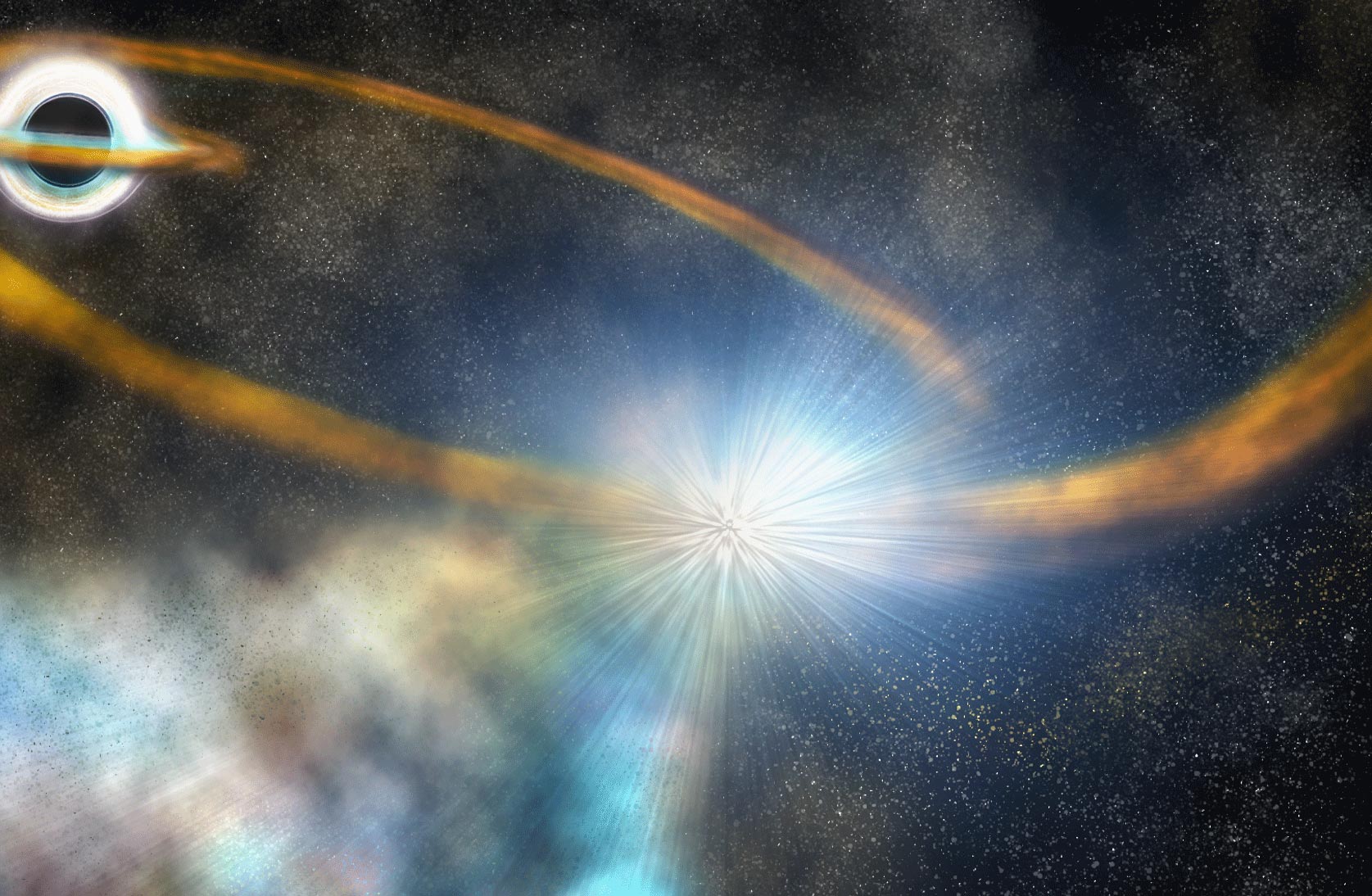
For the first time, astronomers have witnessed the immediate aftermath of a star being violently ripped apart by a supermassive black hole.
The observations were published Thursday in the Astrophysical Journal. Benjamin Shappee at the University of Hawaii Institute for Astronomy (IfA) is part of the team of astronomers led by Carnegie Observatories’ Thomas Holoien. Both are founding members of the Ohio State University-based All-Sky Automated Survey for Supernovae (ASAS-SN).
The ASAS-SN telescope network discovered the event, named ASASSN-19bt, on January 29, 2019, and quickly triggered follow-up observations from ground-based telescopes in Chile, as well as space-based X-ray and ultraviolet cameras on board NASA’s Swift satellite. In a stroke of luck, ASASSN-19bt occurred in the exact patch of sky that NASA’s planet-hunting Transiting Exoplanet Survey Satellite (TESS) was monitoring, allowing astronomers to capture images of the event every 30 minutes for months, including during the first moments.
Known as tidal disruption events, or TDEs, these occur when a star gets too close to a supermassive black hole, like those thought to lie at the center of most large galaxies. The black hole’s immense gravity overwhelms the star’s own gravity, and tears it to shreds. Some of this material is flung out into space, while the rest falls back onto the black hole, forming a disk of hot, bright gas as it is consumed. By observing the light given off during this process, which increases until it reaches a peak brightness and then tapers off, astronomers can better understand the physics of the black hole and the forces driving these phenomena. But first, they have to be discovered.
“When you don’t know where or when something will happen, you have to look everywhere all the time. This is exactly what ASAS-SN tries to do,” explained Shappee.
When a star strays too close to a black hole, intense tides break it apart into a stream of gas. The tail of the stream escapes the system, while the rest of it swings back around, surrounding the black hole with a disk of debris. This video includes images of a tidal disruption event called ASASSN-19bt taken by NASA’s Transiting Exoplanet Survey Satellite (TESS) and Swift missions, as well as an animation showing how the event unfolded. Credit: NASA’s Goddard Space Flight Center
ASAS-SN is a network of 20 robotic telescopes distributed around the world, including one on Haleakalā on Maui. ASAS-SN monitors the entire visible northern and southern skies every 20 hours. This unique capability allows astronomers to look for explosive events nearly everywhere, nearly all the time. The project’s camera in South Africa recorded the changing brightness of an object and sent out an automated alert. Within a day, the team classified ASASSN-19bt as a rare type of event – the tidal disruption of a star by a supermassive black hole.
Jumping into action, the team requested follow-up observations at X-ray and ultraviolet wavelengths using NASA’s Swift telescope, ESA’s (European Space Agency’s) XMM-Newton observatory, ground-based 1-meter telescopes in the global Las Cumbres Observatory network, and a number of other ground-based observatories. Together with the TESS data, these observations paint a picture of a tidal disruption event in unprecedented detail.
“Only a handful of TDEs have been discovered before they reached peak brightness, and this one was found just a few days after it started to brighten. And thanks to being in TESS’ Continuous Viewing Zone, we have observations of it every 30 minutes going back months–more than ever before possible for one of these events,” said Holoien. “This makes ASASSN-19bt the new poster child for TDE research.”
The team was able to follow the TDE’s evolution from 42 days before its peak brightness, by finding it in TESS data taken before the event was discovered by ASAS-SN. “The images that TESS is taking can only be downloaded to Earth every two weeks, which is why we intensively monitor the TESS field with ASAS-SN from the ground,” added Holoien.
ASASSN-19bt turns out to be unique in several ways. Its host galaxy is younger and more dust-filled than those of other previously observed TDEs. The early discovery and quick follow-up observations by the ASAS-SN team caught a short, rapid cooling event that lasted for two days in the first Swift observations, after which its temperature leveled off and its luminosity continued to build toward its peak. The increase in brightness as ASASSN-19bt approached its peak was extremely smooth with very little variation; a new piece of information about TDEs was revealed only by the TESS data that enabled researchers to see such detail. These revelations will improve astronomers’ ability to identify TDEs and differentiate them from other celestial events whose emission is much more variable.
“The excitement is likely to keep coming,” remarked Shappee, describing three initiatives that will intensify research in Hawai’i for the explosive, violent event that will be observed by TESS. First, ASAS-SN will revisit the parts of the sky that TESS is observing more frequently – four times per day – thanks to funding from a Mt. Cuba Astronomical Foundation grant. Second, On July 18, 2019, TESS began its second year of observations, and is now observing regions of the sky where telescopes in Hawai’i are well positioned to observe interesting objects seen by TESS. Third, Ben Shappee and his team were just awarded a $200,000 grant, “Using TESS as a Transient Explorer Survey Telescope,” which will strengthen the partnerships between TESS and the telescopes on Maunakea and Haleakalā.
For more details on this “star destroyer” read NASA’s TESS Mission Spots Star-Shredding Black Hole and Supermassive Black Hole Rips Apart a Star in Rare Tidal Disruption Event.
Reference: “Discovery and Early Evolution of ASASSN-19bt, the First TDE Detected by TESS” by Thomas W.-S. Holoien, Patrick J. Vallely, Katie Auchettl, K. Z. Stanek, Christopher S. Kochanek, K. Decker French, Jose L. Prieto, Benjamin J. Shappee, Jonathan S. Brown, Michael M. Fausnaugh, Subo Dong, Todd A. Thompson, Subhash Bose, Jack M. M. Neustadt, P. Cacella, J. Brimacombe, Malhar R. Kendurkar, Rachael L. Beaton, Konstantina Boutsia, Laura Chomiuk, Thomas Connor, Nidia Morrell, Andrew B. Newman, Gwen C. Rudie, Laura Shishkovksy and Jay Strader, 26 September 2019, The Astrophysical Journal.
DOI: 10.3847/1538-4357/ab3c66
Never miss a breakthrough: Join the SciTechDaily newsletter.
Follow us on Google and Google News.