
Close Menu
    Facebook X (Twitter) Instagram
    SciTechDaily
    • Biology
    • Chemistry
    • Earth
    • Health
    • Physics
    • Science
    • Space
    • Technology
    Facebook X (Twitter) Pinterest YouTube RSS
    SciTechDaily
    Home»Technology»Important Breakthrough in Perovskite Solar Cells
    Technology

    Important Breakthrough in Perovskite Solar Cells

    By Rice UniversityNovember 5, 2019No Comments4 Mins Read
    Facebook Twitter Pinterest Telegram LinkedIn WhatsApp Email Reddit
    Share
    Facebook Twitter LinkedIn Pinterest Telegram Email Reddit
    Sample All-Inorganic Perovskite Solar Cell
    A sample all-inorganic perovskite solar cell is a step toward commercial use, according to scientists at Rice University. Their discovery of a way to quench defects in cesium-lead-iodide solar cells allowed them to preserve the material’s band gap, a critical property in solar cell efficiency. Credit: Jeff Fitlow/Rice University

    Rice University materials scientists use inorganic ingredients to limit defects, retain efficiency.

    Rice University scientists believe they’ve overcome a major hurdle keeping perovskite-based solar cells from achieving mainstream use.
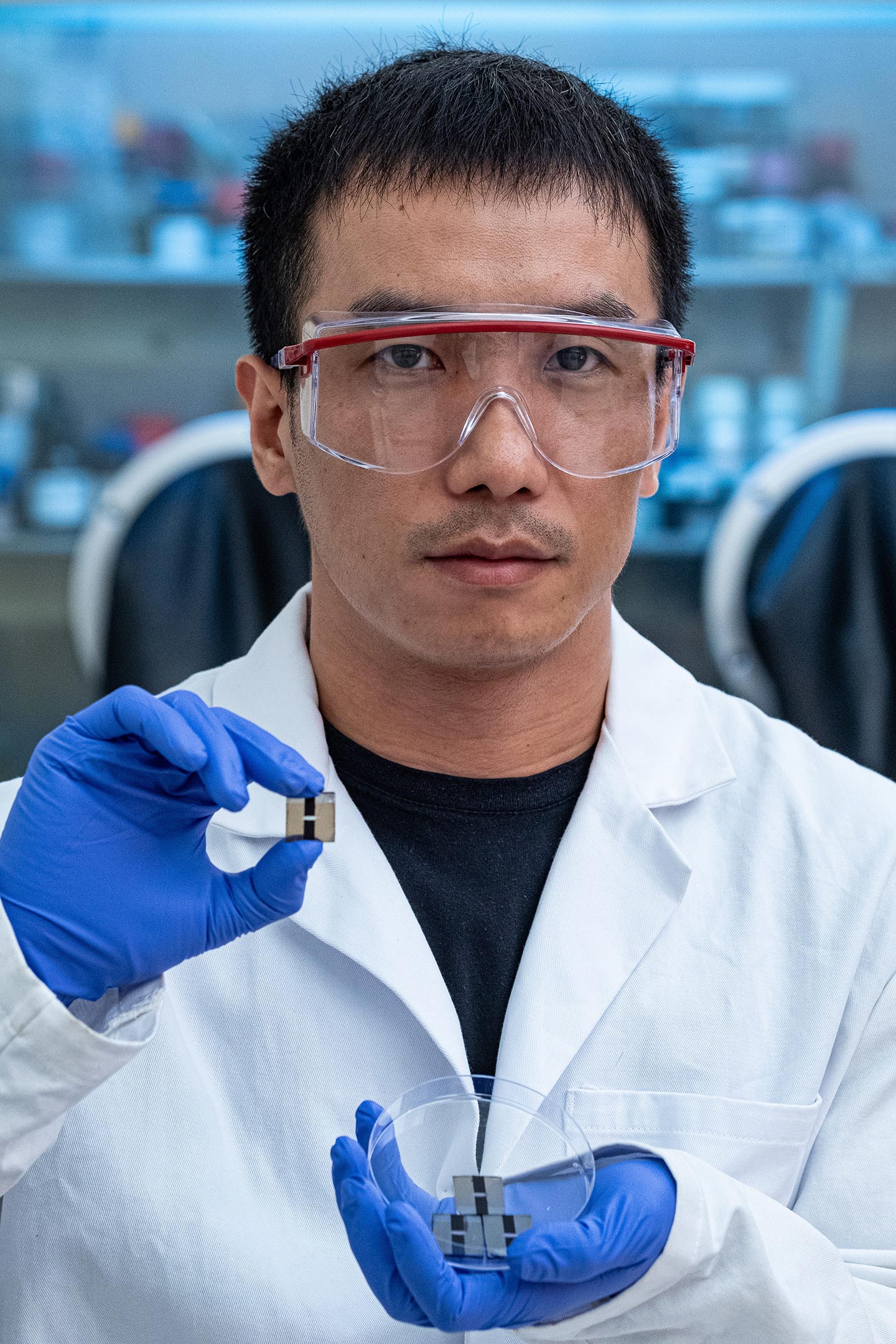
    Jia Liang, Rice University
    Rice University postdoctoral researcher Jia Liang holds perovskite solar cells developed with all inorganic materials. Controlling defects in the cells by eliminating organic components made them more robust while retaining their power conversion efficiency. Credit: Jeff Fitlow/Rice University

    Through the strategic use of the element indium to replace some of the lead in perovskites, Rice materials scientist Jun Lou and his colleagues at the Brown School of Engineering say they’re better able to engineer the defects in cesium-lead-iodide solar cells that affect the compound’s band gap, a critical property in solar cell efficiency.

    As a side benefit, the lab’s newly formulated cells can be made in the open air and last for months rather than days with a solar conversion efficiency slightly above 12%.

    The Rice team’s results were published in Advanced Materials yesterday, November 4, 2019.

    Perovskites are crystals with cubelike lattices that are known to be efficient light harvesters, but the materials tend to be stressed by light, humidity, and heat.

    Not the Rice perovskites, Lou said.

    “From our perspective, this is something new and I think it represents an important breakthrough,” he said. “This is different from the traditional, mainstream perovskites people have been talking about for 10 years — the inorganic-organic hybrids that give you the highest efficiency so far recorded, about 25%. But the issue with that type of material is its instability.

    “Engineers are developing capping layers and things to protect those precious, sensitive materials from the environment,” Lou said. “But it’s hard to make a difference with the intrinsically unstable materials themselves. That’s why we set out to do something different.”
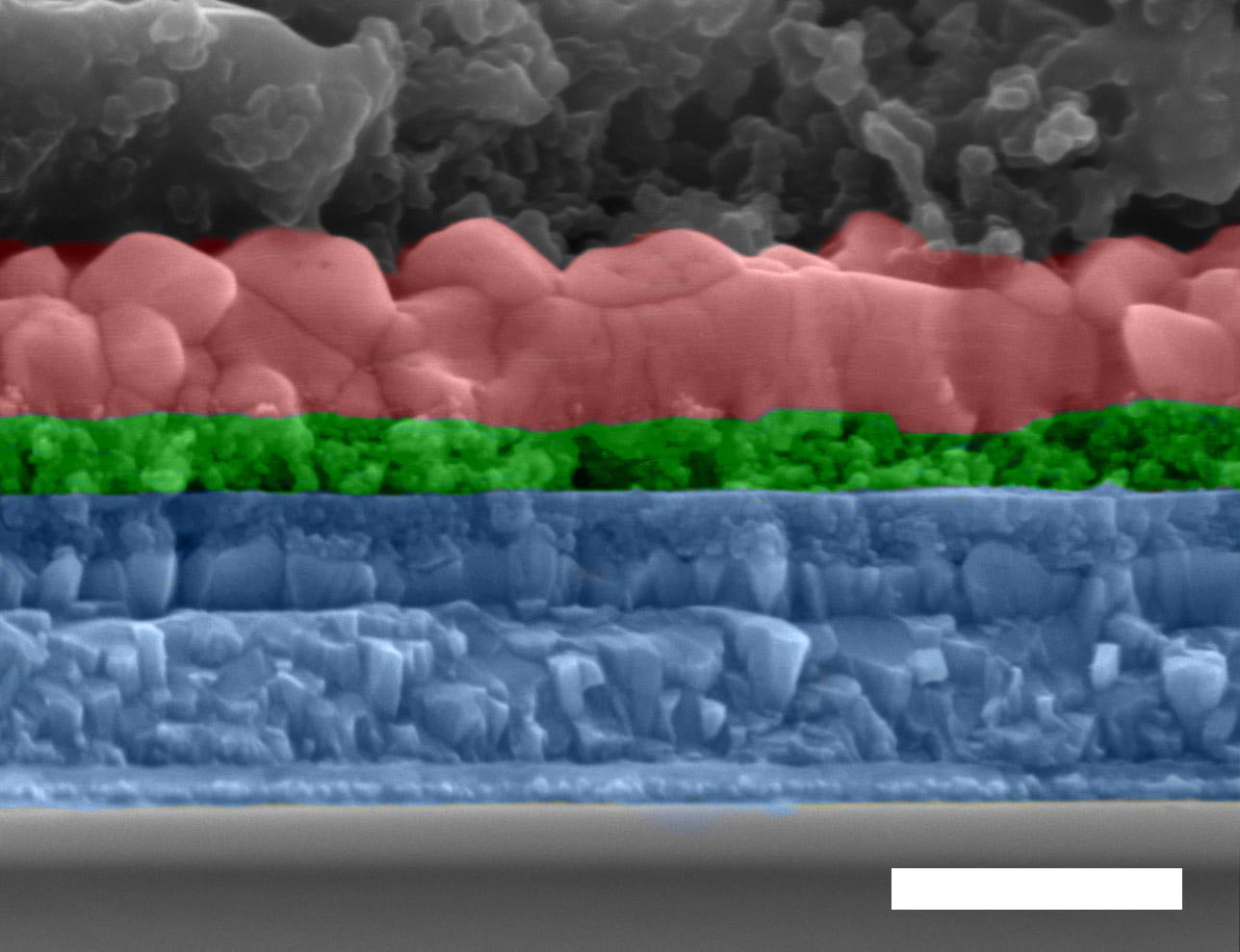
    Electron Microscope Cross Section of All-Inorganic Perovskite Solar Cell
    An electron microscope image shows a cross-section of the all-inorganic perovskite solar cell developed at Rice University. From the top, the layers are a carbon electrode, perovskite, titanium oxide, fluorine-doped tin oxide, and glass. The scale bar equals 500 nanometers. Credit: Lou Group/Rice University

    Rice postdoctoral researcher and lead author Jia Liang and his team built and tested perovskite solar cells of inorganic cesium, lead, and iodide, the very cells that tend to fail quickly due to defects. But by adding bromine and indium, the researchers were able to quash defects in the material, raising the efficiency above 12% and the voltage to 1.20 volts.

    As a bonus, the material proved to be exceptionally stable. The cells were prepared in ambient conditions, standing up to Houston’s high humidity, and encapsulated cells remained stable in air for more than two months, far better than the few days that plain cesium-lead-iodide cells lasted.
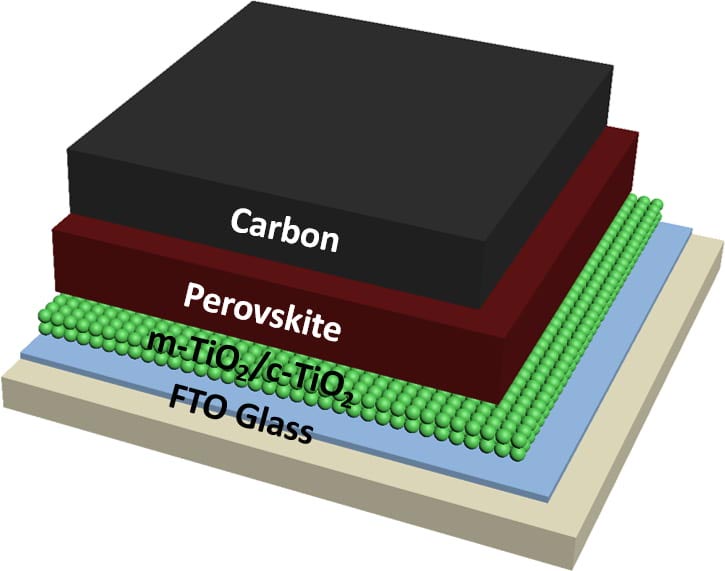
    Schematic View All-Inorganic Perovskite Solar Cell
    A schematic view shows an all-inorganic perovskite solar cell developed by materials scientists at Rice University. Credit: Lou Group/Rice University

    “The highest efficiency for this material may be about 20%, and if we can get there, this can be a commercial product,” Liang said. “It has advantages over silicon-based solar cells because synthesis is very cheap, it’s solution-based, and easy to scale up. Basically, you just spread it on a substrate, let it dry out, and you have your solar cell.”

    ###

    Reference: “Defect‐Engineering‐Enabled High‐Efficiency All‐Inorganic Perovskite Solar Cells” by Jia Liang, Xiao Han, Ji‐Hui Yang, Boyu Zhang, Qiyi Fang, Jing Zhang, Qing Ai, Meredith M. Ogle, Tanguy Terlier, Angel A. Martí and Jun Lou, 4 November 2019, Advanced Materials.
    DOI: 10.1002/adma.201903448

    Co-authors of the paper are Xiao Han of Northwestern Polytechnical University, China; Ji-Hui Yang of Fudan University, Shanghai; and Rice graduate students Boyu Zhang, Qiyi Fang, Meredith Ogle, postdoctoral researcher Jing Zhang, academic visitor Qing Ai, research specialist Tanguy Terlier and Angel Martí, an associate professor of chemistry, of bioengineering and of materials science and nanoengineering. Lou is a professor of materials science and nanoengineering, and of chemistry.

    The Peter M. and Ruth L. Nicholas Postdoctoral Fellowship in Nanotechnology, the Welch Foundation, the China Scholarship Council and the National Science Foundation supported the research.

    Never miss a breakthrough: Join the SciTechDaily newsletter.
    Follow us on Google and Google News.

    Green Energy Materials Science Perovskite Solar Cell Rice University Solar Cells
    Share. Facebook Twitter Pinterest LinkedIn Email Reddit

    Related Articles

    World Record: Perovskite/Silicon Tandem Solar Cells on the Magic Threshold of 30% Efficiency

    Highly Efficient Eco-Friendly Perovskite Solar Cells With Enhanced Stability

    Breakthrough Self-Assembly Innovation Enables Cheaper Solar Energy Production

    New Efficiency Record Set by Novel Multi-Material Solar Cells

    Scientists Make High-Performance Hybrid Perovskite Solar Cells Safer

    Using Extremely Fast Lasers to Develop Perovskite Solar Cells That Can Harvest More Electricity

    Aspects of High Efficiency Perovskite Solar Cells Uncovered With Light 10 Billion Times Brighter Than the Sun

    Solar Cell Performance Boosted by Biological Material That Mimics Photosynthesis

    New Dual-Layer Solar Cell Sets Record for Efficiently Generating Power

    Leave A Reply Cancel Reply

    • Facebook
    • Twitter
    • Pinterest
    • YouTube

    Don't Miss a Discovery

    Subscribe for the Latest in Science & Tech!

    Trending News

    AI Could Detect Early Signs of Alzheimer’s in Under a Minute – Far Before Traditional Tests

    What if Dark Matter Has Two Forms? Bold New Hypothesis Could Explain a Cosmic Mystery

    This Metal Melts in Your Hand – and Scientists Just Discovered Something Strange

    Beef vs. Chicken: Surprising Results From New Prediabetes Study

    Alzheimer’s Breakthrough: Scientists Discover Key Protein May Prevent Toxic Protein Clumps in the Brain

    Quantum Reality Gets Stranger: Physicists Put a Lump of Metal in Two Places at Once

    Scientists May Have Found the Key to Jupiter and Saturn’s Moon Mystery

    Scientists Uncover Brain Changes That Link Pain to Depression

    Follow SciTechDaily
    • Facebook
    • Twitter
    • YouTube
    • Pinterest
    • Newsletter
    • RSS
    SciTech News
    • Biology News
    • Chemistry News
    • Earth News
    • Health News
    • Physics News
    • Science News
    • Space News
    • Technology News
    Recent Posts
    • What if Your Memories Never Happened? Physicists Take a New Look at the Boltzmann Brain Paradox
    • Students Found an Ancient Star That Shouldn’t Be in the Milky Way
    • Astronomers Solve 50-Year Mystery and Reveal Hidden Culprit Behind Strange X-Ray Emissions
    • One of the Universe’s Largest Stars May Be Getting Ready To Explode
    • Scientists Discover Enzyme That Could Supercharge Ozempic-Like Weight Loss Drugs
    Copyright © 1998 - 2026 SciTechDaily. All Rights Reserved.
    • Science News
    • About
    • Contact
    • Editorial Board
    • Privacy Policy
    • Terms of Use

    Type above and press Enter to search. Press Esc to cancel.