
Close Menu
    Facebook X (Twitter) Instagram
    SciTechDaily
    • Biology
    • Chemistry
    • Earth
    • Health
    • Physics
    • Science
    • Space
    • Technology
    Facebook X (Twitter) Pinterest YouTube RSS
    SciTechDaily
    Home»Space»A Wrecking Ball in the HR 5183 System – Massive Gas Giant Exoplanet With Eccentric Orbit
    Space

    A Wrecking Ball in the HR 5183 System – Massive Gas Giant Exoplanet With Eccentric Orbit

    By NASA AstrobiologyDecember 30, 2019No Comments2 Mins Read
    Facebook Twitter Pinterest Telegram LinkedIn WhatsApp Email Reddit
    Share
    Facebook Twitter LinkedIn Pinterest Telegram Email Reddit
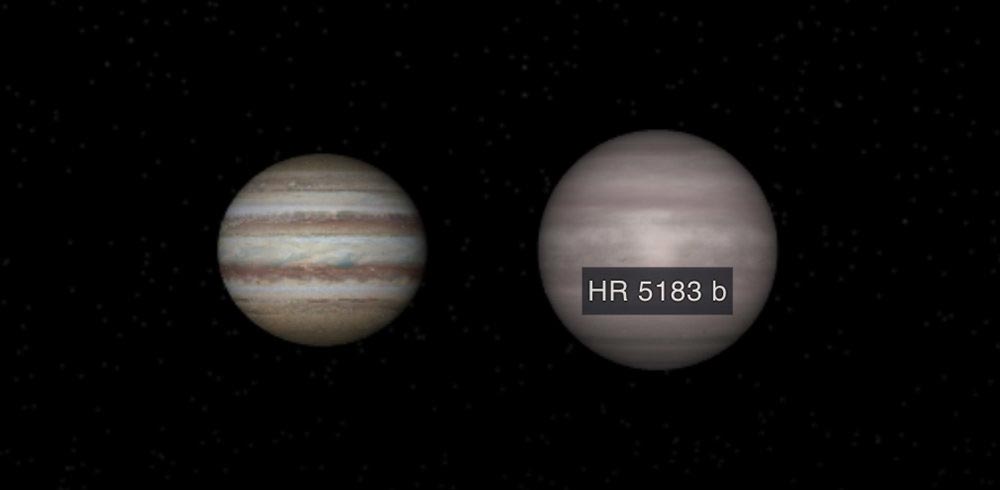
    HR 5183 b
    HR 5183 b is a gas giant exoplanet that orbits a G-type star. Its mass is 3.23 Jupiters, it takes 74 years to complete one orbit of its star, and is 18 AU from its star. Its discovery was announced in 2019. Credit: NASA

    A study supported in part by the NASA Astrobiology Program provides new insight into the potential habitability of stellar systems that contain giant planets in eccentric orbits. Astronomers have now identified numerous stellar systems, many of which are structured differently than our familiar solar system. The recent discovery of the planet HR 5183b is one example. Like Jupiter, HR 5183b is a gas giant. Unlike Jupiter, the planet is on a highly eccentric orbit around its host star, cruising through the system on an orbit that is far from circular.

    Giant planets cause powerful gravitational interactions, and can have profound implications for a stellar system as a whole. Using HR 5183b as a case study, astrobiologists looked at how giant planets on eccentric orbits affect the habitability of a stellar system. Using dynamical simulations, the team studied how the orbit of HR 5183b could allow stable regions to exist within the habitable zone of the host star. Even though HR 5183b causes powerful perturbations, there are still narrow locations where small, rocky planets could find long-term, stable orbits.

    The study, “In the Presence of a Wrecking Ball: Orbital Stability in the HR 5183 System,” was published in The Astronomical Journal. The work was supported by the Nexus for Exoplanet System Science (NExSS). NExSS is a NASA research coordination network supported in part by the NASA Astrobiology Program. This program element is shared between NASA’s Planetary Science Division (PSD) and the Astrophysics Division. This research is a critical part of NASA’s work to understand the Universe, advance human exploration, and inspire the next generation. As NASA’s Artemis program moves forward with human exploration of the Moon, the search for life on other worlds remains a top priority for the agency.

    Reference: “In the Presence of a Wrecking Ball: Orbital Stability in the HR 5183 System” by Stephen R. Kane and Sarah Blunt, 31 October 2019, The Astronomical Journal.
    DOI: 10.3847/1538-3881/ab4c3e

    Never miss a breakthrough: Join the SciTechDaily newsletter.
    Follow us on Google and Google News.

    Astrobiology Astronomy NASA
    Share. Facebook Twitter Pinterest LinkedIn Email Reddit

    Related Articles

    Scientists Propose a Radical New Method To Find Alien Life

    Titan’s Hidden Ocean May Not Exist and That Changes Everything

    Unveiling Alien Oceans: Webb’s Breakthrough in the Hunt for Life

    New Research Identifies Possible Sites of Frozen, Watery Deposits on Europa

    NASA’s NExSS Coalition to Search for Life on Distant Worlds

    New Modeling Reveals that Tilted Orbits Could Make More Worlds Habitable

    Scientists Discover Evidence of Water in Martian Meteorite

    Online Database Tracks Organic Nano-Particles Across the Universe

    “Habitable Zone” Might Help Extreme Life Forms Survive on Exoplanets

    Leave A Reply Cancel Reply

    • Facebook
    • Twitter
    • Pinterest
    • YouTube

    Don't Miss a Discovery

    Subscribe for the Latest in Science & Tech!

    Trending News

    1.4-Million-Year-Old Footprints Reveal a Giant Human Relative

    Astronomers May Have Found the First Moon Beyond Our Solar System

    Underwater Cameras Expose the Secret Lives of Whale Sharks

    Why Dreaming Leaves the Brain Running Low on Energy

    CERN Experiments Detect Signs of the Universe’s Primordial Matter

    Study Finds a Surprising Link Between Gut Microbes and Aging

    Frequent Cannabis Users Wake Up With More “Stress Hormone”

    Scientists Reveal Hidden DNA Traces in the Shroud of Turin

    Follow SciTechDaily
    • Facebook
    • Twitter
    • YouTube
    • Pinterest
    • Newsletter
    • RSS
    SciTech News
    • Biology News
    • Chemistry News
    • Earth News
    • Health News
    • Physics News
    • Science News
    • Space News
    • Technology News
    Recent Posts
    • World’s First Photonic Time Crystal Can Reshape Light in Trillionths of a Second
    • Meteorite That Smashed Through a New Jersey Roof Hid an Ancient Chemical Secret
    • Astronomers Find Ancient Black Holes Shining With the Power of a Trillion Suns
    • These “Good” Immune Cells Could Hold the Key to Spinal Cord Regeneration
    • New Research Questions Decades of Low-Fat Dairy Advice
    Copyright © 1998 - 2026 SciTechDaily. All Rights Reserved.
    • Science News
    • About
    • Contact
    • Editorial Board
    • Privacy Policy
    • Terms of Use

    Type above and press Enter to search. Press Esc to cancel.