
Close Menu
    Facebook X (Twitter) Instagram
    SciTechDaily
    • Biology
    • Chemistry
    • Earth
    • Health
    • Physics
    • Science
    • Space
    • Technology
    Facebook X (Twitter) Pinterest YouTube RSS
    SciTechDaily
    Home»Technology»Spider-Man-Style Robotic Graspers Defy Gravity – Secret Is High-Speed Rotating Water Rings
    Technology

    Spider-Man-Style Robotic Graspers Defy Gravity – Secret Is High-Speed Rotating Water Rings

    By American Institute of PhysicsJanuary 17, 2020No Comments2 Mins Read
    Facebook Twitter Pinterest Telegram LinkedIn WhatsApp Email Reddit
    Share
    Facebook Twitter LinkedIn Pinterest Telegram Email Reddit
    Wall-Climbing Robot
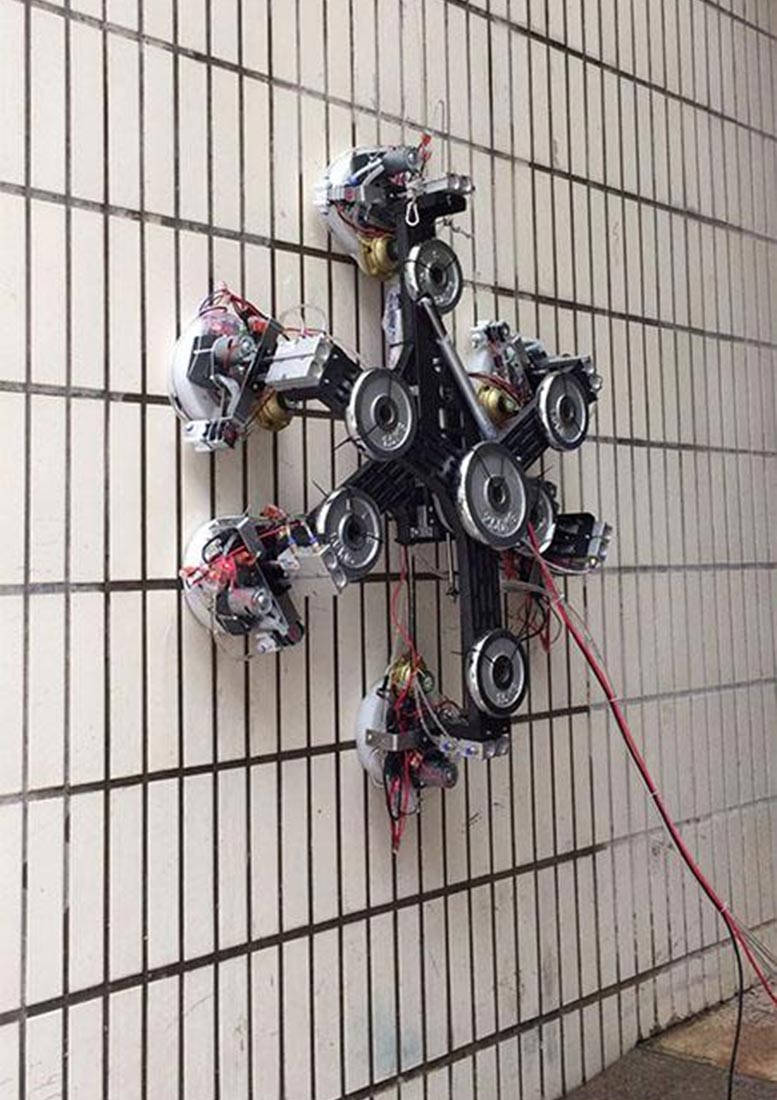
    A wall-climbing robot uses the zero-pressure difference method to form suction. Credit: Xin Li and Kaige Shi

    Centrifugal force from a high-speed rotating water ring enables gripping rough surfaces.

    Specially designed vacuum suction units allow humans to climb walls. Scientists have developed a suction unit that can be used on rough surfaces, no matter how textured, and that has applications in the development of climbing robots and robotic arms with grasping capabilities.

    Traditional methods of vacuum suction and previous vacuum suction devices cannot maintain suction on rough surfaces due to vacuum leakage, which leads to suction failure.

    Researchers Xin Li and Kaige Shi developed a zero-pressure difference (ZPD) method to enhance the development of vacuum suction units. Their method overcame leakage limitations by using a high-speed rotating water ring between the surface and suction cup to maintain the vacuum. They discuss their work in this week’s Physics of Fluids, from AIP Publishing.

    “There are many applications of our design, but we think the wall-climbing robot will be the most useful,” said Li. “Compared to other wall-climbing robots, the robot with our ZPD-based suction unit achieves surprising improvement in performance.”

    The centrifugal force of the rotating water eliminates the pressure difference at the boundary of the vacuum zone to prevent vacuum leakage. It can maintain a high vacuum pressure inside the suction cup.

    Their ZPD suction unit is energy-efficient and smaller and lighter than traditional suction units. The researchers tested their unit with three different suction sizes and applications: on a robotic arm to grip and handle objects, on a hexapod wall-climbing robot and as a Spider-Man-like wall-climbing device.

    “The next step in this research is to cut down the water consumption. If the water consumption can be reduced, the suction unit will work for a very long time with little water so that the wall-climbing robot could carry its own water instead of being connected to a supply,” said Li.

    Reference: “Vacuum suction unit based on the zero pressure difference method” by Kaige Shi and Xin Li, 14 January 2020, Physics of Fluids.
    DOI: 10.1063/1.5129958

    Never miss a breakthrough: Join the SciTechDaily newsletter.
    Follow us on Google and Google News.

    American Institute of Physics Mechanical Engineering Robotics
    Share. Facebook Twitter Pinterest LinkedIn Email Reddit

    Related Articles

    U.S. Army’s Top 10 Science and Technology Advances of 2019 [Video]

    Ultra-Light Robotic Insect Uses Soft Artificial Muscles to Move – Survives Being Flattened by a Fly Swatter

    ‘Robotic Skins’ Turn Inanimate Objects Into Multifunctional Robots

    Hopping Robots Could Use Stutter Jump to Conserve Energy

    Light Activated Muscle Cells May Advance Biorobotics

    Self-Driving Audi TTS Hits Track Speeds of 120 MPH

    Meshworm, A Soft Autonomous Robot That Moves Like an Earthworm

    Semiautonomous “Intelligent Co-Pilot” Helps Vehicles Avoid Collisions

    Researchers Study Butterfly Flight Dynamics to Create Small Airborne Robots

    Leave A Reply Cancel Reply

    • Facebook
    • Twitter
    • Pinterest
    • YouTube

    Don't Miss a Discovery

    Subscribe for the Latest in Science & Tech!

    Trending News

    This Experimental Drug Repaired the Gut and Reversed Severe Fatty Liver Disease

    Physicists Just Turned a Black Hole Energy Theory Into Reality

    Stanford Scientists Solve a 252-Million-Year-Old Mass Extinction Mystery

    The Ancient Survival Mechanism Making Weight Loss So Difficult

    Just 3,000 Steps a Day May Help Protect the Brain From Alzheimer’s

    “Weird Clams” Reveal a New Invasion Along the U.S. Northeast Coast

    Archaeologists Decapitated Tutankhamun and Glued His Body Back Together

    New Black Hole Theory Solves a 50-Year-Old Problem

    Follow SciTechDaily
    • Facebook
    • Twitter
    • YouTube
    • Pinterest
    • Newsletter
    • RSS
    SciTech News
    • Biology News
    • Chemistry News
    • Earth News
    • Health News
    • Physics News
    • Science News
    • Space News
    • Technology News
    Recent Posts
    • One Asteroid Collision May Have Rocked Earth, Mars, and the Moon
    • Scientists Restore the Sense of Touch With Electrical Brain Stimulation
    • New Study Reveals Herpesvirus Infection May Accelerate Alzheimer’s Disease
    • Microplastics Found in 84% of Serious Heart Attack Patients
    • The Oldest Known Right-Handed Animal May Have Lived 550 Million Years Ago
    Copyright © 1998 - 2026 SciTechDaily. All Rights Reserved.
    • Science News
    • About
    • Contact
    • Editorial Board
    • Privacy Policy
    • Terms of Use

    Type above and press Enter to search. Press Esc to cancel.