
Close Menu
    Facebook X (Twitter) Instagram
    SciTechDaily
    • Biology
    • Chemistry
    • Earth
    • Health
    • Physics
    • Science
    • Space
    • Technology
    Facebook X (Twitter) Pinterest YouTube RSS
    SciTechDaily
    Home»Space»Cosmic Fireball Lights Up the Entire Coast Near Seaside Town – Here’s What Happened
    Space

    Cosmic Fireball Lights Up the Entire Coast Near Seaside Town – Here’s What Happened

    By ESA (European Space Agency)January 29, 20202 Comments3 Mins Read
    Facebook Twitter Pinterest Telegram LinkedIn WhatsApp Email Reddit
    Share
    Facebook Twitter LinkedIn Pinterest Telegram Email Reddit
    Cosmic Fireball
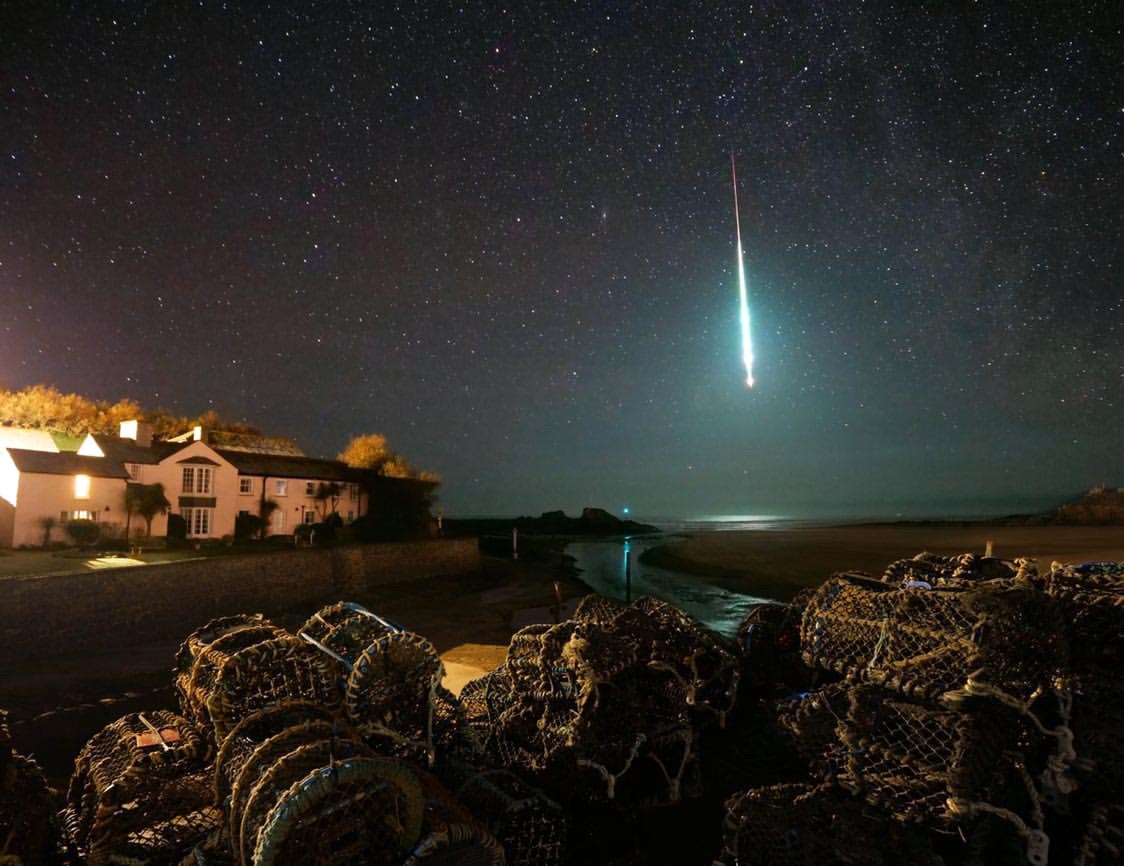
    Image of the fireball from the seaside resort town of Bude, northeast Cornwall, England, at 23:24 UTC. Credit: Chris Small

    On January 21, 2020, a foreign body crashed to Earth causing a cascade of bright light to trail through the sky.

    The fleeting flash was a fireball, defined as a meteor brighter than the planet Venus. Such bright meteors are caused as small asteroids strike the atmosphere, entirely or almost entirely burning up due to friction, sometimes suddenly exploding.

    Every day, roughly 54 tonnes of extra-terrestrial material reaches Earth, including interplanetary dust, meteoroids, and asteroids. Fireballs like this one are estimated to strike Earth hundreds of times every year, however, not all are caught on camera or shine so brightly.

    From the brightness of this fireball, around the time of a full moon, experts have deduced that the original object could have ranged from tens of centimeters to a meter in size, depending on its entry speed, composition, and other characteristics.

    This impressive shot was captured by photographer Chris Small at the seaside resort town of Bude, northeast Cornwall, England, at 23:24 UTC.

    “I see a lot of meteors due to spending so long shooting the night sky, but I’ve never seen anything quite like that before!” says Chris.

    “It was incredible, and lit up the entire coast almost as bright as daytime for a few seconds. There were beautiful green and blue colors.”

    While the foreground is filled with lobster pots used by local fishermen, the background is lit up with this green-blue tinge, revealing the presence of oxygen in Earth’s atmosphere. As the air surrounding the burning ball heats up, atoms become ‘excited’, with oxygen emitting light at a frequency of about 558 nm – in the blue-green part of the visible spectrum.

    This colorful effect is also the reason for the beautiful aurorae at Earth’s poles, caused as charged particles from the Sun strike and excite atoms in the upper atmosphere.

    The fireball in this image was spotted by at least five observers across the UK, who reported it to the International Meteor Organization – an organization set up to collect meteor observations from around the world.

    A new ESA warning system called NEMO (NEar-real time MOnitor) also picked up the event shortly after it happened. The NEMO system tracks social media activity to build a near real-time picture of fireball events around the globe, and is part of the Agency’s Planetary Defence Office.

    Find more of Chris’ photography on his website, Ocean And Earth Photography.

    Never miss a breakthrough: Join the SciTechDaily newsletter.
    Follow us on Google and Google News.

    European Space Agency Meteors Popular
    Share. Facebook Twitter Pinterest LinkedIn Email Reddit

    Related Articles

    Watch the Skies: Debris From NASA’s DART Asteroid Collision Could Spark a Meteor Display on Earth

    Stunning Fireball Over Spain and Portugal Tracked by Lightning Imager From Space

    Planetary Defense: Asteroid Racing Toward Earth Discovered Just Hours Before Impact

    “Chance of Impact 100%” – Fifth Asteroid Ever Discovered Before Impact

    Clean Space Initiative to Target Orbital Debris

    Herschel Image of the Vela C Region

    Researchers Discover First Intermediate-Mass Black Hole

    ESA’s Vega Rocket Has Launched on Its Maiden Voyage, Carries 9 Satellites

    ESA’s Hershel Space Telescope Captures Incredible Views of Eagle Nebula

    2 Comments

    1. Jon Hunt on January 30, 2020 3:23 am

      I’ve been photographing the night sky for years but have never been lucky enough to catch a shot quite like that. Well done to Chris.

      Reply
    2. Densden on February 1, 2020 6:58 am

      Asteroids/meteors burning up due to friction? How about heat caused by atmospheric compression?

      Reply
    Leave A Reply Cancel Reply

    • Facebook
    • Twitter
    • Pinterest
    • YouTube

    Don't Miss a Discovery

    Subscribe for the Latest in Science & Tech!

    Trending News

    This Deadly Disease Was Wiping Out Humans 5,500 Years Ago

    Beyond DNA: Scientists Discover Inheritance That Breaks the Rules of Genetics

    Scientists Just Discovered the Eye Defies a Long-Held Rule of Vision

    What if Time Isn’t Fundamental? Physicists Just Tested the Idea in the Lab

    Scientists Say We’ve Been Wrong About the Aging Brain

    68 Quadrillion Miles: Scientists Map Earth’s Vast Hidden Fungal Network for the First Time

    Hidden Damage From Youth May Explode Into Disease Later in Life

    Climate Models May Be Wrong About How Trees Store Carbon

    Follow SciTechDaily
    • Facebook
    • Twitter
    • YouTube
    • Pinterest
    • Newsletter
    • RSS
    SciTech News
    • Biology News
    • Chemistry News
    • Earth News
    • Health News
    • Physics News
    • Science News
    • Space News
    • Technology News
    Recent Posts
    • Scientists Rediscover Rare Island Fox Not Seen for More Than 20 Years
    • The Amazon’s Mysterious “Ghost Dog” Has Been Hiding a Big Secret
    • Scientists Say Frequent Ejaculation May Improve Sperm Quality and Fertility
    • Antarctica’s Future May Be More Predictable Than Scientists Thought
    • Sea Level Rise Is Swallowing Farmland at Alarming Rates
    Copyright © 1998 - 2026 SciTechDaily. All Rights Reserved.
    • Science News
    • About
    • Contact
    • Editorial Board
    • Privacy Policy
    • Terms of Use

    Type above and press Enter to search. Press Esc to cancel.