
Close Menu
    Facebook X (Twitter) Instagram
    SciTechDaily
    • Biology
    • Chemistry
    • Earth
    • Health
    • Physics
    • Science
    • Space
    • Technology
    Facebook X (Twitter) Pinterest YouTube RSS
    SciTechDaily
    Home»Space»Planetary Defense: Asteroid Racing Toward Earth Discovered Just Hours Before Impact
    Space

    Planetary Defense: Asteroid Racing Toward Earth Discovered Just Hours Before Impact

    By European Space Agency (ESA)February 14, 20232 Comments4 Mins Read
    Facebook Twitter Pinterest Telegram LinkedIn WhatsApp Email Reddit
    Share
    Facebook Twitter LinkedIn Pinterest Telegram Email Reddit
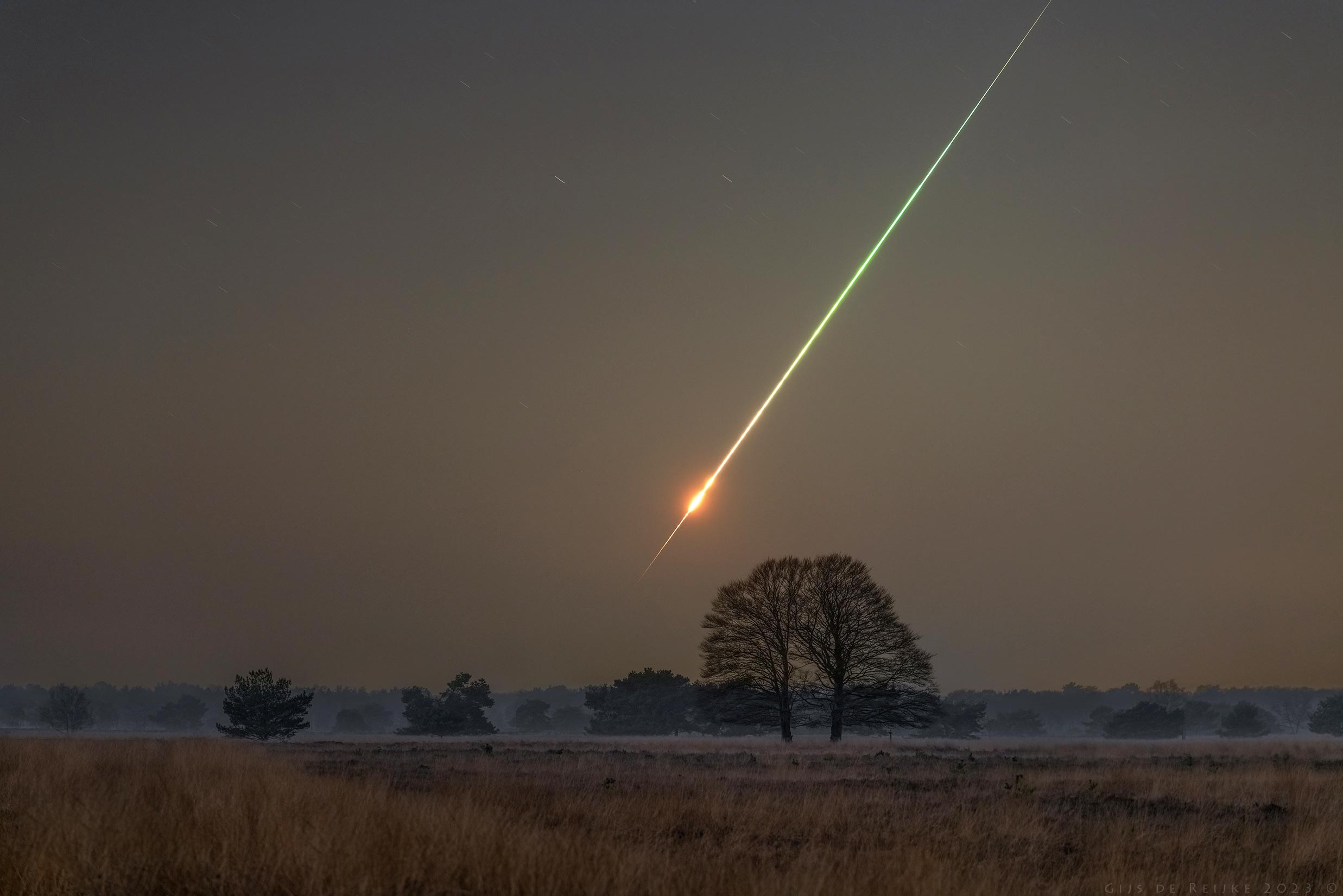
    Asteroid 2023 CX1 Entering Earth's Atmosphere
    Asteroid 2023 CX1 entering Earth’s atmosphere captured in the skies over the southern Netherlands. Credit: Gijs de Reijke

    Seventh Shooting Star Ever Spotted Before Impact

    For the seventh time, a small asteroid – a meteoroid as astronomers call it – was discovered in space as it raced towards Earth for impact. The predicted time and location of the impact (02:50 – 03:03 UTC, above northern France) were made possible with observations by European astronomer Krisztián Sárneczky using the 60 cm Schmidt telescope from the Piszkésteto Observatory in Hungary. 2023 CX1 is the second impactor discovered by Krisztián, after the impact of 2022 EB5 less than a year ago.

    The last three predicted impacts have all occurred in the last 12 months– an encouraging illustration of how asteroid detection capabilities are rapidly advancing.

    2023 CX1 Impact
    On impact, the beautiful fireball lit up the skies within the expected time window (at 02:59 UTC) and location. Observations came mostly from southern UK and France but also from Belgium, the Netherlands and even Germany. It is likely that some fragments of the meteoroid could have survived its atmospheric journey and landed somewhere onshore, close to the coast north of Rouen in Normandy, France. Credit: Muhammed Uzzal

    What Happened?

    At 20:18:07 UTC on February 12, 2023, the new asteroid (now officially designated 2023 CX1 but initially designated Sar2667 by its discoverer) was imaged by the Piszkésteto Observatory. Once a second observation was taken, it was reported to the Minor Planet Center at 20:49 UTC.

    About 40 minutes later, follow-up observations reported by the Višnjan Observatory in Croatia confirmed the object. At this point, various impact assessment systems around the globe calculated a 100% impact probability, expected above the English Channel between 02:00 – 04:00 UTC. The asteroid was estimated to be around one meter in diameter and posed no threat to people or property.
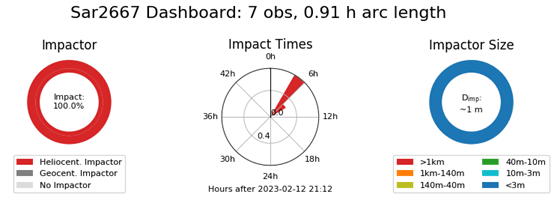
    Sar2667 First Impact Assessment
    First impact assessment by ESA’s tool Meerkat as reported at 21:33 UTC with only 7 measurements, already indicating an impact probability of ~100%. Credit: ESA / PDO

    Over the next seven hours, astronomers around the globe observed the Earth-bound object and pinpointed its ‘impact corridor’ over the Channel with a trajectory going from west to east. The object continued to be observed until just ten minutes before impact, only five minutes before it fell into Earth’s shadow becoming ‘invisible’.

    On impact, the beautiful fireball lit up the skies within the expected time window (at 02:59 UTC) and location. Observations came mostly from southern UK and France but also from Belgium, the Netherlands and even Germany. It is likely that some fragments of the meteoroid could have survived its atmospheric journey and landed somewhere onshore, close to the coast north of Rouen in Normandy, France.
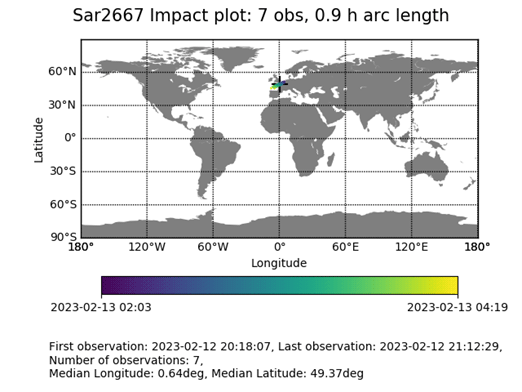
    Sar2667 Impact Plot
    First impact corridor reported by ESA’s tool Meerkat as reported at 21:33 UTC, with the actual impact time at 02:59 UTC in the middle of the uncertainty window. Credit: ESA / PDO

    The team at ESA’s Planetary Defence Office contributed to this historic event both with timely notifications from the ‘Meerkat’ warning system and use of a network of optical telescopes established for just these occasions.

    As it becomes more common that we can predict these small, stunning shooting stars in our skies, more people can be in the right place at the right time to witness a phenomenon only few have been lucky enough to spot before.

    Of course, one day we’ll find an imminent impactor that isn’t one meter in size, but perhaps 100. To protect ourselves, as NASA’s DART mission has shown is possible and ESA’s Hera Mission will build on, we need to see them coming.

    Never miss a breakthrough: Join the SciTechDaily newsletter.
    Follow us on Google and Google News.

    Asteroid European Space Agency Meteors Planetary Defense Popular
    Share. Facebook Twitter Pinterest LinkedIn Email Reddit

    Related Articles

    Impact Imminent: Racing To Track Asteroid 2024 BX1’s Collision Course With Earth

    NEOMIR: Planetary Defense Mission for Finding Dangerous Asteroids Hidden by Sun

    Experts on the Future of Planetary Defense 10 Years After the Chelyabinsk Asteroid Impact’s 440 Kiloton Explosion

    Riskiest Asteroid Known to Humankind in the Last Year Will Not Strike Earth for at Least 100 Years

    “Chance of Impact 100%” – Fifth Asteroid Ever Discovered Before Impact

    The Rise and Fall of the Riskiest Asteroid in a Decade – “I’ve Never Seen Such a Risky Object”

    Huge Region of Europe Destroyed by Asteroid Impact in Planetary Defense Exercise

    Planetary Defense Conference: NASA to Participate in Exercise Simulating Asteroid Impact

    Asteroid Deflection Planetary Defense Mission Target: “Dimorphos”

    2 Comments

    1. Aaron Cervantes on February 15, 2023 9:15 pm

      How often are we trying to actually intercept or destroy an incoming asteroid?

      Reply
    2. Richard Duffy on February 17, 2023 3:07 pm

      If our destruction is meant to come from an Astroid Impact, so be it; it couldn’t be any worse than death from a political folly.

      Reply
    Leave A Reply Cancel Reply

    • Facebook
    • Twitter
    • Pinterest
    • YouTube

    Don't Miss a Discovery

    Subscribe for the Latest in Science & Tech!

    Trending News

    First-of-Its-Kind Discovery: Homer’s Iliad Found Embedded in a 1,600-Year-Old Egyptian Mummy

    Beyond Inflammation: Scientists Uncover New Cause of Persistent Rheumatoid Arthritis

    A Simple Molecule Could Unlock Safer, Easier Weight Loss

    Scientists Just Built a Quantum Battery That Charges Almost Instantly

    Researchers Unveil Groundbreaking Sustainable Solution to Vitamin B12 Deficiency

    Millions of People Have Osteopenia Without Realizing It – Here’s What You Need To Know

    Researchers Discover Boosting a Single Protein Helps the Brain Fight Alzheimer’s

    World-First Study Reveals Human Hearts Can Regenerate After a Heart Attack

    Follow SciTechDaily
    • Facebook
    • Twitter
    • YouTube
    • Pinterest
    • Newsletter
    • RSS
    SciTech News
    • Biology News
    • Chemistry News
    • Earth News
    • Health News
    • Physics News
    • Science News
    • Space News
    • Technology News
    Recent Posts
    • After Decades, MIT Researchers Capture the First 3D Atomic View of a Mysterious Material
    • Your Favorite Fishing Spot Is Turning Brown – and the Fish Are Changing
    • 380-Million-Year-Old Fish Fossil Reveals Secrets of Life’s First Steps Onto Land
    • Mezcal “Worm” in a Bottle Mystery: DNA Testing Reveals a Surprise
    • Scientists Turn Red Lettuce Green, Unlocking Hidden Nutrients
    Copyright © 1998 - 2026 SciTechDaily. All Rights Reserved.
    • Science News
    • About
    • Contact
    • Editorial Board
    • Privacy Policy
    • Terms of Use

    Type above and press Enter to search. Press Esc to cancel.