
Close Menu
    Facebook X (Twitter) Instagram
    SciTechDaily
    • Biology
    • Chemistry
    • Earth
    • Health
    • Physics
    • Science
    • Space
    • Technology
    Facebook X (Twitter) Pinterest YouTube RSS
    SciTechDaily
    Home»Biology»Imidacloprid, A Major Factor in Colony Collapse Disorder
    Biology

    Imidacloprid, A Major Factor in Colony Collapse Disorder

    By Karen Feldscher, Harvard School of Public Health CommunicationsApril 19, 2012No Comments3 Mins Read
    Facebook Twitter Pinterest Telegram LinkedIn WhatsApp Email Reddit
    Share
    Facebook Twitter LinkedIn Pinterest Telegram Email Reddit
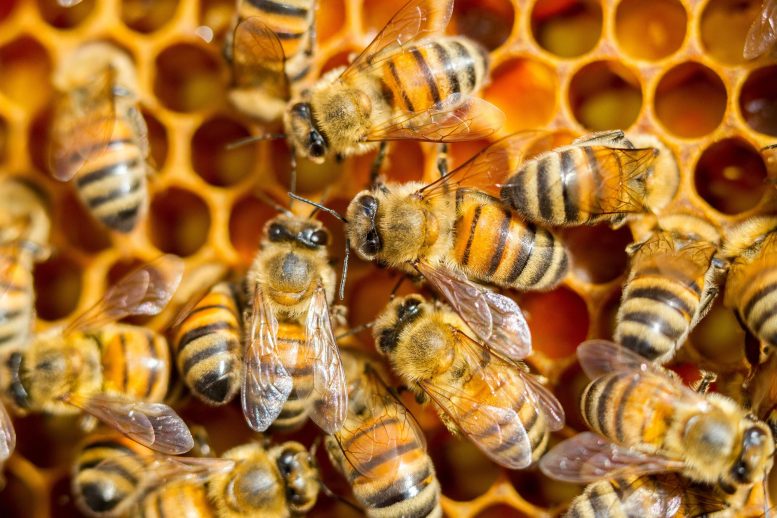
    Honeybee Colony
    The significance of bees to agriculture cannot be underestimated,” says Alex Lu, associate professor of environmental exposure biology. “And it apparently doesn’t take much of the pesticide to affect the bees. Our experiment included pesticide amounts below what is normally present in the environment.”

    A study set to be published in June explains a reason for the worldwide declines in honeybee colonies and the drastic effects these changes could have on the agricultural market. The researchers believe the increase in Colony Collapse Disorder (CCD) is directly related to the use of imidacloprid, a neonicotinoid introduced in the 1990s, and have run studies aimed at replicating how imidacloprid may have caused the CCD outbreak.

    The likely culprit in sharp worldwide declines in honeybee colonies since 2006 is imidacloprid, one of the most widely used pesticides, according to a new study from the Harvard School of Public Health (HSPH).

    The authors, led by Alex Lu, associate professor of environmental exposure biology in the Department of Environmental Health, write that the new research provides “convincing evidence” of the link between imidacloprid and the phenomenon known as Colony Collapse Disorder (CCD), in which adult bees abandon their hives.

    The study will appear in the June issue of the Bulletin of Insectology.

    “The significance of bees to agriculture cannot be underestimated,” says Lu. “And it apparently doesn’t take much of the pesticide to affect the bees. Our experiment included pesticide amounts below what is normally present in the environment.”

    Pinpointing the cause of the problem is crucial because bees — beyond producing honey — are prime pollinators of roughly one-third of the crop species in the United States, including fruits, vegetables, nuts, and livestock feed such as alfalfa and clover. Massive loss of honeybees could result in billions of dollars in agricultural losses, experts estimate.

    Lu and his co-authors hypothesized that the uptick in CCD resulted from the presence of imidacloprid, a neonicotinoid introduced in the early 1990s. Bees can be exposed in two ways: through nectar from plants or through high-fructose corn syrup beekeepers use to feed their bees. (Since most U.S.-grown corn has been treated with imidacloprid, it’s also found in corn syrup.)

    In the summer of 2010, the researchers conducted an in situ study in Worcester County aimed at replicating how imidacloprid may have caused the CCD outbreak. Over a 23-week period, they monitored bees in four different bee yards; each yard had four hives treated with different levels of imidacloprid and one control hive. After 12 weeks of imidacloprid dosing, all the bees were alive. But after 23 weeks, 15 of the 16 imidacloprid-treated hives had perished. Those exposed to the highest levels of the pesticide died first.

    The characteristics of the dead hives were consistent with CCD, said Lu; the hives were empty except for food stores, some pollen, and young bees, with few dead bees nearby. When other conditions cause hive collapse — such as disease or pests — many dead bees are typically found inside and outside the affected hives.

    Strikingly, said Lu, it took only low levels of imidacloprid to cause hive collapse — less than what is typically used in crops or in areas where bees forage.

    Scientists, policymakers, farmers, and beekeepers, alarmed at the sudden losses of between 30 percent and 90 percent of honeybee colonies since 2006, have posed numerous theories as to the cause of the collapse, including pests, disease, pesticides, migratory beekeeping, or some combination of these factors.

    Never miss a breakthrough: Join the SciTechDaily newsletter.
    Follow us on Google and Google News.

    Bees Ccd Colony Collapse Disorder Harvard University Insect Pesticide
    Share. Facebook Twitter Pinterest LinkedIn Email Reddit

    Related Articles

    New Chemical Kills 95% of Termites and Can’t Harm Humans

    New Pollen-Replacing Food Could Save Bee Colonies Worldwide

    Buzzing Discovery: European Scientists Uncover New Bee Species in an Unexpected Place

    Ancient Insect Mysteries Solved: 312-Million-Year-Old Fossil Sheds Light on Behavior and Evolution

    Bizarre New Bee Species Discovered With Dog-Like Snout

    Giant Hornet Attacks Cause Honeybee Alarm Buzz in Hives – “I Literally Could Not Believe What I Was Hearing”

    Common Pesticides Are Severely Affecting Bees

    Entomologists Recreate Colony Collapse Disorder That Affects Bee Populations Worldwide

    Parasitic Fly Could Be Responsible For Disappearing Honeybees

    Leave A Reply Cancel Reply

    • Facebook
    • Twitter
    • Pinterest
    • YouTube

    Don't Miss a Discovery

    Subscribe for the Latest in Science & Tech!

    Trending News

    Black Hole Collisions May Follow a Surprisingly Simple Rule

    The Eye Has a Hidden Cleanup System and Scientists Just Discovered It

    The Truth About Vikings Is More Complicated Than Museums Admit

    New Catalyst Turns Stubborn Plant Waste Into Valuable Chemicals

    Quantum Gravity May Be Far Less Quantum Than Physicists Expected

    New Tool Supercharges Immunotherapy Against Prostate Cancer

    The Hidden Cancer Risk of Ketogenic Diets

    One Asteroid Collision May Have Rocked Earth, Mars, and the Moon

    Follow SciTechDaily
    • Facebook
    • Twitter
    • YouTube
    • Pinterest
    • Newsletter
    • RSS
    SciTech News
    • Biology News
    • Chemistry News
    • Earth News
    • Health News
    • Physics News
    • Science News
    • Space News
    • Technology News
    Recent Posts
    • Scientists Crack the Code for Making “Impossible” Nanocrystals
    • Earth’s Hidden Thermostat Has Regulated Climate for 60 Million Years
    • This 518-Million-Year-Old Creature Reveals How Spiders Got Their Bite
    • Forgotten for 20 Years, This 240-Million-Year-Old Fossil Reveals a New Reptile Species
    • 190-Year-Old Museum Specimen Solves a Pangolin Mystery
    Copyright © 1998 - 2026 SciTechDaily. All Rights Reserved.
    • Science News
    • About
    • Contact
    • Editorial Board
    • Privacy Policy
    • Terms of Use

    Type above and press Enter to search. Press Esc to cancel.