

Close Menu
    Facebook X (Twitter) Instagram
    SciTechDaily
    • Biology
    • Chemistry
    • Earth
    • Health
    • Physics
    • Science
    • Space
    • Technology
    Facebook X (Twitter) Pinterest YouTube RSS
    SciTechDaily
    Home»Space»Bombardment by Asteroids and Comets in Another Planetary System Predicted by Astronomers
    Space

    Bombardment by Asteroids and Comets in Another Planetary System Predicted by Astronomers

    By University of GroningenMay 30, 2020No Comments3 Mins Read
    Facebook Twitter Pinterest Telegram LinkedIn WhatsApp Email Reddit
    Share
    Facebook Twitter LinkedIn Pinterest Telegram Email Reddit
    Asteroid Bombardment
    The HR8799 planetary system resembles ours, and a simulation shows that the gas planets receive materials from asteroids and comets, just like in our Solar System.

    The planetary system around star HR8799 is remarkably similar to our Solar System. A research team led by astronomers from the University of Groningen and SRON Netherlands Institute for Space Research has used this similarity to model the delivery of materials by asteroids, comets, and other minor bodies within the system. Their simulation shows that the four gas planets receive material delivered by minor bodies, just like in our Solar System. The results were published by the journal Astronomy & Astrophysics on May 29, 2020.

    Counting outwards from the Sun, our Solar System consists of four rocky planets, an asteroid belt, four gas giants, and another asteroid belt. The inner planets are rich in refractory materials such as metals and silicates, the outer planets are rich in volatiles such as water and methane. While forming, the inner planets had a hard time collecting a volatile atmosphere because the strong solar wind kept blowing the gas away. At the same time, the heat from the Sun evaporated any ice clumps, so it was harder to retain water. In the outer regions, there was less solar heat and wind, so the eventual gas giants could collect water ice and also gather large atmospheres filled with volatiles.
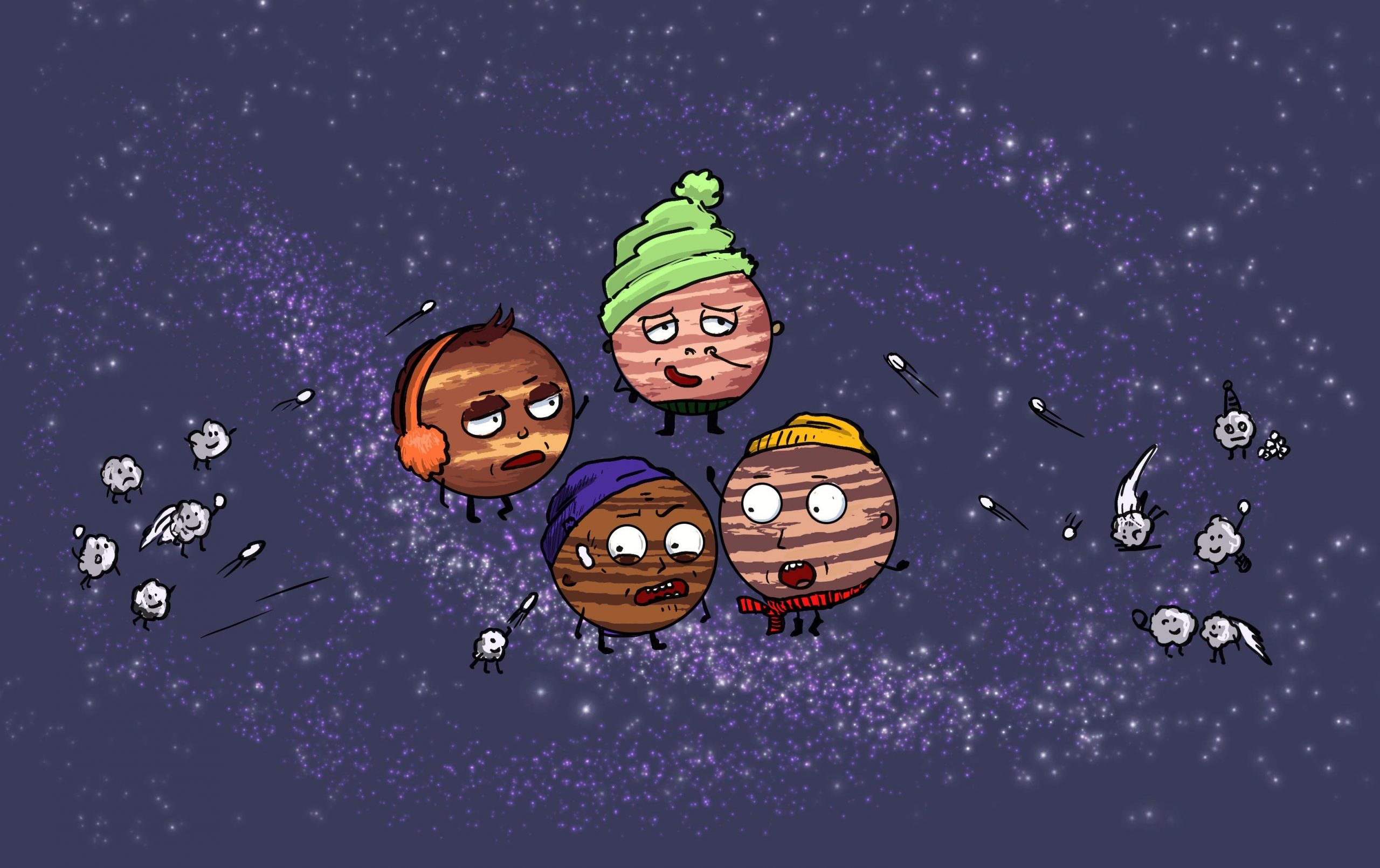
    Astronomers Predict Bombardment
    Astronomers predict bombardment from asteroids and comets in another planetary system. Credit: Anastasia Kruchevska

    Simulation

    Minor bodies, including asteroids, comets, and dust, fine-tuned this outcome later on by delivering refractories from the inner belt and both volatiles and refractories from the outer belt. A research team led by astronomers from the University of Groningen and SRON Netherlands Institute for Space Research wondered if the same delivery system applies to planetary systems around other stars. They created a simulation for the system around HR8799, which is similar to our Solar System with four gas giants plus an inner and outer belt, and possibly rocky planets inside the inner belt. Therefore the team could take some unknowns about HR8799 from our own Solar System.

    Terrestrial planets

    The simulation shows that just like in our Solar System, the four gas planets receive material delivered by minor bodies. The team predicts a total delivery of both material types of around half a millionth of the planets’ masses. Future observations, for example by NASA’s James Webb Space Telescope, will be able to measure the amount of refractories in the volatile-rich gas giants. ‘If telescopes detect the predicted amount of refractories, it means that these can be explained by delivery from the belts as shown in the model’, explains Kateryna Frantseva, first author of the paper. ‘However, if they detect more refractories than predicted, the delivery process is more active than was assumed in the model, for example, because HR8799 is much younger than the Solar System. The HR8799 system may contain terrestrial planets, for which volatile delivery from the asteroid belts may be of astrobiological relevance.’

    Reference: “Enrichment of the HR 8799 planets by minor bodies and dust ” by K. Frantseva, M. Mueller, P. Pokorný, F. F.S. van der Tak and I. L. ten Kate, 29 May 2020, Astronomy & Astrophysics.
    DOI: 10.1051/0004-6361/201936783

    Never miss a breakthrough: Join the SciTechDaily newsletter.
    Follow us on Google and Google News.

    Asteroid Astronomy Astrophysics Comet University of Groningen
    Share. Facebook Twitter Pinterest LinkedIn Email Reddit

    Related Articles

    Asteroid, Comet…or Something Else? Mysterious Activity on “Oddball” Space Object Raises New Questions

    Mysterious Voyagers: Are We Drinking Water Delivered by Dark Comets?

    Cracking the ’Oumuamua Code: Alien Spaceship or Natural Phenomenon?

    Comet-Like Activity Discovered in Near-Earth Object Don Quixote

    Researchers Confirm Three Asteroids Are Co-Orbital With Uranus

    NASA’s Swift Helps Astronomers Get a Closer Look at Comet ISON

    Finding the Asteroids That Threaten Earth

    Trillions of Comet Collisions Explain 17-Year-Old Stellar Mystery

    Trajectory Models of Refractory Particles Help Solve Two Solar System Puzzles

    Leave A Reply Cancel Reply

    • Facebook
    • Twitter
    • Pinterest
    • YouTube

    Don't Miss a Discovery

    Subscribe for the Latest in Science & Tech!

    Trending News

    Aging’s “Zombie Cell” Problem May Have a Solution, Scientists Discover

    Scientists Discover a Surprising Dental Benefit of Cranberry Juice

    Scientists Discover That Eating Peanuts Every Day May Help Protect the Aging Brain

    Scientists Discover Mysterious 150,000-Year-Old Bone From an Extinct Human Relative in Chinese Cave

    Why Do We Have Necks? Scientists Uncover a 380-Million-Year-Old Evolutionary Twist

    “Strangest of Its Kind”: Scientists Uncover a Bizarre Bacterial Self-Destruct Switch

    Scientists Reverse 60 Years of Aging in Human Cells, Turning 80-Year-Old Cells Into 20-Year-Olds

    A Solar Storm Heading Toward Earth Suddenly Changed in Ways Scientists Didn’t Predict

    Follow SciTechDaily
    • Facebook
    • Twitter
    • YouTube
    • Pinterest
    • Newsletter
    • RSS
    SciTech News
    • Biology News
    • Chemistry News
    • Earth News
    • Health News
    • Physics News
    • Science News
    • Space News
    • Technology News
    Recent Posts
    • Scientists Uncover Why Breast Cancer Becomes Deadlier As We Age
    • Scientists Discover a Surprising New Target for Treating Type 2 Diabetes
    • Eating a Handful of Peanuts Could Change Your Blood in a Surprising Way, Study Finds
    • Scientists Use Light To Build a New Generation of Drug Molecules
    • Scientists Unlock a 1,000-Year-Old Mystery Buried Inside Ancient Melon Seeds
    Copyright © 1998 - 2026 SciTechDaily. All Rights Reserved.
    • Science News
    • About
    • Contact
    • Editorial Board
    • Privacy Policy
    • Terms of Use

    Type above and press Enter to search. Press Esc to cancel.