
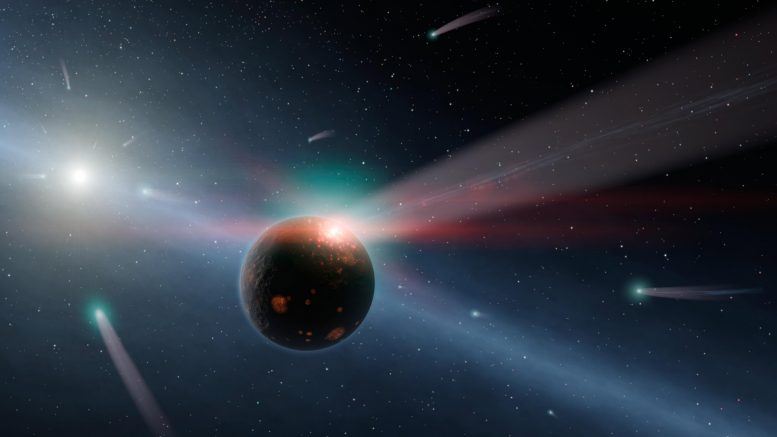
In a recently published study, scientists propose that the mysterious gas orbiting 49 CETI is similar to the sun’s Kuiper Belt and is a result of trillions of comets bashing into one another.
Every six seconds, for millions of years, comets have been colliding with one another near a star in the constellation Cetus called 49 CETI, which is visible to the naked eye.
Over the past three decades, astronomers have discovered hundreds of dusty disks around stars, but only two — 49 CETI is one — have been found that also have large amounts of gas orbiting them.
Young stars, about a million years old, have a disk of both dust and gas orbiting them, but the gas tends to dissipate within a few million years and almost always within about 10 million years. Yet 49 CETI, which is thought to be considerably older, is still being orbited by a tremendous quantity of gas in the form of carbon monoxide molecules, long after that gas should have dissipated.
“We now believe that 49 CETI is 40 million years old, and the mystery is how in the world can there be this much gas around an otherwise ordinary star that is this old,” said Benjamin Zuckerman, a University of California, Los Angeles (UCLA) professor of physics and astronomy and co-author of the research, which was recently published in the Astrophysical Journal. “This is the oldest star we know of with so much gas.”
Zuckerman and his co-author Inseok Song, a University of Georgia assistant professor of physics and astronomy, propose that the mysterious gas comes from a very massive disk-shaped region around 49 CETI that is similar to the sun’s Kuiper Belt, which lies beyond the orbit of Neptune.
The total mass of the various objects that make up the Kuiper Belt, including the dwarf planet Pluto, is about one-tenth the mass of the Earth. But back when the Earth was forming, astronomers say, the Kuiper Belt likely had a mass that was approximately 40 times larger than the Earth’s; most of that initial mass has been lost in the last 4.5 billion years.
By contrast, the Kuiper Belt analogue that orbits around 49 CETI now has a mass of about 400 Earth masses — 4,000 times the current mass of the Kuiper Belt.
“Hundreds of trillions of comets orbit around 49 CETI and one other star whose age is about 30 million years. Imagine so many trillions of comets, each the size of the UCLA campus — approximately 1 mile in diameter — orbiting around 49 CETI and bashing into one another,” Zuckerman said. “These young comets likely contain more carbon monoxide than typical comets in our solar system. When they collide, the carbon monoxide escapes as a gas. The gas seen around these two stars is the result of the incredible number of collisions among these comets.
“We calculate that comets collide around these two stars about every six seconds,” he said. “I was absolutely amazed when we calculated this rapid rate. I would not have dreamt it in a million years. We think these collisions have been occurring for 10 million years or so.”
Using a radio telescope in the Sierra Nevada mountains of southern Spain in 1995, Zuckerman and two colleagues discovered the gas that orbits 49 CETI, but the origin of the gas had remained unexplained for 17 years, until now.
Reference: “A 40 Myr Old Gaseous Circumstellar Disk at 49 Ceti: Massive Co-Rich Comet Clouds at Young A-Type Stars” by B. Zuckerman and Inseok Song, 27 September 2012, The Astrophysical Journal.
DOI: 10.1088/0004-637X/758/2/77
Never miss a breakthrough: Join the SciTechDaily newsletter.
Follow us on Google and Google News.
2 Comments
Another star in the Cetus constellation – Tau Ceti, contains about 10 times the number of comets as our Sun.
In the constellation of CETUS ,observation of 49 CETI having a cometary debris around it in a relatively short time of 40 million years old “SUN- 49 CETI” speaks well of stellar formation in the early years. Similar our Kuiper belt there would be many Kuiper belts around distant stars also. Planetary formation would have preceded later with pieces of asteroids formed by innumerable collision of such comets.In our solar system we have two belts , one being Kuiper belt of cometary objects at a very far away distance and Asteroidal belt near our sun next to Mars. The debris is also found around Jupiter, Saturn, Uranus and Neptune as rings of stones and planets. Same history will be there in any other star also like 49 CETI. Thank You.