
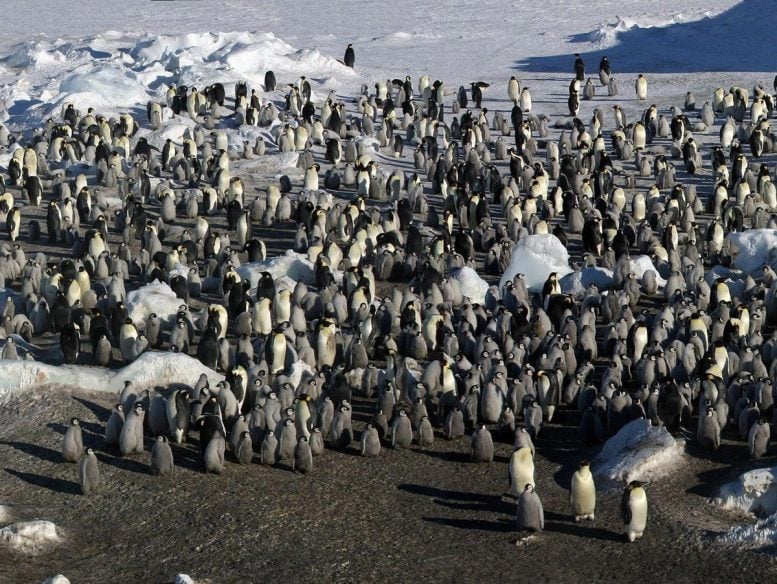
Scientists observed two new colonies totaling 6,000 emperor penguin chicks near Mertz Glacier in Antarctica, raising the estimated population in this area to about threefold of what was previously thought.
While about 2500 chicks of emperor penguins are raised this year at the colony close to the French Dumont d’Urville Station, two new colonies totaling 6000 chicks have just been observed about 250 km (155 mi) away, near Mertz Glacier by the scientists Dr. André Ancel and Dr. Yvon Ancel, from the Institut Pluridisciplinaire Hubert Curien in Strasbourg (CNRS and Université de Strasbourg). Since a pair of emperor penguins may only successfully raise one chick a year, the population of breeding emperor penguins in this area of the Antarctic can therefore be estimated to be more than about 8500 pairs, about threefold that previously thought.
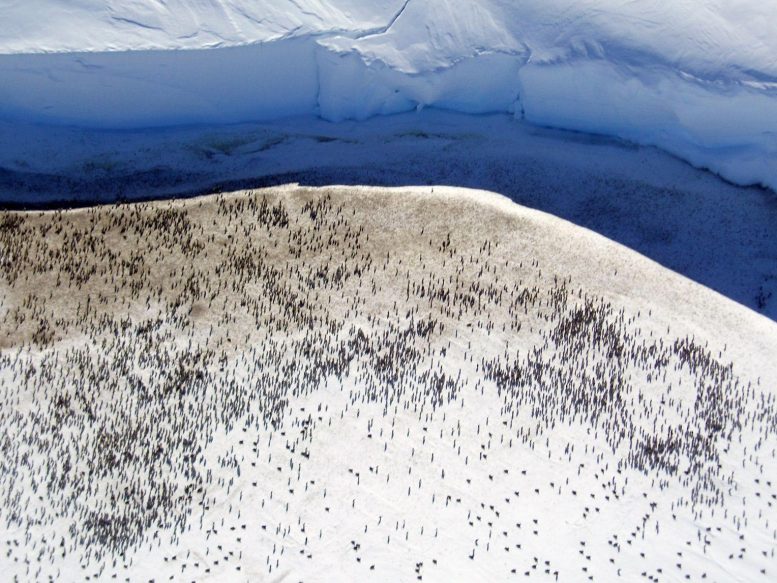
The two new colonies have been revealed on November 1st and 2nd, during the late winter season trip of the MSS Astrolabe1 towards Dumont d’Urville. They are located on the winter sea ice. This ice surrounds the remains of the Mertz Glacier, from which a large ice wall, 80 km (50 mi) long, 40 km (25 mi) wide, and 300-400 m (1,000-1,300 ft) thick has separated. These may be two sub-populations originating from the initial Mertz colony which, following the Mertz Glacier break, are attempting to settle again on favorable surroundings. One accounts for about 2000 chicks and the second for about 4000 chicks.
Dr. André Ancel had suspected the existence of an emperor penguin colony near the Mertz Glacier since 1999, when with Dr. Barbara Wienecke (Australian Antarctic Division), they observed thousands of emperor penguins going back and forth in the Mertz glacier area. Dr. Peter Fretwell and Dr. Phil Trathan of the British Antarctic Survey localized this colony in 2009 based on the images from space of emperor penguin nitrogen dejections on the sea ice. However, the break of the Mertz glacier in 2010 questioned the fate of this colony. New satellite images obtained since then suggested that the birds might attempt breeding on different sites. Over the last 13 years all French attempts to find the birds had failed, due to the harsh winter conditions and the summer disappearance of the sea ice where the Emperors breed.

This year, the human, logistic, and environmental conditions finally came together. The French Polar Institute (IPEV) then decided to modify the Astrolabe’s route to enable Dr. André Ancel and Dr. Yvon Le Maho to find this population. A good climate window, the excellent knowledge of the environment by the IPEV logistic teams, the expert navigational skill of the Astrolabe crew on the ice, and the essential helicopter support in such areas, have allowed for the success of this detection. The break of the Mertz Glacier had profoundly modified the environment into a chaos of small icebergs and sea ice. The French scientists discovered that the initial colony seen from space by their British colleagues had been split over two sites. The first, whose localization had been recently indicated by the British, accounts for about 2000 chicks, whereas 4000 are being raised in the second. The second site was discovered by chance, 15 km from the first, while conducting a scientific helicopter survey.
Dr, Yvon Le Maho, CNRS Director of Research, Member of the French Academy of Sciences, and team leader of the scientific program of the French Polar Institute under the frame of which this discovery has been made, in line with the research conducted at the Institut Ecologie et Environnement of CNRS), said “This success rewards the long-term attempts and dedication of Dr. André Ancel. It is also the outcome of a national and international collaboration.” This collaboration involves the Center d’Etudes Biologiques of Chizé, the Scientific Center of Monaco principality and also British and Australian Antarctic research organizations, nations that invest a lot in Antarctica.
Never miss a breakthrough: Join the SciTechDaily newsletter.
Follow us on Google and Google News.
2 Comments
Awesome! Three times more penguins than what was anticipated.. that is such good news.. so sick of hearing about beautiful creatures becoming extinct because of humanity’s ignorance..
Penquins are the last of the truly free air-breathing species on earth. Just living on land that God owns, and swimming and fishing all day. Its like they are still in Eden.