
Close Menu
    Facebook X (Twitter) Instagram
    SciTechDaily
    • Biology
    • Chemistry
    • Earth
    • Health
    • Physics
    • Science
    • Space
    • Technology
    Facebook X (Twitter) Pinterest YouTube RSS
    SciTechDaily
    Home»Space»Hubble Spots Lenticular Galaxy NGC 5010
    Space

    Hubble Spots Lenticular Galaxy NGC 5010

    By NASANovember 12, 20121 Comment2 Mins Read
    Facebook Twitter Pinterest Telegram LinkedIn WhatsApp Email Reddit
    Share
    Facebook Twitter LinkedIn Pinterest Telegram Email Reddit
    NGC 5010
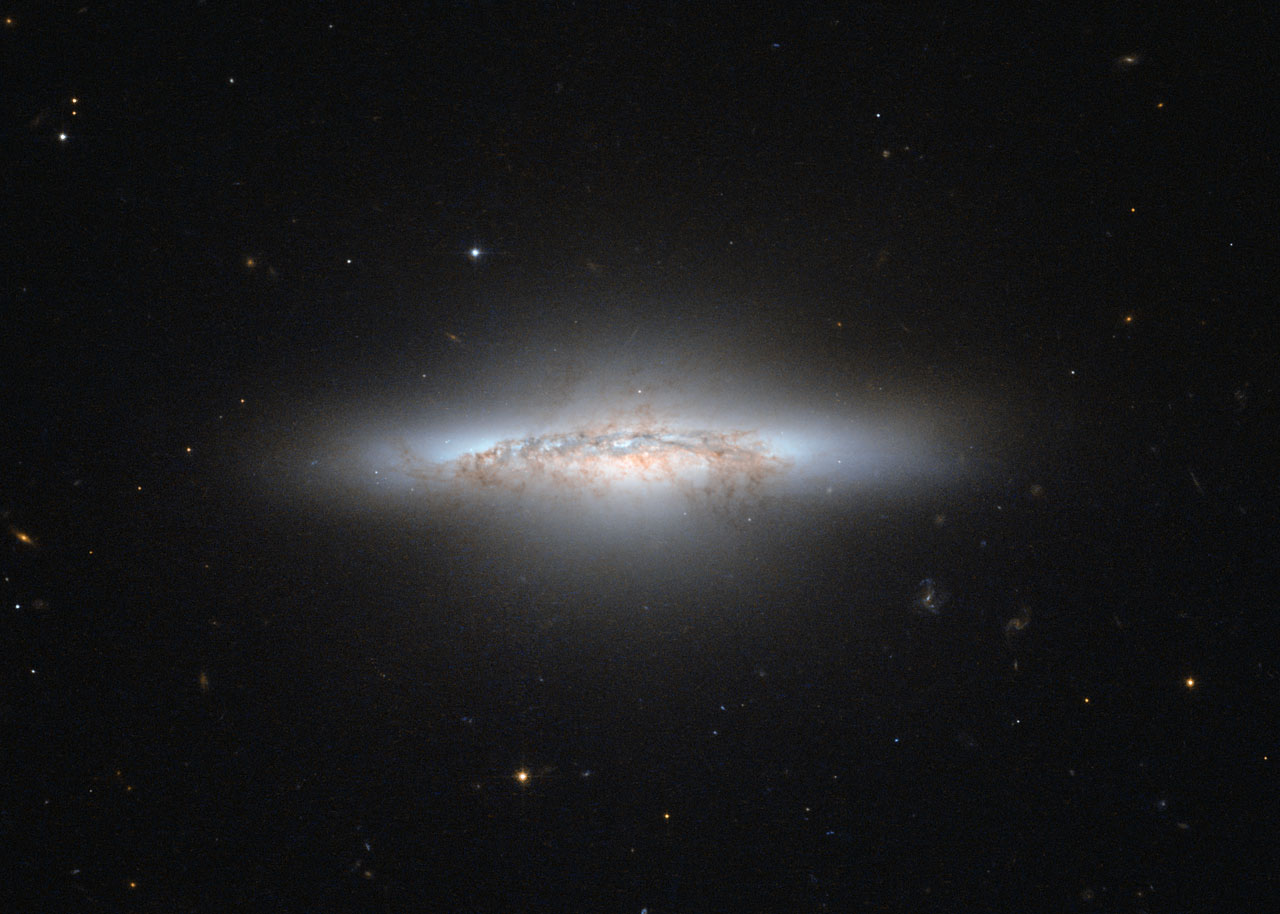
    Hubble Space Telescope image of galaxy NGC 5010. Credit: ESA/Hubble & NASA

    This new image from the Hubble Space Telescope shows galaxy NGC 5010, which is located about 140 million light-years away in the constellation of Virgo and has features of both a spiral and elliptical galaxy.

    The NASA/ESA Hubble Space Telescope has captured a beautiful galaxy that, with its reddish and yellow central area, looks rather like an explosion from a Hollywood movie. The galaxy, called NGC 5010, is in a period of transition. The aging galaxy is moving on from life as a spiral galaxy, like our Milky Way, to an older, less defined type called an elliptical galaxy. In this in-between phase, astronomers refer to NGC 5010 as a lenticular galaxy, which has features of both spirals and ellipticals.

    NGC 5010 is located around 140 million light-years away in the constellation of Virgo (The Virgin). The galaxy is oriented sideways to us, allowing Hubble to peer into it and show the dark, dusty, remnant bands of spiral arms. NGC 5010 has notably started to develop a big bulge in its disk as it takes on a more rounded shape.

    Most of the stars in NGC 5010 are red and elderly. The galaxy no longer contains all that many of the fast-lived blue stars common in younger galaxies that still actively produce new populations of stars.

    Much of the dusty and gaseous fuel needed to create fresh stars has already been used up in NGC 5010. Over time, the galaxy will grow progressively more “red and dead,” as astronomers describe elliptical galaxies.

    Hubble’s Advanced Camera for Surveys snapped this image in violet and infrared light.

    Never miss a breakthrough: Join the SciTechDaily newsletter.
    Follow us on Google and Google News.

    Galaxy Hubble Space Telescope NASA Popular
    Share. Facebook Twitter Pinterest LinkedIn Email Reddit

    Related Articles

    Hubble Snaps Spiral Galaxy’s Profile – From Hydra Constellation, 80 Million Light-Years Away

    Hubble Image of the Week – A Distinctly Disorganized Dwarf Galaxy

    Hubble Views a Starburst Galaxy Hard at Work

    Hubble Views Spiral Galaxy NGC 3344

    Hubble Image of Peculiar Galaxy Pair Arp 116

    Hubble Captures a New Image of Messier 107

    Hubble Views the Needle Galaxy, NGC 4565

    Dark Matter Core of Abell 520 Differs from Bullet Cluster

    Researchers Discover First Intermediate-Mass Black Hole

    1 Comment

    1. Bill D on November 12, 2012 7:23 am

      Come on Hubble…I want to see the beginning of the universe!! Your almost there..what’s taking so long??!! You’ve looked 13.2 billion years into the depth of our 13.7 billion year old universe! You have 0.5 billion years to go…lets do it! 🙂

      Reply
    Leave A Reply Cancel Reply

    • Facebook
    • Twitter
    • Pinterest
    • YouTube

    Don't Miss a Discovery

    Subscribe for the Latest in Science & Tech!

    Trending News

    First-of-Its-Kind Discovery: Homer’s Iliad Found Embedded in a 1,600-Year-Old Egyptian Mummy

    Beyond Inflammation: Scientists Uncover New Cause of Persistent Rheumatoid Arthritis

    A Simple Molecule Could Unlock Safer, Easier Weight Loss

    Scientists Just Built a Quantum Battery That Charges Almost Instantly

    Researchers Unveil Groundbreaking Sustainable Solution to Vitamin B12 Deficiency

    Millions of People Have Osteopenia Without Realizing It – Here’s What You Need To Know

    Researchers Discover Boosting a Single Protein Helps the Brain Fight Alzheimer’s

    World-First Study Reveals Human Hearts Can Regenerate After a Heart Attack

    Follow SciTechDaily
    • Facebook
    • Twitter
    • YouTube
    • Pinterest
    • Newsletter
    • RSS
    SciTech News
    • Biology News
    • Chemistry News
    • Earth News
    • Health News
    • Physics News
    • Science News
    • Space News
    • Technology News
    Recent Posts
    • Scientists Flip Immune System “Switch,” Uncover Surprising Path To Stop Gut Inflammation
    • Magnesium Magic: New Drug Melts Fat Even on a High-Fat, High-Sugar Diet
    • Weight-Loss Drugs Like Ozempic May Come With an Unexpected Cost
    • After Decades, MIT Researchers Capture the First 3D Atomic View of a Mysterious Material
    • Your Favorite Fishing Spot Is Turning Brown – and the Fish Are Changing
    Copyright © 1998 - 2026 SciTechDaily. All Rights Reserved.
    • Science News
    • About
    • Contact
    • Editorial Board
    • Privacy Policy
    • Terms of Use

    Type above and press Enter to search. Press Esc to cancel.