
Close Menu
    Facebook X (Twitter) Instagram
    SciTechDaily
    • Biology
    • Chemistry
    • Earth
    • Health
    • Physics
    • Science
    • Space
    • Technology
    Facebook X (Twitter) Pinterest YouTube RSS
    SciTechDaily
    Home»Space»Unmatched View: Newly-Discovered Comet NEOWISE Spied by NASA’s Parker Solar Probe
    Space

    Unmatched View: Newly-Discovered Comet NEOWISE Spied by NASA’s Parker Solar Probe

    By NASA's Goddard Space Flight CenterJuly 10, 20201 Comment4 Mins Read
    Facebook Twitter Pinterest Telegram LinkedIn WhatsApp Email Reddit
    Share
    Facebook Twitter LinkedIn Pinterest Telegram Email Reddit
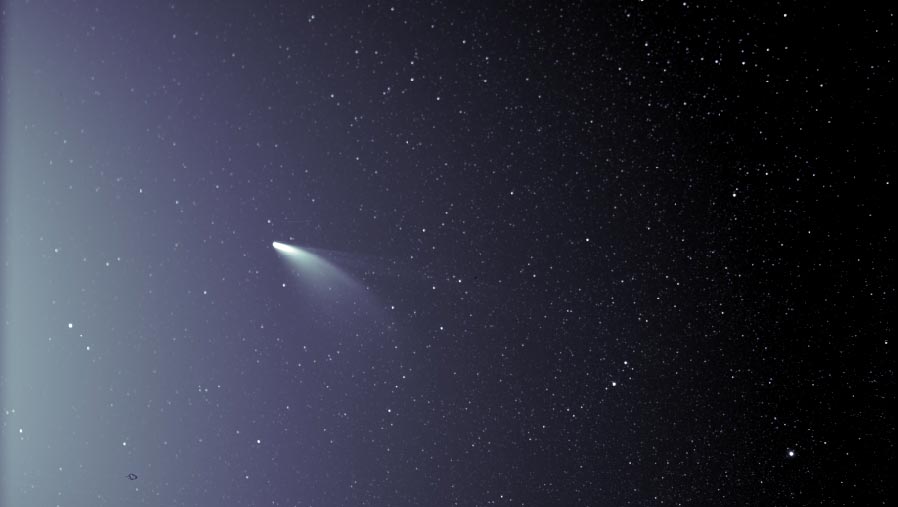
    WISPR Comet NEOWISE
    An unprocessed image from the WISPR instrument on board NASA’s Parker Solar Probe shows comet NEOWISE on July 5, 2020, shortly after its closest approach to the Sun. The Sun is out of frame to the left. The faint grid pattern near the center of the image is an artifact of the way the image is created. The small black structure near the lower left of the image is caused by a grain of dust resting on the imager’s lens. Credit: NASA/Johns Hopkins APL/Naval Research Lab/Parker Solar Probe/Brendan Gallagher

    NASA’s Parker Solar Probe was at the right place at the right time to capture a unique view of comet NEOWISE on July 5, 2020. Parker Solar Probe’s position in space gave the spacecraft an unmatched view of the comet’s twin tails when it was particularly active just after its closest approach to the Sun, called perihelion.

    The comet was discovered by NASA’s Near-Earth Object Wide-field Infrared Survey Explorer, or NEOWISE, on March 27. Since then, the comet — called comet C/2020 F3 NEOWISE and nicknamed comet NEOWISE — has been spotted by several NASA spacecraft, including Parker Solar Probe, NASA’s Solar and Terrestrial Relations Observatory, the ESA/NASA Solar and Heliospheric Observatory, and astronauts aboard the International Space Station.

    The image above is unprocessed data from Parker Solar Probe’s WISPR instrument, which takes images of the Sun’s outer atmosphere and solar wind in visible light. WISPR’s sensitivity also makes it well-suited to see fine detail in structures like comet tails. Parker Solar Probe collected science data through June 28 for its fifth solar flyby, but the availability of additional downlink time allowed the team to take extra images, including this image of comet NEOWISE.
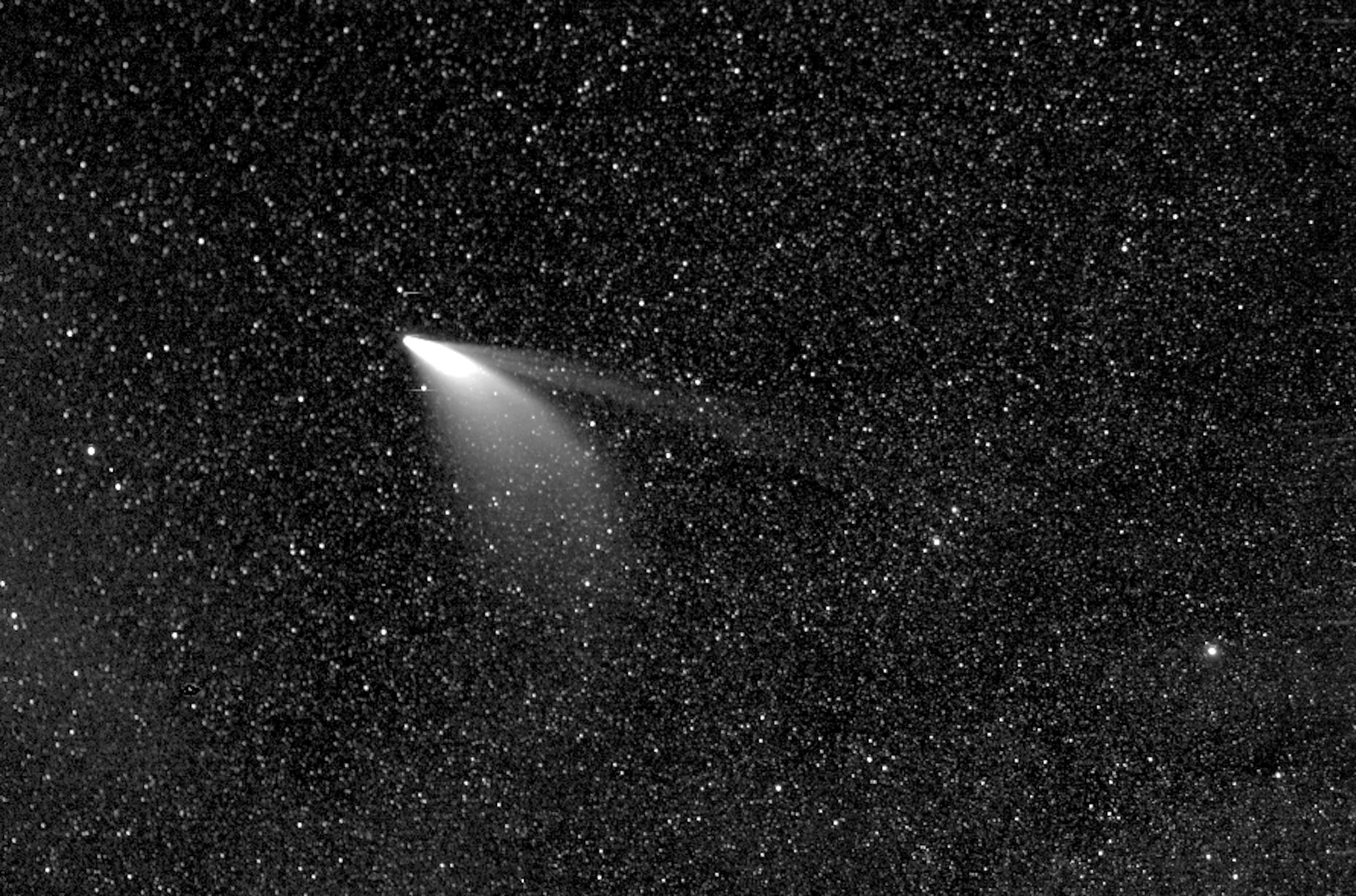
    WISPR Comet NEOWISE Processed
    Processed data from the WISPR instrument on NASA’s Parker Solar Probe shows greater detail in the twin tails of comet NEOWISE, as seen on July 5, 2020. The lower, broader tail is the comet’s dust tail, while the thinner, upper tail is the comet’s ion tail. Credit: NASA/Johns Hopkins APL/Naval Research Lab/Parker Solar Probe/Guillermo Stenborg

    The twin tails of comet NEOWISE are seen more clearly in this image from the WISPR instrument, which has been processed to increase contrast and remove excess brightness from scattered sunlight, revealing more detail in the comet tails.

    The lower tail, which appears broad and fuzzy, is the dust tail of comet NEOWISE — created when dust lifts off the surface of the comet’s nucleus and trails behind the comet in its orbit. Scientists hope to use WISPR’s images to study the size of dust grains within the dust tail, as well as the rate at which the comet sheds dust.
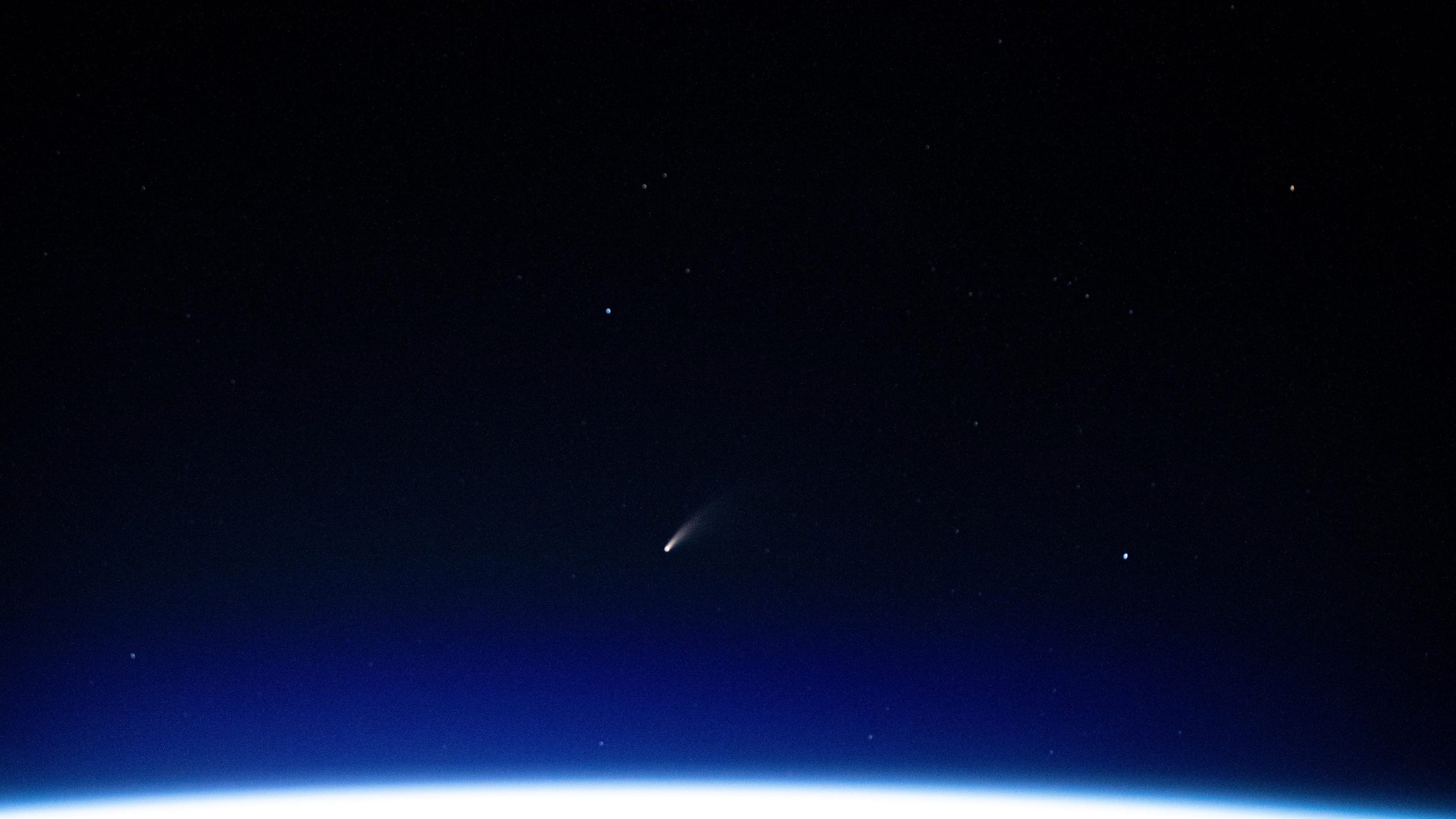
    Comet Neowise From ISS
    The tiny shooting star in the lower center of this image is Comet Neowise pictured from the International Space Station as it orbited above the Mediterranean Sea in between Tunisia and Italy. Credit: NASA

    The upper tail is the ion tail, which is made up of gases that have been ionized by losing electrons in the Sun’s intense light. These ionized gases are buffeted by the solar wind — the Sun’s constant outflow of magnetized material — creating the ion tail that extends directly away from the Sun. Parker Solar Probe’s images appear to show a divide in the ion tail. This could mean that comet NEOWISE has two ion tails, in addition to its dust tail, though scientists would need more data and analysis to confirm this possibility.


    These images from ESA and NASA’s Solar and Heliospheric Observatory show comet NEOWISE as it approached the Sun in late June 2020. The instrument that produced this data is a coronagraph, which uses a solid disk to block out the Sun’s bright face, revealing the comparatively outer atmosphere, the corona, along with objects like comet NEOWISE. Credit: ESA/NASA/SOHO

    Never miss a breakthrough: Join the SciTechDaily newsletter.
    Follow us on Google and Google News.

    Comet NASA NASA Goddard Space Flight Center NEOWISE Parker Solar Probe
    Share. Facebook Twitter Pinterest LinkedIn Email Reddit

    Related Articles

    A Small, Bright Surprise: Two Views of a Sungrazing Comet

    Celebrity Comet NEOWISE Close-Up Snapped by Hubble

    “Very Surprised!” – NASA’s Exoplanet-Hunting Mission Catches an Explosive Comet Outburst

    Dozens of ‘Comet Crumbs’ Detected by LISA Pathfinder [Video]

    First Confirmed Interstellar Comet Observed by Hubble [Video]

    NEOWISE Mission Spots One Comet, Maybe Two

    Astronomers Identify Greenhouse Gases in Comets

    NEOWISE: One Year of Observations Mapped

    NASA’s NEOWISE Spacecraft Views Its First Comet

    1 Comment

    1. Peter J Denholm on July 11, 2020 6:25 am

      Really a nice comet to view. I think it looks similar to comet Hale-Bop which had easily visible dust tail and ion tail. I will be watching it.

      Reply
    Leave A Reply Cancel Reply

    • Facebook
    • Twitter
    • Pinterest
    • YouTube

    Don't Miss a Discovery

    Subscribe for the Latest in Science & Tech!

    Trending News

    Giant Plasma Waves May Be Stripping Away Mars’ Atmosphere

    Scientists Thought SuperAgers Had Lucky Genes. They Were Wrong

    Astronomers Find Ancient Black Holes Shining With the Power of a Trillion Suns

    Researchers Solve Mystery Behind Contradictory Weight-Loss Drug Paradox

    Long-Lost Megalodon Fossils Found Hiding on a Museum Shelf

    Experimental Eye Drops Restore Sight in Blind Mice

    Scientists Discover the Brain May Enter a New Biological Phase Between 50 and 75

    New Research Reveals Autistic Brains Process Faces Differently

    Follow SciTechDaily
    • Facebook
    • Twitter
    • YouTube
    • Pinterest
    • Newsletter
    • RSS
    SciTech News
    • Biology News
    • Chemistry News
    • Earth News
    • Health News
    • Physics News
    • Science News
    • Space News
    • Technology News
    Recent Posts
    • Pesticide Exposure May Carry a Serious Neurological Risk Years Later
    • Ozempic Could Fight Addiction Too – Scientists Finally Know How
    • Spain’s Largest Wildfire on Record Burned an Area the Size of New York City
    • Meet the 30-Million-Year-Old Dog That Climbed Trees Instead of Chasing Sticks
    • Two Mysterious ‘Ghost’ Ancestors Are Hiding in Our DNA
    Copyright © 1998 - 2026 SciTechDaily. All Rights Reserved.
    • Science News
    • About
    • Contact
    • Editorial Board
    • Privacy Policy
    • Terms of Use

    Type above and press Enter to search. Press Esc to cancel.