
Close Menu
    Facebook X (Twitter) Instagram
    SciTechDaily
    • Biology
    • Chemistry
    • Earth
    • Health
    • Physics
    • Science
    • Space
    • Technology
    Facebook X (Twitter) Pinterest YouTube RSS
    SciTechDaily
    Home»Space»Astronomers Identify Greenhouse Gases in Comets
    Space

    Astronomers Identify Greenhouse Gases in Comets

    By DC Agle, Jet Propulsion LaboratoryNovember 24, 2015No Comments4 Mins Read
    Facebook Twitter Pinterest Telegram LinkedIn WhatsApp Email Reddit
    Share
    Facebook Twitter LinkedIn Pinterest Telegram Email Reddit
    NEOWISE Discovers Greenhouse Gases in Comets
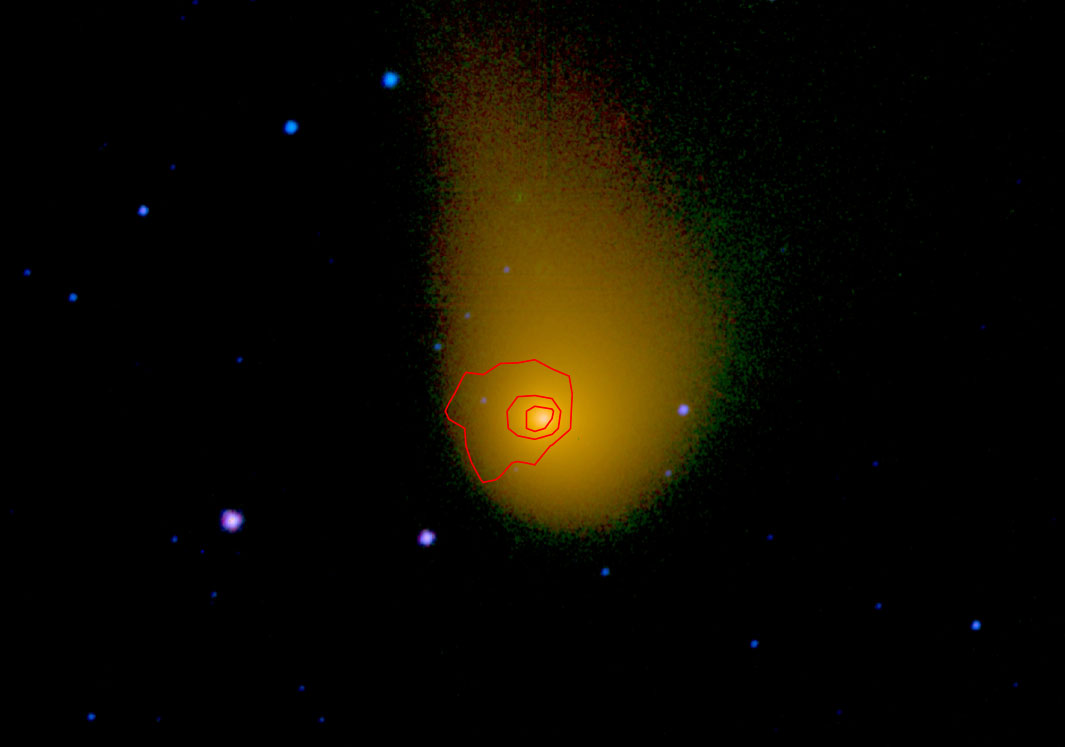
    An expanded view of comet C/2006 W3 (Christensen) is shown here. The WISE spacecraft observed this comet on April 20th, 2010 as it traveled through the constellation Sagittarius. Comet Christensen was nearly 370 million miles (600 million kilometers) from Earth at the time. The extent of the dust, about a tenth of a degree across in this image, is about 2/3rds the diameter of the sun. The red contours show the signal from the gas emission observed by the WISE spacecraft in the 4.6 micron wavelength channel, which contains carbon monoxide (CO) and carbon dioxide (CO2) emission lines. The strength of the 4.6 micron signal indicates over half a metric ton per second of CO or CO2 was emitted from this comet at the time of the observations. Credit: NASA/JPL-Caltech

    Using data from the NEOWISE Space Telescope, astronomers have gained new insights into the dust and production rates for difficult-to-observe gases like carbon dioxide and carbon monoxide in comets.

    After its launch in 2009, NASA’s NEOWISE spacecraft observed 163 comets during the WISE/NEOWISE prime mission. This sample from the space telescope represents the largest infrared survey of comets to date. Data from the survey are giving new insights into the dust, comet nucleus sizes, and production rates for difficult-to-observe gases like carbon dioxide and carbon monoxide. Results of the NEOWISE census of comets were recently published in the Astrophysical Journal.

    Carbon monoxide (CO) and carbon dioxide (CO2) are common molecules found in the environment of the early solar system, and in comets. In most circumstances, water–ice sublimation likely drives the activity in comets when they come nearest to the sun, but at larger distances and colder temperatures, other common molecules like CO and CO2 may be the main drivers. Spaceborne carbon dioxide and carbon monoxide are difficult to directly detect from the ground because their abundance in Earth’s own atmosphere obscures the signal. The NEOWISE spacecraft soars high above Earth’s atmosphere, making these measurements of a comet’s gas emissions possible.

    “This is the first time we’ve seen such large statistical evidence of carbon monoxide taking over as a comet’s gas of choice when they are farther out from the sun,” said James Bauer, deputy principal investigator of the NEOWISE mission from NASA’s Jet Propulsion Laboratory in Pasadena, California, and author of a paper on the subject. “By emitting what is likely mostly carbon monoxide beyond four astronomical units (4 times the Earth-Sun distance; about 370 million miles, 600 million kilometers) it shows us that comets may have stored most of the gases when they formed, and secured them over billions of years. Most of the comets that we observed as active beyond 4 AU are long-period comets, comets with orbital periods greater than 200 years that spend most of their time beyond Neptune’s orbit.”

    While the amount of carbon monoxide and dioxide increases relative to ejected dust as a comet gets closer to the sun, the percentage of these two gases, when compared to other volatile gases, decreases.

    “As they get closer to the sun, these comets seem to produce a prodigious amount of carbon dioxide,” said Bauer. “Your average comet sampled by NEOWISE would expel enough carbon dioxide to provide the bubble power for thousands of cans of soda per second.”

    Reference: “The NEOWISE-Discovered Comet Population and the CO+CO2 production rates” by James M. Bauer, Rachel Stevenson, Emily Kramer, A. K. Mainzer, Tommy Grav, Joseph R. Masiero, Yan R. Fernández, Roc M. Cutri, John W. Dailey, Frank J. Masci, Karen J. Meech, Russel Walker, C. M. Lisse, Paul R. Weissman, Carrie R. Nugent, Sarah Sonnett, Nathan Blair, Andrew Lucas, Robert S. McMillan, Edward L. Wright and the WISE and NEOWISE Teams, 19 November 2015, The Astrophysical Journal.
    DOI: 10.1088/0004-637X/814/2/85
    arXiv:1509.08446

    The NEOWISE mission hunts for near-Earth objects using the Wide-field Infrared Survey Explorer (WISE) spacecraft. Funded by NASA’s Planetary Science division, the NEOWISE project uses images taken by the spacecraft to look for asteroids and comets, providing a rich source of measurements of solar system objects at infrared wavelengths. These measurements include emission lines that are difficult or impossible to detect directly from the ground.

    Never miss a breakthrough: Join the SciTechDaily newsletter.
    Follow us on Google and Google News.

    Astronomy Comet Greenhouse Gas NASA NEOWISE
    Share. Facebook Twitter Pinterest LinkedIn Email Reddit

    Related Articles

    Comet NEOWISE Streaks Across the Sky Above Lone Pine Lake in Stunning NASA Image

    Stunning Photo Captures International Space Station Above Comet NEOWISE

    Comet NEOWISE Sizzles As It Slides by the Sun – A Treat for Observers on Earth and in Space

    Comet NEOWISE Has Suddenly Become Visible to the Unaided Eye

    NEOWISE Mission Spots One Comet, Maybe Two

    NEOWISE: One Year of Observations Mapped

    NASA’s NEOWISE Spacecraft Views Its First Comet

    Comet 2013 A1 to Make a Very Close Flyby of Mars

    View the Eta Aquarid Meteor Shower From Halley’s Comet

    Leave A Reply Cancel Reply

    • Facebook
    • Twitter
    • Pinterest
    • YouTube

    Don't Miss a Discovery

    Subscribe for the Latest in Science & Tech!

    Trending News

    Millions Take These IBS Drugs, But a New Study Finds Serious Risks

    Scientists Unlock Hidden Secrets of 2,300-Year-Old Mummies Using Cutting-Edge CT Scanner

    Bread Might Be Making You Gain Weight Even Without Eating More Calories

    Scientists Discover Massive Magma Reservoir Beneath Tuscany

    Europe’s Most Active Volcano Just Got Stranger – Here’s Why Scientists Are Rethinking It

    Alzheimer’s Symptoms May Start Outside the Brain, Study Finds

    Millions Take This Popular Supplement – Scientists Discover a Concerning Link to Heart Failure

    The Universe Is Expanding Too Fast and Scientists Can’t Explain Why

    Follow SciTechDaily
    • Facebook
    • Twitter
    • YouTube
    • Pinterest
    • Newsletter
    • RSS
    SciTech News
    • Biology News
    • Chemistry News
    • Earth News
    • Health News
    • Physics News
    • Science News
    • Space News
    • Technology News
    Recent Posts
    • Doctors Surprised by the Power of a Simple Drug Against Colon Cancer
    • Why Popular Diabetes Drugs Like Ozempic Don’t Work for Everyone: The “Genetic Glitch”
    • Scientists Create Improved Insulin Cells That Reverse Diabetes in Mice
    • Scientists Stunned After Finding Plant Thought Extinct for 60 Years
    • A Common Diabetes Drug May Hold the Key to Stopping HIV From Coming Back
    Copyright © 1998 - 2026 SciTechDaily. All Rights Reserved.
    • Science News
    • About
    • Contact
    • Editorial Board
    • Privacy Policy
    • Terms of Use

    Type above and press Enter to search. Press Esc to cancel.