
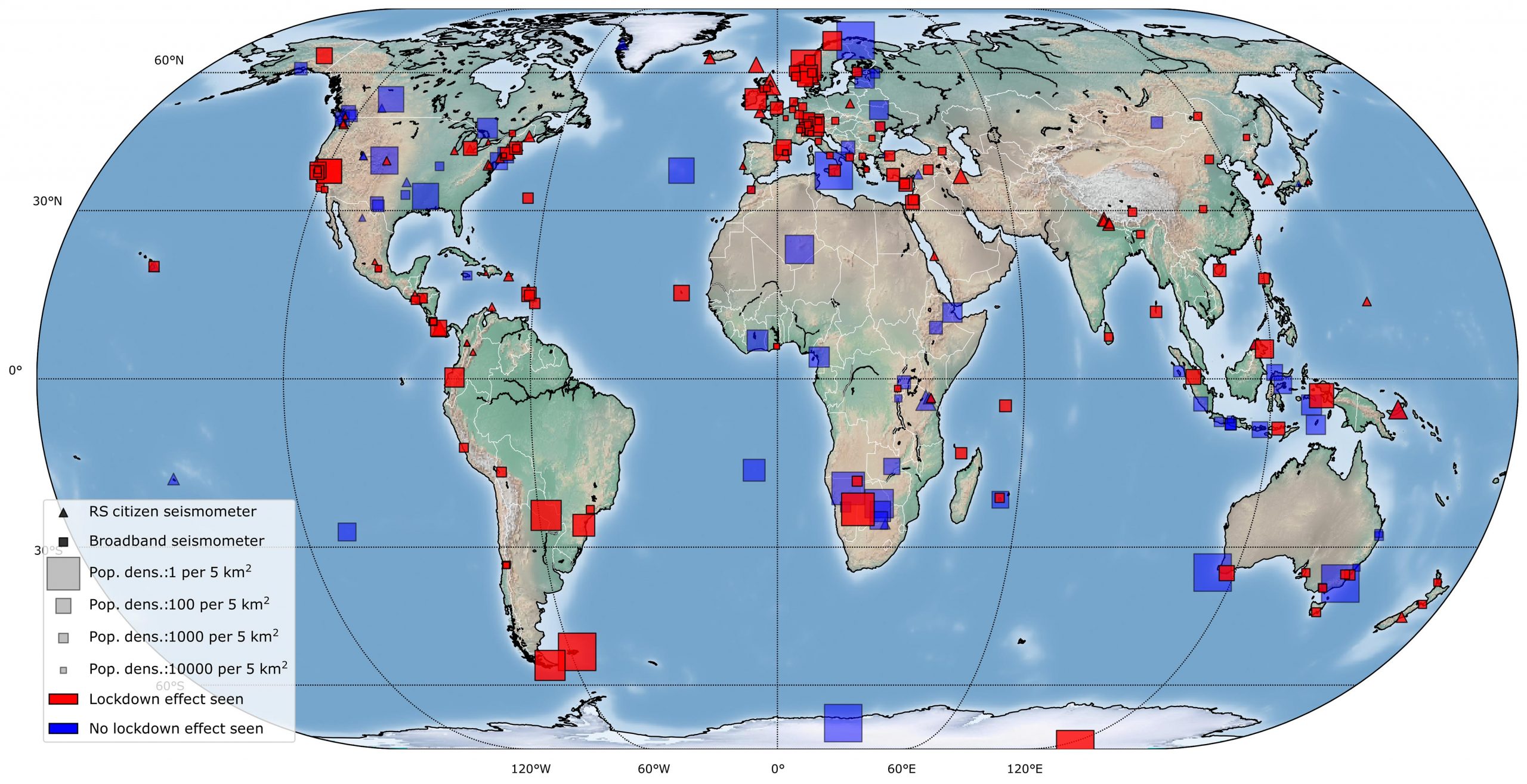
The lack of human activity during the lockdown caused human-linked vibrations in the Earth to drop by an average of 50% between March and May 2020.
This quiet period, likely caused by the total global effect of social distancing measures, closure of services and industry, and drops in tourism and travel, is the longest and most pronounced quiet period of seismic noise in recorded history.
“Our study uniquely highlights just how much human activities impact the solid Earth, and could let us see more clearly than ever what differentiates human and natural noise.” Dr. Stephen Hicks, Department of Earth Science and Engineering
The new research, led by the Royal Observatory of Belgium and five other institutions around the world including Imperial College London, showed that the dampening of ‘seismic noise’ caused by humans was more pronounced in more densely populated areas.
The relative quietness allowed researchers to listen in to previously concealed earthquake signals, and could help us differentiate between human and natural seismic noise more clearly than ever before.
Co-author Dr Stephen Hicks, from Imperial’s Department of Earth Science and Engineering, said: “This quiet period is the longest and largest dampening of human-caused seismic noise since we started monitoring the Earth in detail using vast monitoring networks of seismometers.
“Our study uniquely highlights just how much human activities impact the solid Earth, and could let us see more clearly than ever what differentiates human and natural noise.”
The paper was published on July 23, 2020, in the journal Science.
Anthropause
Measured by instruments called seismometers, seismic noise is caused by vibrations within the Earth, which travel like waves. The waves can be triggered by earthquakes, volcanoes, and bombs — but also by daily human activity like travel and industry.
Although 2020 has not seen a reduction in earthquakes, the drop in human-caused seismic noise is unprecedented. The strongest drops were found in urban areas, but the study also found signatures of the lockdown on sensors buried hundreds of meters underground and in more remote areas.
Human-generated noise usually dampens during quiet periods like over the Christmas/New Year period and Chinese New Year, and during weekends and overnight. However, the drop in vibrations caused by COVID-19 lockdown measures eclipses even those seen during these periods.
Some researchers are dubbing this drop in anthropogenic (human-caused) noise and pollution the ‘anthropause.’
Dr. Hicks said: “This is the first global study of the impact of the coronavirus anthropause on the solid Earth beneath our feet.”
To gather the data, researchers looked at seismic data from a global network of 268 seismic stations in 117 countries and found significant noise reductions compared to before any lockdown at 185 of those stations. Beginning in China in late January 2020, and followed by Europe and the rest of the world in March to April 2020, researchers tracked the ‘wave’ of quietening between March and May as worldwide lockdown measures took hold.
“With increasing urbanisation and growing global populations, more people will be living in geologically hazardous areas. It will therefore become more important than ever to differentiate between natural and human-caused noise.” Dr. Thomas Lecocq, Royal Observatory of Belgium
The largest drops in vibrations were seen in the most densely populated areas, like Singapore and New York City, but drops were also seen in remote areas like Germany’s Black Forest and Rundu in Namibia.
Citizen-owned seismometers, which tend to measure more localized noise, noted large drops around universities and schools around Cornwall, UK, and Boston, USA – a drop in noise 20 percent larger than seen during school holidays.
Countries like Barbados, where lockdown coincided with the tourist season, saw a 50 percent decrease in noise. This coincided with flight data that suggested tourists returned home in the weeks before the official lockdown.
Listening in
Over the past few decades, seismic noise has gradually increased as economies and populations have grown.
The drastic changes to daily life caused by the pandemic have provided a unique opportunity to study their environmental impacts, such as reductions in emissions and pollution in the atmosphere. The changes have also given us the opportunity to listen in to the Earth’s natural vibrations without the distortions of human input.

The study reports the first evidence that previously concealed earthquake signals, especially during the daytime, appeared much clearer on seismometers in urban areas during the lockdown.
The researchers say the lockdown quietening could also help them differentiate between human-caused noise and natural signals that might warn of upcoming natural disasters.
Lead author Dr. Thomas Lecocq from the Royal Observatory of Belgium said: “With increasing urbanization and growing global populations, more people will be living in geologically hazardous areas. It will therefore become more important than ever to differentiate between natural and human-caused noise so that we can ‘listen in’ and better monitor the ground movements beneath our feet. This study could help to kick-start this new field of study.”
The study’s authors hope that their work will spawn further research on the seismic lockdown, as well as finding previously hidden signals from earthquakes and volcanoes.
Dr. Hicks said: “The lockdowns caused by the coronavirus pandemic may have given us a glimmer of insight into how human and natural noise interacts with the Earth. We hope this insight will spawn new studies that help us listen better to the Earth and understand natural signals we would otherwise have missed.”
Reference: “Global quieting of high-frequency seismic noise due to COVID-19 pandemic lockdown measures” by Thomas Lecocq , Stephen P. Hicks, Koen Van Noten, Kasper Van Wijk, Paula Koelemeijer, Raphael S. M. De Plaen, Frédérick Massin, Gregor Hillers, Robert E. Anthony, Maria-Theresia Apoloner, Mario Arroyo-Solórzano, Jelle D. Assink, Pinar Büyükakpinar, Andrea Cannata, Flavio Cannavo, Sebastian Carrasco, Corentin Caudron, Esteban J. Chaves, David G. Cornwell, David Craig, Olivier F. C. Den Ouden, Jordi Diaz, Stefanie Donner, Christos P. Evangelidis, Läslo Evers, Benoit Fauville, Gonzalo A. Fernandez, Dimitrios Giannopoulos, Steven J. Gibbons, Társilo Girona, Bogdan Grecu, Marc Grunberg, György Hetényi, Anna Horleston, Adolfo Inza, Jessica C. E. Irving, Mohammadreza Jamalreyhani, Alan Kafka, Mathijs R. Koymans, Celeste R. Labedz, Eric Larose, Nathaniel J. Lindsey, Mika Mckinnon, Tobias Megies, Meghan S. Miller, William Minarik, Louis Moresi, Víctor H. Márquez-Ramírez, Martin Möllhoff, Ian M. Nesbitt, Shankho Niyogi, Javier Ojeda, Adrien Oth, Simon Proud, Jay Pulli, Lise Retailleau, Annukka E. Rintamäki, Claudio Satriano, Martha K. Savage, Shahar Shani-Kadmiel, Reinoud Sleeman, Efthimios Sokos, Klaus Stammler, Alexander E. Stott, Shiba Subedi, Mathilde B. Sørensen, Taka’aki Taira, Mar Tapia, Fatih Turhan, Ben Van Der Pluijm, Mark Vanstone, Jerome Vergne, Tommi A. T. Vuorinen, Tristram Warren, Joachim Wassermann and Han Xiao,, 23 July 2020, Science.
DOI: 10.1126/science.abd2438
Never miss a breakthrough: Join the SciTechDaily newsletter.
Follow us on Google and Google News.
1 Comment
I liked your thesis very much: “The researchers say the lockdown quietening could also help them differentiate between human-caused noise and natural signals that might warn of upcoming natural disasters.”