
Close Menu
    Facebook X (Twitter) Instagram
    SciTechDaily
    • Biology
    • Chemistry
    • Earth
    • Health
    • Physics
    • Science
    • Space
    • Technology
    Facebook X (Twitter) Pinterest YouTube RSS
    SciTechDaily
    Home»Earth»Air Pollution Over China Returning to Pre-COVID Levels
    Earth

    Air Pollution Over China Returning to Pre-COVID Levels

    By European Space Agency (ESA)March 16, 20211 Comment4 Mins Read
    Facebook Twitter Pinterest Telegram LinkedIn WhatsApp Email Reddit
    Share
    Facebook Twitter LinkedIn Pinterest Telegram Email Reddit
    Nitrogen Dioxide Concentrations Over China
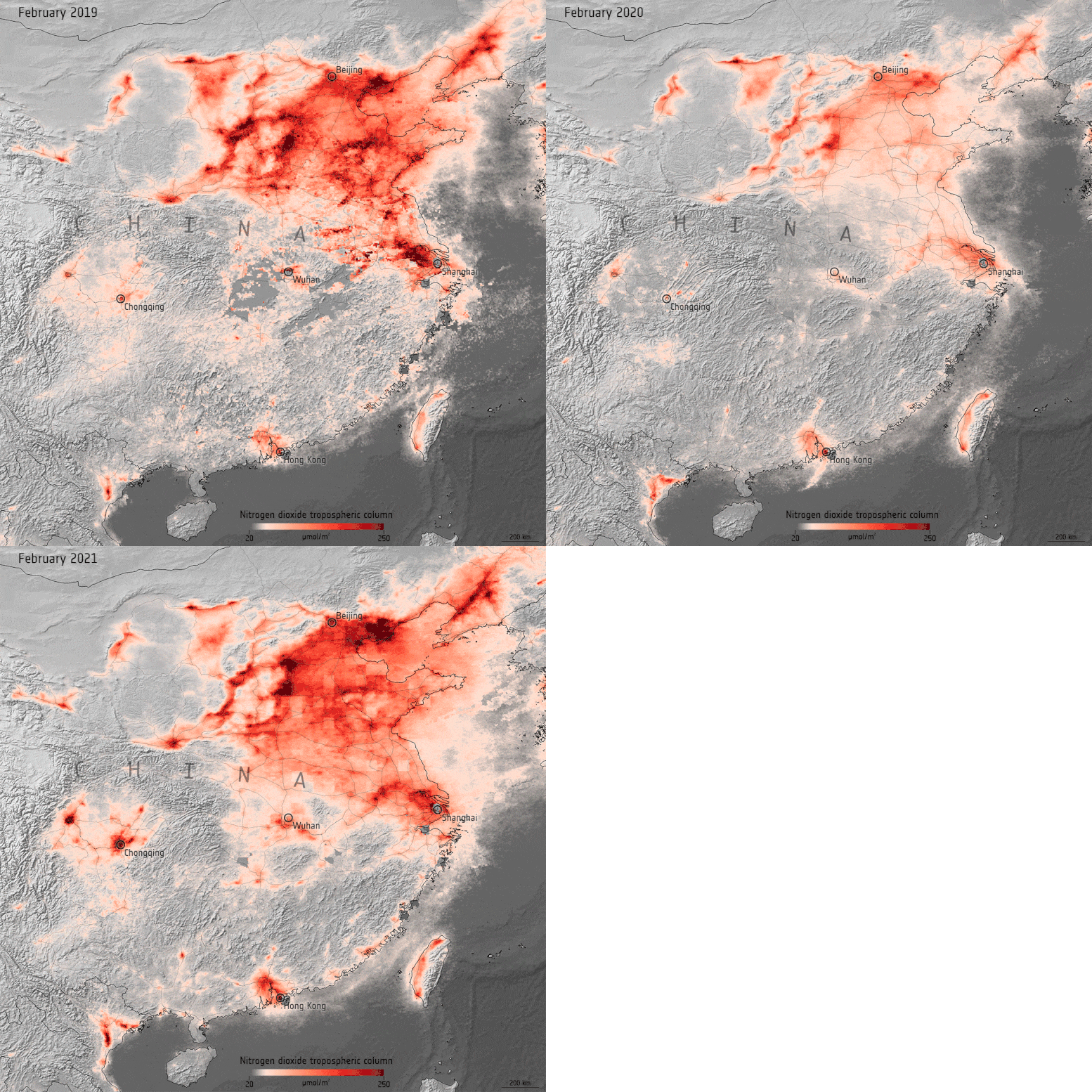
    This animation uses data from the Copernicus Sentinel-5P satellite to show the monthly average nitrogen dioxide concentrations over China in February 2019, February 2020, and February 2021. Credit: Contains modified Copernicus Sentinel data (2019-21), processed by ESA, CC BY-SA 3.0 IGO

    Pollution dropped during lockdowns—now it’s back, as satellites track rising nitrogen dioxide levels with human activity.

    In early 2020, data from satellites were used to show a decline in air pollution coinciding with nationwide lockdowns put in place to stop the spread of COVID-19. One year later, as lockdown restrictions loosen in some countries and regular activity resumes, nitrogen dioxide levels are bouncing back to pre-COVID levels.

    On January 23, 2020, the world saw the first coronavirus lockdown come into force in Wuhan, China in an effort to stop the spread of the illness. This lockdown set the precedent for similar measures in other cities across the country, putting a halt to daily activities including industry and traffic. Factories and other industries were shut down and people were confined to their homes. Similar measures were then put in place worldwide in the following weeks and months.

    As a result, a significant reduction in air pollutants across China was detected by satellites. This included reduced emissions of nitrogen dioxide – a gas that pollutes the air mainly as a result of traffic and the combustion of fossil fuel in industrial processes.

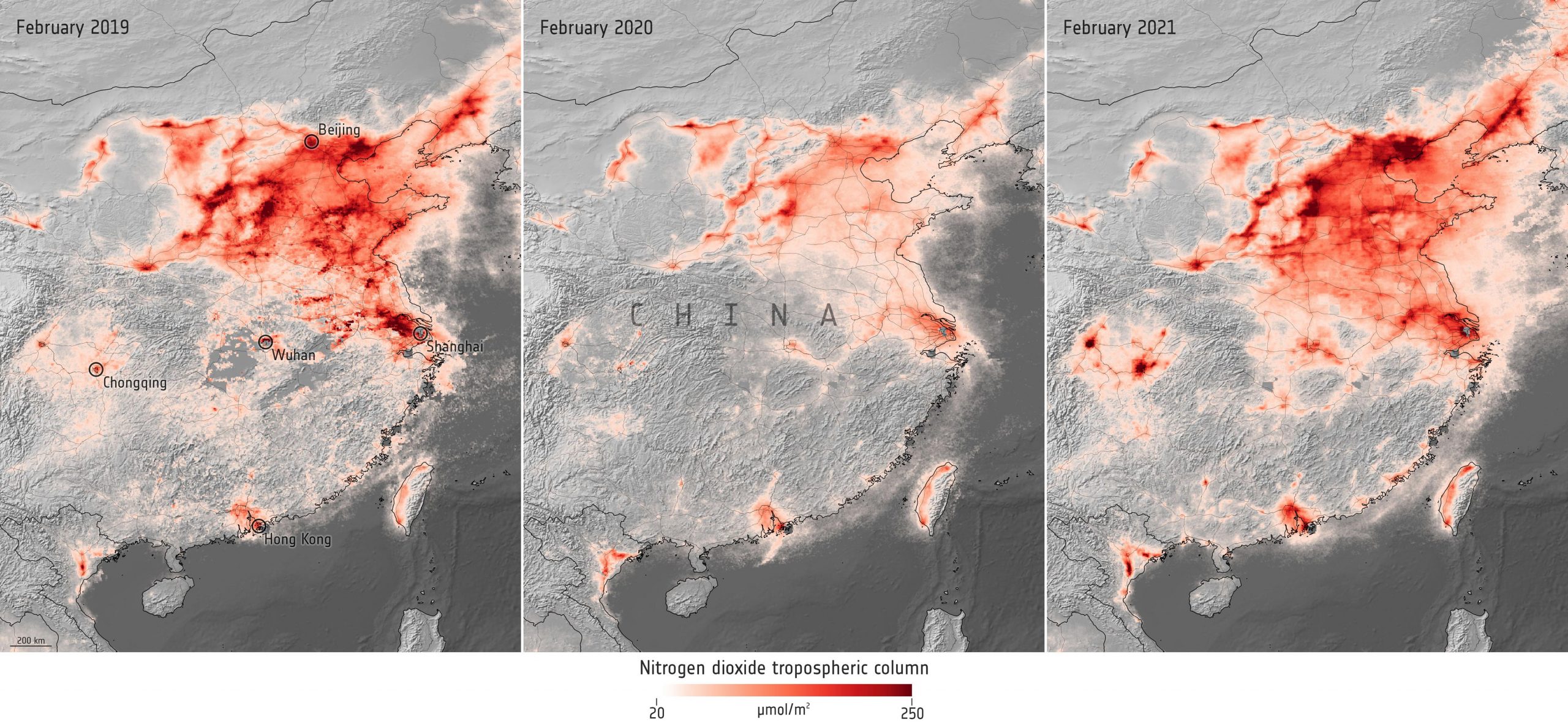
    Now, more than one year later, as restrictions have eased, the average level of air pollutants has rebounded and is on the rise again. The maps below show the monthly average concentrations of nitrogen dioxide, derived from data from the Copernicus Sentinel-5P satellite, in the central and eastern portions of China in February 2019, February 2020 and February 2021. The map shows the fluctuation in levels between the three periods, with dark red indicating high concentrations of nitrogen dioxide.
    Nitrogen Dioxide Concentrations Over China
    Nitrogen dioxide concentrations over China. These images, using data from the Copernicus Sentinel-5P satellite, show the monthly average nitrogen dioxide concentrations over China in February 2019, February 2020, and February 2021. Credit: Contains modified Copernicus Sentinel data (2019-21), processed by ESA, CC BY-SA 3.0 IGO

    The data indicate that nitrogen dioxide concentrations in Beijing dropped by around 35% between February 2019 and 2020, before returning to similar levels in February 2021. Similarly, in Chongqing, nitrogen dioxide dropped by approximately 45% between February 2019 and February 2020, before returning to almost double pre-COVID numbers.

    Pollution Linked to More Than Just Human Activity

    Claus Zehner, ESA’s Copernicus Sentinel-5P mission manager, says, “We expected air pollution to rebound as lockdowns are lifted across the globe. Nitrogen dioxide concentrations in our atmosphere do not depend on human activity alone. Weather conditions such as wind speed and cloud cover also affect those levels, however a large quantity of these reductions are due to restrictions being eased. In the coming weeks and months, we expect increases of nitrogen dioxide concentrations also over Europe.”

    These data are thanks to the Tropomi instrument on board the Copernicus Sentinel-5P satellite – the first Copernicus mission dedicated to monitoring our atmosphere.

    Claus continues, “The special features of the Copernicus Sentinel-5P satellite, with its high spatial resolution and accurate ability to observe trace gases compared to other atmospheric satellite missions, allows us to generate these unique nitrogen dioxide concentration measurement maps from space.”

    Beyond NO₂: Tracking a Host of Harmful Gases

    The satellite carries the Tropomi instrument to map a multitude of trace gases such as nitrogen dioxide, ozone, formaldehyde, sulfur dioxide, methane, carbon monoxide and aerosols – all of which affect the air we breathe and therefore our health, and our climate.

    Never miss a breakthrough: Join the SciTechDaily newsletter.
    Follow us on Google and Google News.

    COVID-19 Environment European Space Agency Pollution Popular
    Share. Facebook Twitter Pinterest LinkedIn Email Reddit

    Related Articles

    COVID-19’s Remarkable Changes to the Environment Seen From Space [Video]

    NASA Satellite Captures a Dimming China Due to COVID-19 Shutdown

    Satellite Captures Stunning Drop in Pollution Across Europe From COVID-19 Lockdown

    Shocking Video Shows Dramatic Nitrogen Dioxide Drop Over China Due to COVID-19 Lockdown

    Jaw-Dropping Video Shows Nitrogen Dioxide Emissions Drop Over Italy Due to Coronavirus

    Aerosol Spread From Ferocious Australian Fires [Video]

    Polystyrene, a Common Plastic, Degrades Much Faster Than Expected in Sunlight

    Global Warming Impacts Lake Water

    Study Reports Air Pollution Causes Thousands of Premature Deaths Each Year

    1 Comment

    1. Jackson J on April 10, 2021 8:03 pm

      Hopefully China can find a way to cut down on pollution levels consistently. If they are able to implement renewable and/or clean energy sources while keeping up production, that would make a massive difference on the environment for all of East Asia.

      Reply
    Leave A Reply Cancel Reply

    • Facebook
    • Twitter
    • Pinterest
    • YouTube

    Don't Miss a Discovery

    Subscribe for the Latest in Science & Tech!

    Trending News

    Scientists Uncover Potential Brain Risks of Popular Fish Oil Supplements

    Scientists Discover a Surprising Way To Make Bread Healthier and More Nutritious

    After 60 Years, Scientists Uncover Unexpected Brain Effects of Popular Diabetes Drug Metformin

    New Research Uncovers Hidden Side Effects of Popular Weight-Loss Drugs

    Scientists Rethink Extreme Warming After Surprising Ocean Discovery

    Landmark Study Links Never Marrying to Significantly Higher Cancer Risk

    Researchers Discover Unknown Beetle Species Just Steps From Their Lab

    Largest-Ever Study Finds Medicinal Cannabis Ineffective for Anxiety, Depression, PTSD

    Follow SciTechDaily
    • Facebook
    • Twitter
    • YouTube
    • Pinterest
    • Newsletter
    • RSS
    SciTech News
    • Biology News
    • Chemistry News
    • Earth News
    • Health News
    • Physics News
    • Science News
    • Space News
    • Technology News
    Recent Posts
    • Students Build Dark Matter Detector and Set New Experimental Limits
    • Scientists Discover Caffeine Can Repair Key Memory Circuits After Sleep Loss
    • Strange 65-Foot Dinosaur Discovered in Argentina
    • Researchers Uncover Source of Strange Deformation in Earth’s Largest Continental Rift
    • Scientists Solve Mystery of Where the Colorado River Vanished Millions of Years Ago
    Copyright © 1998 - 2026 SciTechDaily. All Rights Reserved.
    • Science News
    • About
    • Contact
    • Editorial Board
    • Privacy Policy
    • Terms of Use

    Type above and press Enter to search. Press Esc to cancel.