
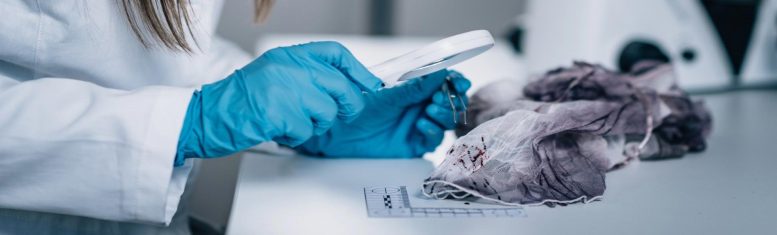
Breakthrough forensic research at Northumbria University, Newcastle, has revealed for the first time that textile fibers can, under certain circumstances, be transferred between clothing in the absence of contact.
This new forensic discovery has not been demonstrated before and could have a major implication for fiber evidence in certain criminal cases.
Researchers within Northumbria University’s Department of Applied Sciences have proved that contactless transfer of fibers between garments can be possible through airborne travel.
Because it has largely been assumed that fiber transfer only occurs when two surfaces touch, it is generally accepted in a case that two surfaces have, at some point, been in contact with each other. However, researchers at Northumbria University have revealed that under certain conditions, this is not necessarily always the case.
Dr. Kelly Sheridan, who led the research at Northumbria University, said: “Our experiment was simple but efficient. We used fluorescently tagged fibers to track their airborne transfer between clothing. Everyday tagged clothes – jumpers, long-sleeved tops and fleeces — were worn by two people who stood in opposite corners of an elevator.
“The elevator operated as normal and non-participants of the study entered and exited as usual. Following the experiment, the surfaces of the recipient’s clothing were photographed using UV-imagery techniques to determine the number of fibers that were transferred from one person to the other.
“The results of the study were remarkable. It not only proved that textile fibers can transfer between garments in the absence of contact, but they can do so in relatively high numbers.”
In this study, the potential of fiber transfer between different items of sheddable clothing through airborne travel has been assessed for small, compact, and semi-enclosed spaces, such as elevators.
The results of this study demonstrate that when certain strict conditions are met (i.e. time, sheddability of garment, proximity, and confined space), airborne transfer of fibers can occur in forensic scenarios, and that these could be in potentially significant numbers for fiber types, such as cotton and polyester.
The results of this study define a set of circumstances that can be used as a ‘baseline’ to evaluate the likelihood of an alleged activity being conducive to contactless transfer.
Textile fibers are one of the forensic sciences’ fundamental evidence types and have been pivotal in solving some of the UK’s most notorious crimes; for example, the murders of Stephen Lawrence and Joanna Yeates, as well as the Ipswich serial killings.
Establishing textile fiber links, however, is only half the battle, according to fellow Northumbria researcher, and co-author on the paper, Dr Matteo Gallidabino.
“What is equally, if not more, important, is how that fiber was transferred from one surface to another,” he said. “This research shows that airborne transfer is viable in a number of case scenarios despite previous beliefs and could explain the presence of fibers on a variety of surfaces.”
Dr. Ray Palmer, a visiting academic and former senior lecturer in forensics at Northumbria University and co-author on this research paper, has given evidence at numerous high-profile trials, including that of the so-called Suffolk Strangler in England and the Claremont serial killings in Western Australia.
He said: “This study was designed so that the experimental parameters were as conducive to contactless transfer as possible, whilst still maintaining a real-life scenario.
“Since there is a paucity of published studies relating to contactless transfer, the results obtained from this study will be useful to forensic practitioners as a ’baseline,’ in evaluating how likely it is that a proposed activity or case circumstance has resulted in contactless transfer.”
Reference: “A study on contactless airborne transfer of textile fibres between different garments in small compact semi-enclosed spaces” by Kelly J. Sheridan, Evelina Saltupyte, Ray Palmer and Matteo D. Gallidabino, 14 August 2020, Forensic Science International.
DOI: 10.1016/j.forsciint.2020.110432
Never miss a breakthrough: Join the SciTechDaily newsletter.
Follow us on Google and Google News.
1 Comment
The “not guilty” headline is somewhat misleading, however the research done by the team at Northumbria Uni is excellent. http://www.ForensicFibreExpert.com