
Columbia engineers have built a new AI that shatters a long-held belief in forensics–that fingerprints from different fingers of the same person are unique. It turns out they are similar, only we’ve been comparing fingerprints the wrong way!
From “Law and Order” to “CSI,” not to mention real life, investigators have used fingerprints as the gold standard for linking criminals to a crime. But if a perpetrator leaves prints from different fingers in two different crime scenes, these scenes are very difficult to link, and the trace can go cold.
It’s a well-accepted fact in the forensics community that fingerprints of different fingers of the same person — ”intra-person fingerprints” — are unique, and therefore unmatchable.
Research led by Columbia Engineering undergraduate
A team led by Columbia Engineering undergraduate senior Gabe Guo challenged this widely held presumption. Guo, who had no prior knowledge of forensics, found a public U.S. government database of some 60,000 fingerprints and fed them in pairs into an artificial intelligence-based system known as a deep contrastive network. Sometimes the pairs belonged to the same person (but different fingers), and sometimes they belonged to different people.
AI has potential to greatly improve forensic accuracy
Over time, the AI system, which the team designed by modifying a state-of-the-art framework, got better at telling when seemingly unique fingerprints belonged to the same person and when they didn’t. The accuracy for a single pair reached 77%. When multiple pairs were presented, the accuracy shot significantly higher, potentially increasing current forensic efficiency by more than tenfold. The project, a collaboration between Hod Lipson’s Creative Machines lab at Columbia Engineering and Wenyao Xu’s Embedded Sensors and Computing lab at University at Buffalo, SUNY, was published today in Science Advances.
Study findings challenge–and surprise–forensics community
Once the team verified their results, they quickly sent the findings to a well-established forensics journal, only to receive a rejection a few months later. The anonymous expert reviewer and editor concluded that “It is well known that every fingerprint is unique,” and therefore it would not be possible to detect similarities even if the fingerprints came from the same person.
The team did not give up. They doubled down on the lead, fed their AI system even more data, and the system kept improving. Aware of the forensics community’s skepticism, the team opted to submit their manuscript to a more general audience. The paper was rejected again, but Lipson, who is the James and Sally Scapa Professor of Innovation in the Department of Mechanical Engineering and co-director of the Makerspace Facility, appealed. “I don’t normally argue editorial decisions, but this finding was too important to ignore,” he said. “If this information tips the balance, then I imagine that cold cases could be revived, and even that innocent people could be acquitted.”
While the system’s accuracy is not sufficient to officially decide a case, it can help prioritize leads in ambiguous situations. After more back and forth, the paper was finally accepted for publication by Science Advances.
Unveiled: a new kind of forensic marker to precisely capture fingerprints
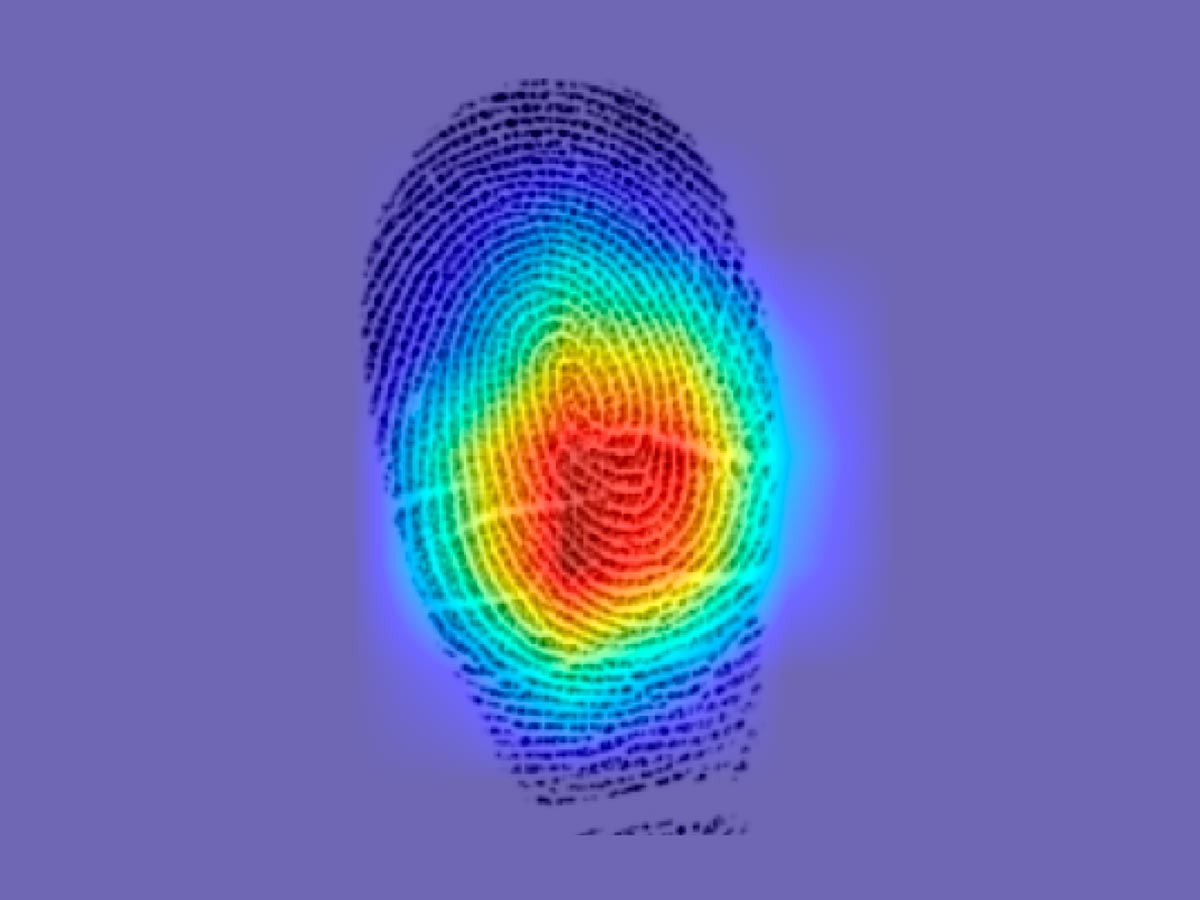
One of the sticking points was the following question: What alternative information was the AI actually using that has evaded decades of forensic analysis? After careful visualizations of the AI system’s decision process, the team concluded that the AI was using a new kind of forensic marker.
“The AI was not using ‘minutiae,’ which are the branchings and endpoints in fingerprint ridges – the patterns used in traditional fingerprint comparison,” said Guo, who began the study as a first-year student at Columbia Engineering in 2021. “Instead, it was using something else, related to the angles and curvatures of the swirls and loops in the center of the fingerprint.”
Columbia Engineering senior Aniv Ray and PhD student Judah Goldfeder, who helped analyze the data, noted that their results are just the beginning. “Just imagine how well this will perform once it’s trained on millions, instead of thousands of fingerprints,” said Ray.
A need for broader datasets
The team is aware of potential biases in the data. The authors present evidence that indicates that the AI performs similarly across genders and races, where samples were available. However, they note, more careful validation needs to be done using datasets with broader coverage if this technique is to be used in practice.
Transformative potential of AI in a well-established field
This discovery is an example of more surprising things to come from AI, notes Lipson. “Many people think that AI cannot really make new discoveries–that it just regurgitates knowledge,” he said. “But this research is an example of how even a fairly simple AI, given a fairly plain dataset that the research community has had lying around for years, can provide insights that have eluded experts for decades.”
He added, “Even more exciting is the fact that an undergraduate student, with no background in forensics whatsoever, can use AI to successfully challenge a widely held belief of an entire field. We are about to experience an explosion of AI-led scientific discovery by non-experts, and the expert community, including academia, needs to get ready.”
Reference: “Unveiling intra-person fingerprint similarity via deep contrastive learning” by Gabe Guo, Aniv Ray, Miles Izydorczak, Judah Goldfeder, Hod Lipson and Wenyao Xu, 12 January 2024, Science Advances.
DOI: 10.1126/sciadv.adi0329
Never miss a breakthrough: Join the SciTechDaily newsletter.
Follow us on Google and Google News.