
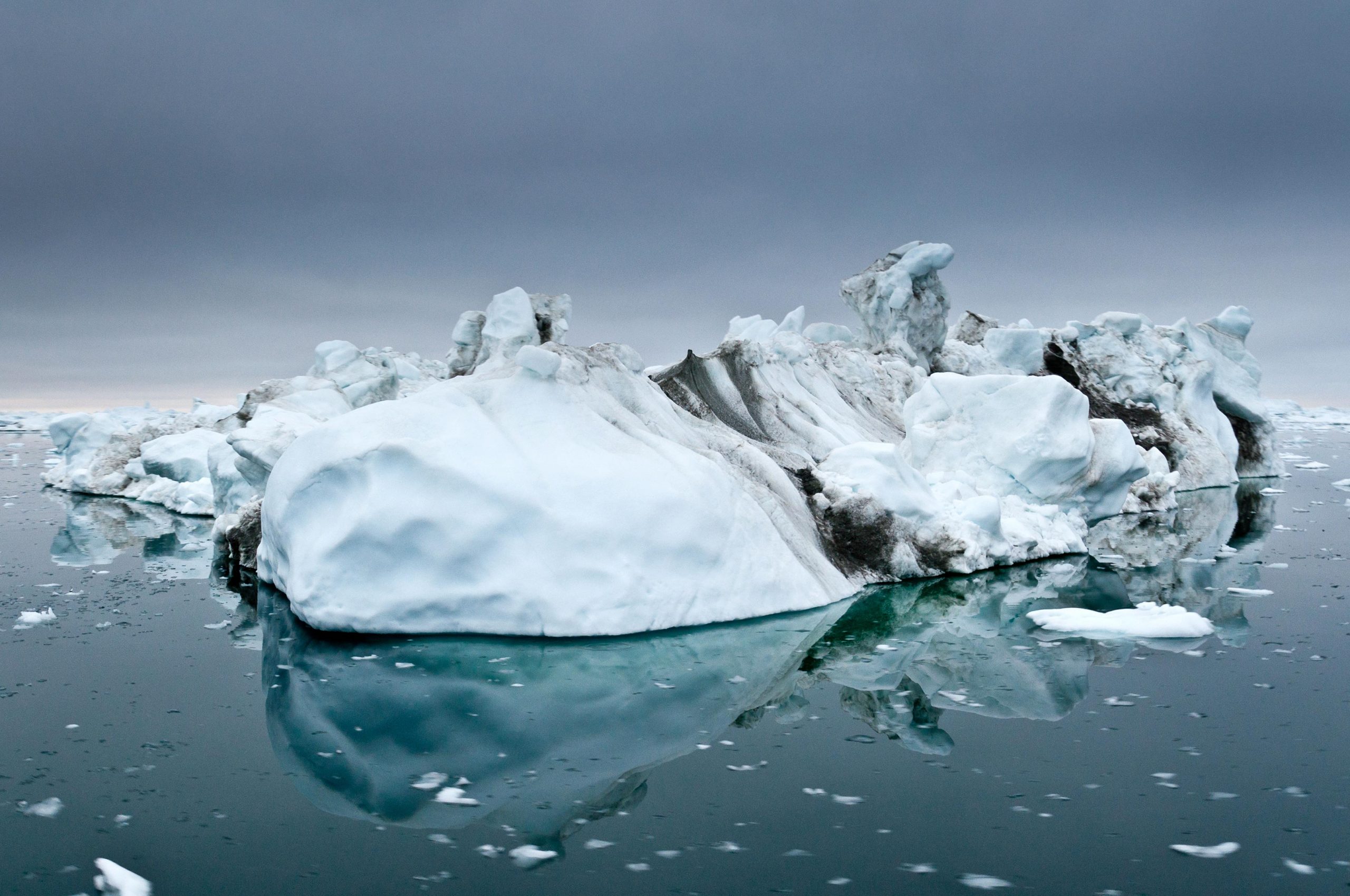
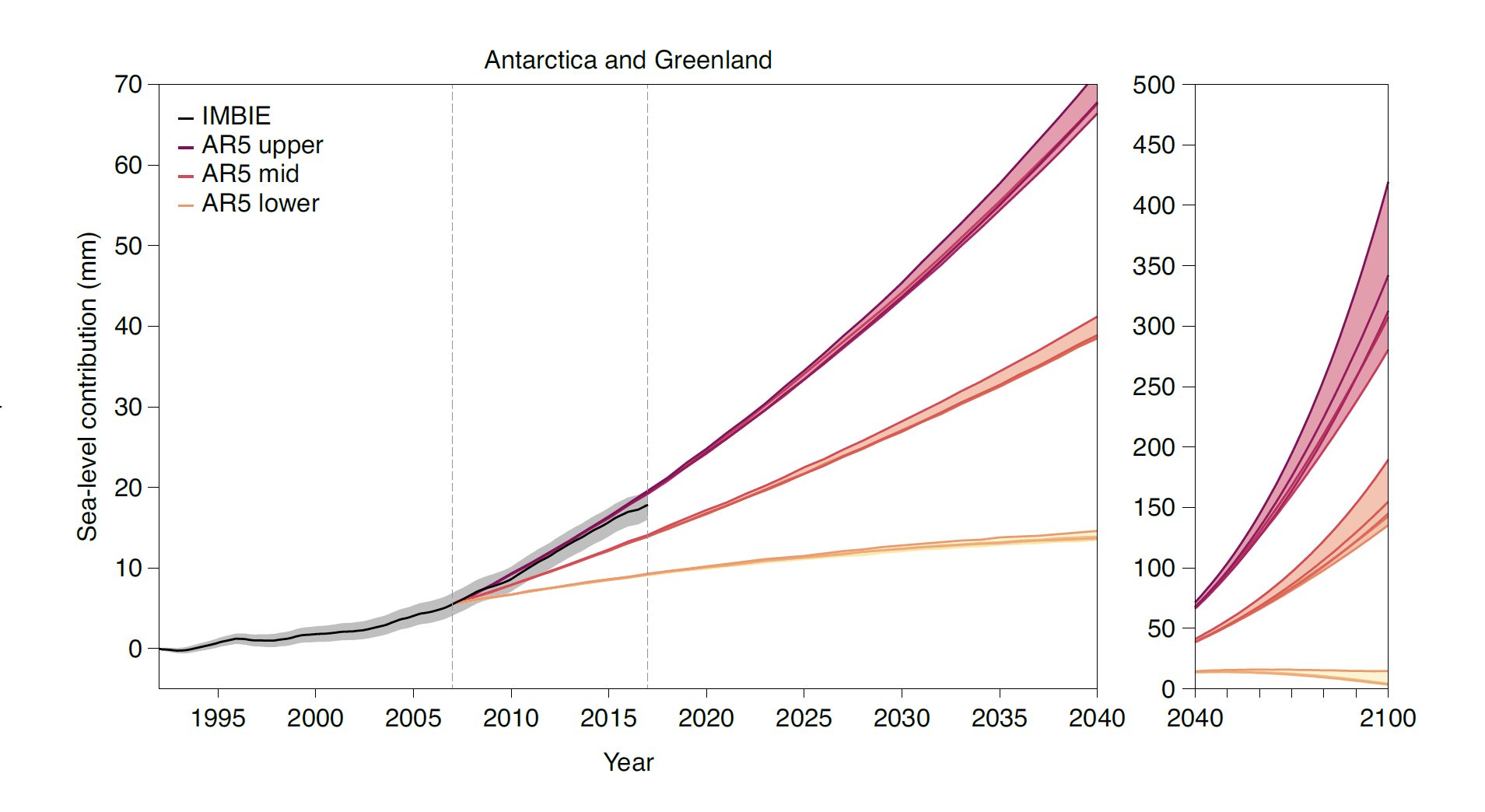
A recent report confirms that ice sheets in Greenland and Antarctica, whose mass-loss rates have been rapidly increasing, are matching the Intergovernmental Panel on Climate Change’s worst-case sea-level rise scenarios.
The study, published in Nature Climate Change, compares ice-sheet mass-balance results from satellite observations with projections from climate models. The results come from an international team of scientists from the University of Leeds (UK) and the Danish Meteorological Institute (DMI), who are also part of the ongoing Ice Sheet Mass Balance Inter-comparison Exercise (IMBIE).
IMBIE is an international collaboration between scientists, established in 2011 as a community effort to reduce uncertainties in different satellite-based measurements of ice sheet mass balance, and is co-funded by ESA and NASA.
Since the systematic monitoring of ice sheets began in the early 1990s, Greenland and Antarctica combined lost 6.4 trillion tonnes of ice between 1992 and 2017 – pushing global sea levels up by 17.8 millimeters. If these rates continue, ice sheets are expected to raise sea levels by a further 17 cm (6.7 in) – exposing an additional 16 million people to annual coastal flooding by the end of the century.
Tom Slater, lead author of the study and climate researcher at the Centre for Polar Observation and Modelling at the University of Leeds, comments, “Satellites are our only means of routinely monitoring these vast and remote areas, so they are absolutely critical in providing measurements which we can use to validate ice sheet models.
“Satellite observations not only tell us how much ice is being lost, they also help us to identify and understand which parts of Antarctica and Greenland are losing ice and through what processes – both are key in helping us improve ice sheet models.”
IMBIE uses data from various satellite missions – including ESA’s ERS-1, ERS-2, Envisat, and CryoSat missions, as well as the EU’s Copernicus Sentinel-1 mission – to monitor changes in the ice sheet’s volume, flow, and mass.
Ruth Mottram, co-author of the study and Climate Scientist at DMI, adds, “Data from ESA satellite missions have underpinned many advances in our understanding of ice sheet behavior over the past three decades. ESA’s family of satellite radar altimeters: ERS-1, ERS-2, Envisat and CryoSat have provided a long-term continuous record of ice sheet changes since the early 1990s.”
ESA’s Marcus Engdahl adds, “Satellite observations are showing us that the ice sheets are reacting surprisingly rapidly to environmental change. It is vital that scientists have access to data from future satellite missions that can observe polar areas, for example, the next high priority Copernicus candidate missions CRISTAL, ROSE-L, and CIMR.”
Reference: “Ice-sheet losses track high-end sea-level rise projections” by Thomas Slater, Anna E. Hogg and Ruth Mottram, 31 August 2020, Nature Climate Change.
DOI: 10.1038/s41558-020-0893-y
IMBIE is supported by ESA’s EO Science for Society program and ESA’s Climate Change Initiative, which generates accurate and long-term satellite-derived datasets for 21 Essential Climate Variables, to characterise the evolution of the Earth system.
Never miss a breakthrough: Join the SciTechDaily newsletter.
Follow us on Google and Google News.
5 Comments
if they melt soi fast at current temps ,just imagine how fast they melted 1000 trs ago when it was 40-50 degrees warmer
Greenland melt started 3 weeks late and started building 3 weeks early this year. The arctic ice started building mass 3 weeks early. This is according to Danish Meteorological Institute.
The Antarctic the last time I checked a week ago was 233000km above the 30 year trend. This is according to NISDC
Haha whats the concern, this ice got there somehow. Water levels had to be higher, goofnuts. Get used to the earth being a living organism.
I am now 83 years old and have been hearing such predictions since I was a boy Still no real sign of flooding from melting ice.
I think Republicans will continue to buy the line that non of this is real or a threat until Miami Beach is underwater. It’s already under contant high-tide flooding so they are building bigger and bigger pumps and planning to raise roads. My prediction of sea level rise is much faster than all of these models. Try melting ice in the sink and watch how the melting accelerates.