

Global ice loss has surged, driven by warming oceans and air, leading to higher sea levels and rapid glacier retreat.
A research team – the first to carry out a survey of global ice loss using satellite data – has discovered that the rate at which ice is disappearing across the planet is speeding up. The findings also reveal that 28 trillion tonnes of ice was lost between 1994 and 2017 – equivalent to a sheet of ice 100 meters (330 feet) thick covering the whole of the UK.
A paper, published in The Cryosphere, describes how a team of researchers led by the University of Leeds in the UK used information from ESA’s ERS, Envisat, and CryoSat satellites as well as the Copernicus Sentinel-1 and Sentinel-2 missions to find that the rate at which Earth has lost ice has increased markedly within the past three decades, from 0.8 trillion tonnes per year in the 1990s to 1.3 trillion tonnes per year by 2017.
To put this into perspective, one trillion tonnes of ice can be thought of as a cube of ice measuring 10x10x10 km, which would be taller than Mount Everest.

The research shows that overall, there has been a 65% increase in the rate of ice loss over the 23-year survey. This has been driven mainly by steep rises in losses from the polar ice sheets in Antarctica and Greenland.
Ice melt from ice sheets and glaciers raises sea levels, increases the risk of flooding in coastal communities, which has severe consequences for society, the economy, and the environment.
Worst-Case Warming Scenarios Becoming Reality
Lead author Thomas Slater, a research fellow at Leeds’ Centre for Polar Observation and Modelling, said, “Although every region we studied lost ice, losses from the Antarctic and Greenland ice sheets have accelerated the most.
“The ice sheets are now following the worst-case climate warming scenarios set out by the Intergovernmental Panel on Climate Change. Sea-level rise on this scale will have very serious impacts on coastal communities this century.”
The study is the first of its kind to examine all the ice that is disappearing on Earth, using satellite observations.
The survey covers 215,000 mountain glaciers spread around the planet, the polar ice sheets in Greenland and Antarctica, the ice shelves floating around Antarctica, and sea ice drifting in the Arctic and Southern Oceans.
Dr. Slater added, “Over the past three decades there’s been a huge international effort to understand what’s happening to individual components in Earth’s ice system. This has been revolutionized by satellites as they allow us to routinely monitor the vast and inhospitable regions where ice can be found.”
The increase in ice loss has been triggered by warming of the atmosphere and oceans, which have warmed by 0.26°C (0.47°F) and 0.12°C (0.22°F) per decade since 1980, respectively.
Disappearing Sea Ice and the Arctic Feedback Loop
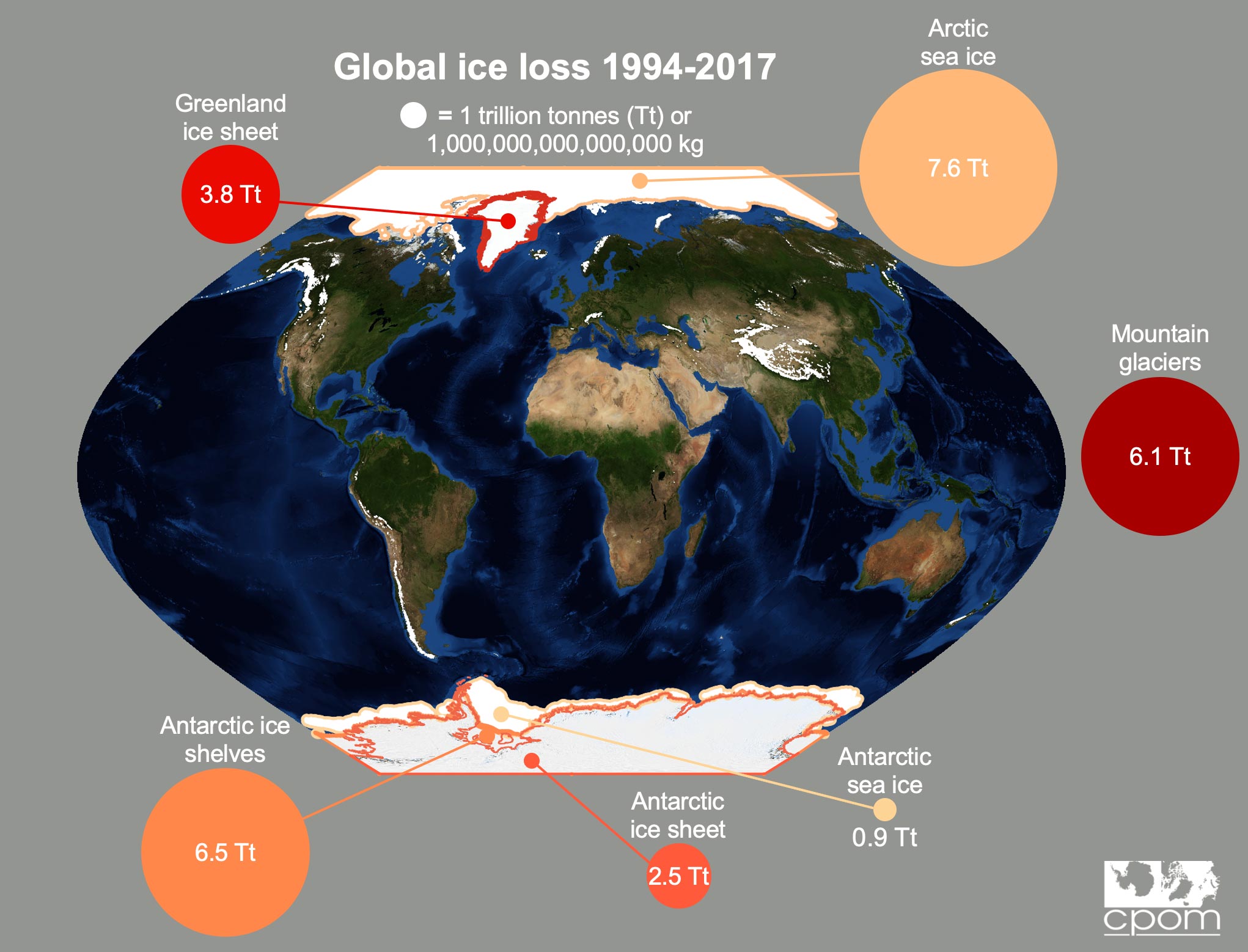
During the survey period, there was a loss of 7.6 trillion tonnes of Arctic sea ice and a loss of 6.5 trillion tonnes from Antarctic ice shelves, both of which float on the polar oceans.
Isobel Lawrence, also a research fellow at the Centre for Polar Observation and Modelling, said, “Sea-ice loss doesn’t contribute directly to sea-level rise, but it does have an indirect influence. One of the key roles of Arctic sea ice is to reflect solar radiation back into space, which helps keep the Arctic cool.
“As the sea ice shrinks, more solar energy is being absorbed by the oceans and atmosphere, causing the Arctic to warm faster than anywhere else on the planet.”
Land Ice Loss and Rising Sea Levels
Half of all losses were from ice on land – including 6.1 trillion tonnes from mountain glaciers, 3.8 trillion tonnes from the Greenland ice sheet, and 2.5 trillion tonnes from the Antarctic ice sheet. These losses have raised global sea levels by 35 millimeters.
It is estimated that for every centimeter of sea-level rise, approximately a million people in low-lying regions are in danger of being displaced.
Despite storing only 1% of Earth’s total ice volume, glaciers have contributed to almost a quarter of the global ice losses over the study period, with all glacier regions around the world losing ice.
Report co-author and PhD researcher Inès Otosaka, also from the Centre for Polar Observation and Modelling, said, “As well as contributing to global mean sea-level rise, mountain glaciers are also critical as a freshwater resource for local communities.
“The retreat of glaciers around the world is therefore of crucial importance at both local and global scales.”
Satellites Key to Climate Monitoring Future
ESA’s Mark Drinkwater added, “The tap to the vast global icy reservoir has been well and truly opened by global warming. Continuity in satellite data is the key to predicting future ice losses, and to assist in mitigating the threats posed by sea-level rise, shrinking high mountain glaciers, and further climate feedbacks. The Copernicus Expansion missions, CRISTAL, CIMR, and ROSE-L have been designed to fill the gaps in current Sentinel capabilities for comprehensive monitoring of changes in the global ice cover.”
Read more about this study: Ice Is Disappearing Across the Planet at Record Rate.
Reference: “Earth’s ice imbalance” by Thomas Slater, Isobel R. Lawrence, Inès N. Otosaka, Andrew Shepherd, Noel Gourmelen, Livia Jakob, Paul Tepes, Lin Gilbert and Peter Nienow, 25 January 2021, The Cryosphere.
DOI: 10.5194/tc-15-233-2021
Never miss a breakthrough: Join the SciTechDaily newsletter.
Follow us on Google and Google News.
4 Comments
“One of the key roles of Arctic sea ice is to reflect solar radiation back into space, which helps keep the Arctic cool.”
This editorializing is without citation and cannot be found in the linked research article. What the article DOES say is, “Arctic sea ice loss has been attributed to atmospheric warming driven by anthropogenic CO2 emissions (Meredith et al., 2019; Stroeve and Notz, 2018), which has been enhanced in the Arctic when compared to the mid-latitudes likely due to sea ice loss itself (Dai et al., 2019; Screen and Simmonds, 2010).” There is a significant difference between something playing a “key role,” and “likely due to … sea ice loss …”
As I have previously asserted, the effect of the loss of ice is probably exaggerated. See my argument here:
https://wattsupwiththat.com/2016/09/12/why-albedo-is-the-wrong-measure-of-reflectivity-for-modeling-climate/
Where is Santa Claus going to live now.
Santa Claus will continue to live where he always has — in the minds of children.
Perhaps a more important question is whether we will be under social pressure to start referring to him by a different pronoun.
In the overall scheme of things. This is literally a drop in the ocean. People will hype their papers to get grants. These authors want thirty dump trucks full of burning grant money. You might get it under Biden. just sayin’…..