
Close Menu
    Facebook X (Twitter) Instagram
    SciTechDaily
    • Biology
    • Chemistry
    • Earth
    • Health
    • Physics
    • Science
    • Space
    • Technology
    Facebook X (Twitter) Pinterest YouTube RSS
    SciTechDaily
    Home»Space»NASA Dragonfly Launch Delayed – Revolutionary Mission to Saturn’s Moon Titan
    Space

    NASA Dragonfly Launch Delayed – Revolutionary Mission to Saturn’s Moon Titan

    By NASASeptember 27, 2020No Comments2 Mins Read
    Facebook Twitter Pinterest Telegram LinkedIn WhatsApp Email Reddit
    Share
    Facebook Twitter LinkedIn Pinterest Telegram Email Reddit
    NASA Dragonfly Rotorcraft
    Dragonfly is a rotorcraft lander mission – part of NASA’s New Frontiers Program – designed to take advantage of Titan’s environment to sample materials and determine surface composition in different geologic settings. This revolutionary mission concept includes the capability to explore diverse locations to characterize the habitability of Titan’s environment, to investigate how far prebiotic chemistry has progressed, and even to search for chemical signatures that could indicate water-based and/or hydrocarbon-based life. Credit: Johns Hopkins APL

    Dragonfly is a NASA mission that delivers a rotorcraft to Saturn’s moon Titan to advance our search for the building blocks of life. While Dragonfly was originally scheduled to launch in 2026, NASA has requested the Dragonfly team pursue their alternative launch readiness date in 2027. No changes will be needed to the mission architecture to accommodate this new date, and launching at a later date will not affect Dragonfly’s science return or capabilities once at Titan.

    The decision to pursue the alternative launch date is based on factors external to the Dragonfly project team, including COVID-19’s impact on the Planetary Science Division’s budget.
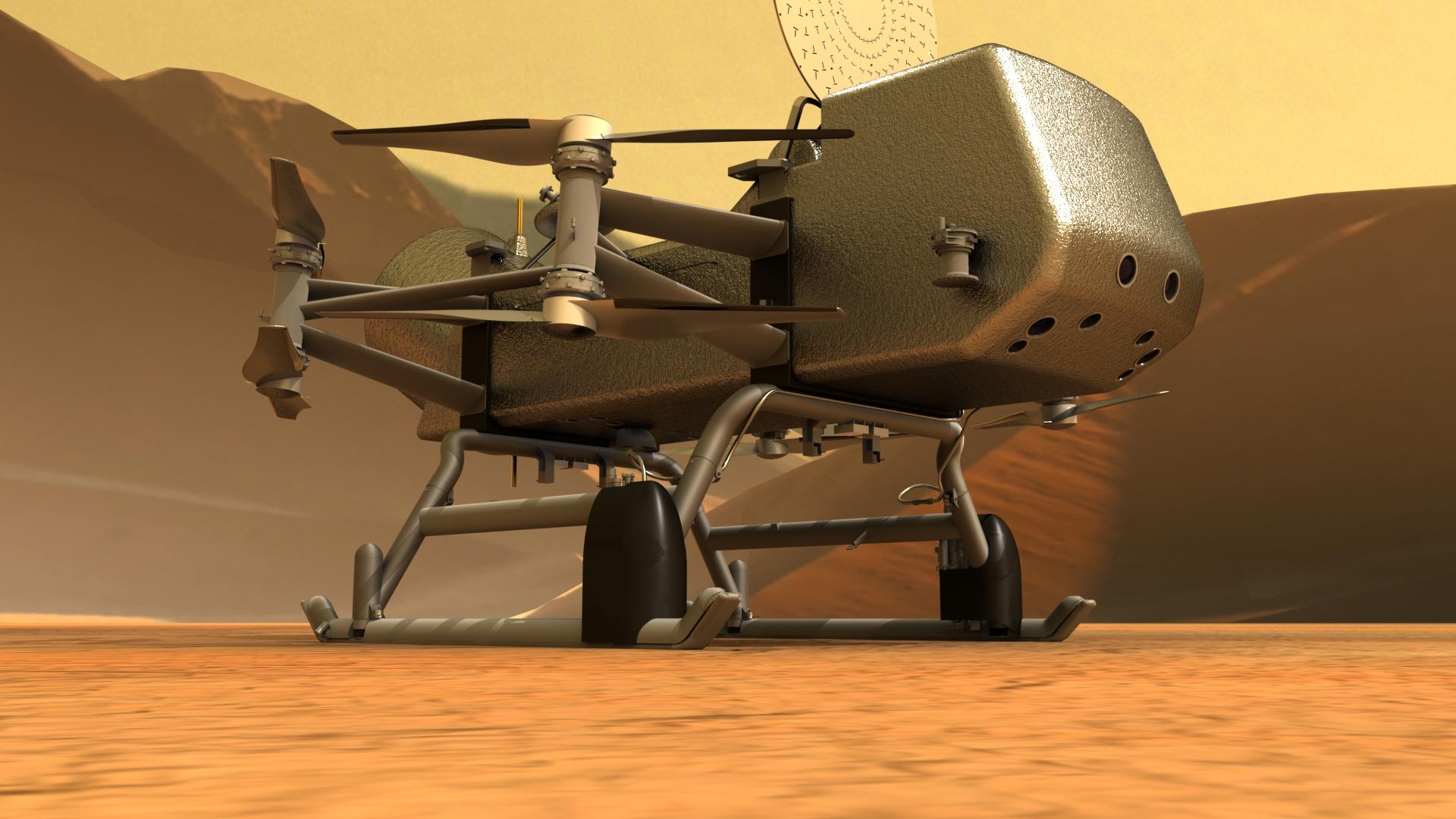
    Dragonfly on Titan's Surface
    Artist’s Impression of Dragonfly on Titan’s surface. Credit: NASA/Johns Hopkins APL

    “NASA has the utmost confidence in the Dragonfly team to deliver a successful mission that conducts compelling science,” said Lori Glaze, Director for the Planetary Science Division at NASA Headquarters in Washington. “Dragonfly will significantly increase our understanding of this richly organic world and help answer key astrobiology questions in our search to understand the processes that supported the development of life on Earth.”

    Dragonfly marks the first time NASA will fly a multi-rotor vehicle for science on another planet. Taking advantage of Titan’s dense atmosphere – four times denser than Earth’s – it will also become the first vehicle ever to fly its entire science payload to multiple locations for repeatable and targeted access to surface materials. By surveying dozens of locations across the icy world, Dragonfly will characterize the habitability of Titan’s environment and investigate the progression of its prebiotic chemistry.

    https://youtu.be/SB8BpBrLkkk

    Never miss a breakthrough: Join the SciTechDaily newsletter.
    Follow us on Google and Google News.

    Moon NASA NASA Dragonfly Mission Popular Saturn Titan
    Share. Facebook Twitter Pinterest LinkedIn Email Reddit

    Related Articles

    NASA Unveils Possible Building Blocks of Life on Saturn’s Moon Titan

    NASA Confirms Revolutionary Dragonfly Mission To Explore Saturn’s Moon, Titan

    Saturn’s Moon Titan Beckons As NASA’s Dragonfly Mission Achieves Critical Milestone

    NASA Dragonfly Bound for Saturn’s Giant Moon Titan Could Reveal Chemistry Leading to Life

    NASA’s Dragonfly Mission to Saturn’s Moon Titan Announces Big Science Goals

    NASA Is Sending Dragonfly on a Revolutionary Mission to Saturn’s Moon Titan – Here’s Why

    A Closer Look at Titan’s Chemical Production

    Cassini Explores Titan’s Lake, Similarities to Etosha Salt Pan

    Saturn’s Largest Moon Titan Seen in Unprecedented Detail

    Leave A Reply Cancel Reply

    • Facebook
    • Twitter
    • Pinterest
    • YouTube

    Don't Miss a Discovery

    Subscribe for the Latest in Science & Tech!

    Trending News

    Don’t Miss: A Brilliant Venus and Glowing Harvest Moon Light Up the Sky

    New Twist on the Einstein Problem Reveals Unexpected Physics

    JWST Captures Stunning Evidence of How Supermassive Black Holes Feed

    Early Exercise May Permanently Change How Much Energy the Body Uses To Move

    New Molecule Wipes Out Aggressive Lymphoma Tumors in Mice in Just 11 Days

    The Human Family Tree May Need a Major Rewrite

    Scientists Find a Surprising Cancer-Fighting Effect in Dark Sweet Cherries

    New AI Detects Hidden Warning Signs of Solar Eruptions Hours Before They Emerge

    Follow SciTechDaily
    • Facebook
    • Twitter
    • YouTube
    • Pinterest
    • Newsletter
    • RSS
    SciTech News
    • Biology News
    • Chemistry News
    • Earth News
    • Health News
    • Physics News
    • Science News
    • Space News
    • Technology News
    Recent Posts
    • Africa’s Giant Herbivores Were Disappearing Millions of Years Before Humans Could Hunt Them
    • This Utah Mountain Is Hiding Enough Ice To Fill 600 Olympic Pools
    • Vagus Nerve Stimulation Could Unlock the Brain’s Hidden Learning Potential
    • Your Mother’s Age May Leave a Biological Mark That Lasts for Generations
    • Women Who Ate More Antioxidants Had Strikingly Lower Rates of Cervical Cancer
    Copyright © 1998 - 2026 SciTechDaily. All Rights Reserved.
    • Science News
    • About
    • Contact
    • Editorial Board
    • Privacy Policy
    • Terms of Use

    Type above and press Enter to search. Press Esc to cancel.