

Researchers propose that vesicles could form in Titan’s hydrocarbon lakes, hinting at a new pathway for life’s precursors. This expands the possibilities for where life might originate in the solar system.
NASA scientists have found evidence that cell-like structures known as vesicles could naturally develop within the lakes of Saturn’s moon Titan.
Titan stands out as the only place in the solar system, besides Earth, with stable liquid on its surface. These lakes and seas, however, are not composed of water. Instead, they are filled with liquid hydrocarbons, such as ethane and methane.
On Earth, the presence of liquid water is considered a key factor in the emergence of life as we know it. This has led many astrobiologists to question whether Titan’s hydrocarbon-rich environment might also allow the assembly of life’s essential molecules—either for life in a form familiar to us, or in an entirely different form.
How vesicles form in Earth’s environments
A recent NASA study, published in the International Journal of Astrobiology, describes a possible way stable vesicles could develop on Titan, drawing on current knowledge of the moon’s atmospheric and chemical makeup. Creating these enclosed structures is considered a key step toward producing the building blocks of living cells (or protocells).
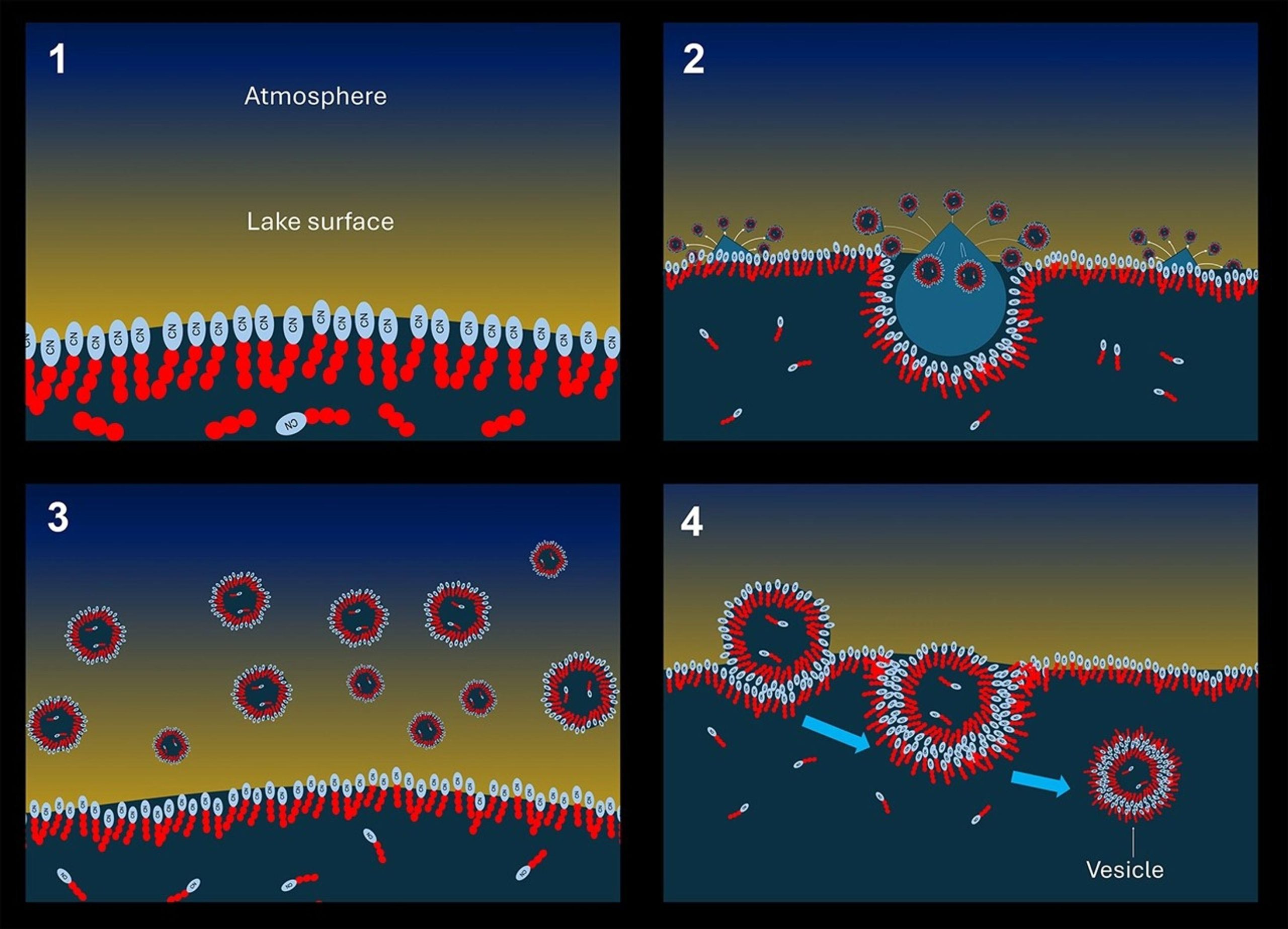
The proposed mechanism centers on molecules known as amphiphiles, which have the ability to spontaneously arrange themselves into vesicles under certain conditions. On Earth, these polar molecules consist of two distinct parts: a hydrophobic (water-repelling) end and a hydrophilic (water-attracting) end. In aqueous environments, they can cluster together into spherical shapes similar to soap bubbles. In these spheres, the hydrophilic ends face outward to interact with the surrounding water, while the hydrophobic ends are shielded inside. Under suitable circumstances, two such layers can align to form a bilayer membrane, creating a cell-like sphere that traps a droplet of water inside.
For Titan, researchers had to adapt this concept to an environment that is drastically different from the conditions on early Earth.
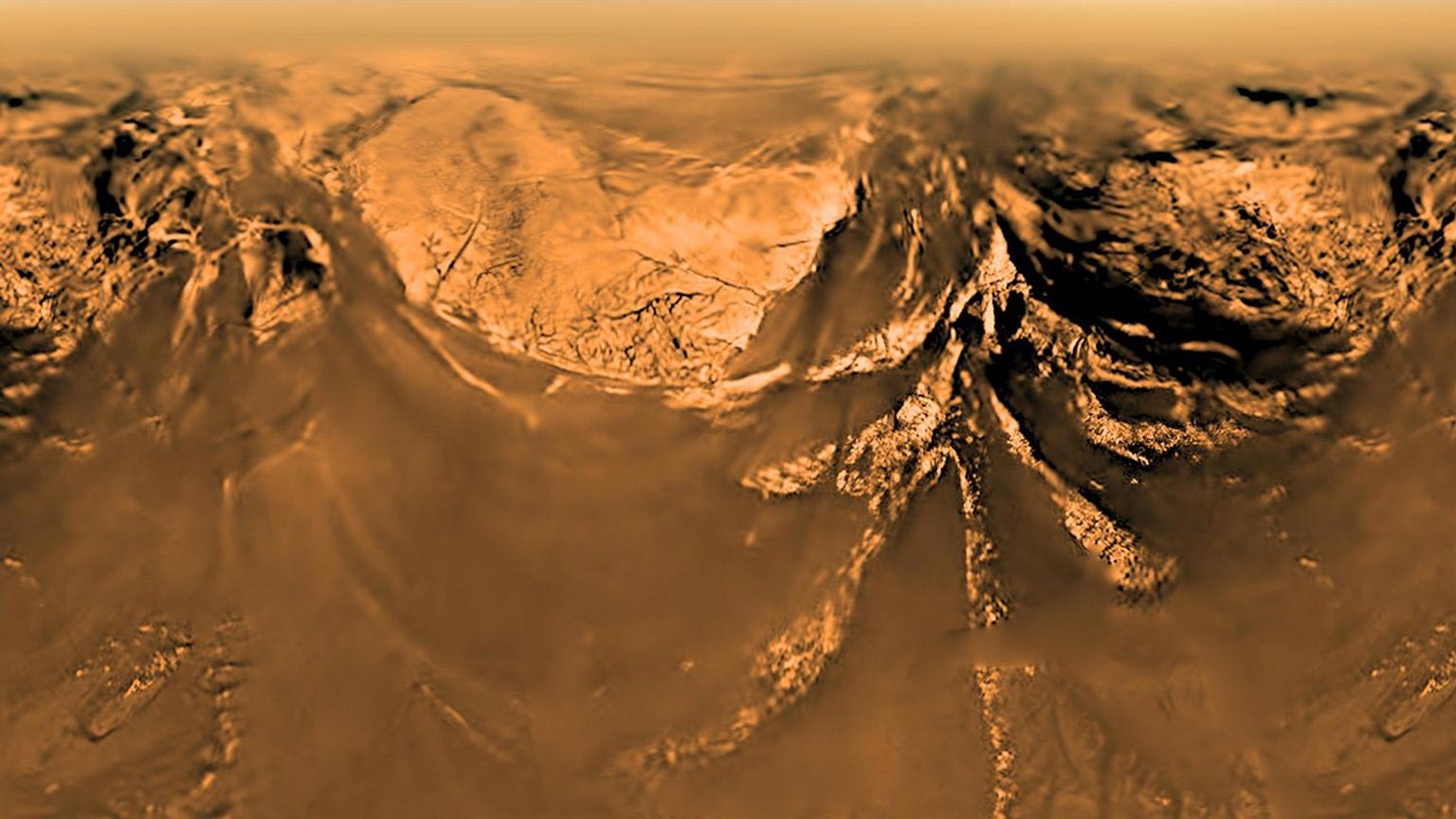
Titan, Saturn’s largest moon and the second-largest in the solar system, is unique in being the only moon with a dense, substantial atmosphere.
For centuries, Titan’s thick, golden haze obscured its surface and kept much about it unknown. This changed in 2004, when NASA’s Cassini spacecraft entered Saturn’s system, dramatically transforming scientific understanding of the moon.
Complex weather and organic chemistry on Titan
Cassini revealed that Titan experiences a dynamic weather system that continues to shape its surface today. The atmosphere is composed primarily of nitrogen, with a notable proportion of methane (CH₄). This methane condenses into clouds and produces rain, which falls to the surface, carving river channels and contributing to erosion before collecting in lakes and seas. Under sunlight, the liquid evaporates back into the atmosphere, forming clouds once more.
This meteorological cycle also drives complex chemical reactions. Solar energy breaks apart molecules such as methane, and the resulting fragments recombine into more intricate organic compounds. Many astrobiologists think these processes may provide valuable insights into how the essential molecules for life originated and developed on the early Earth.
The new study considered how vesicles might form in the freezing conditions of Titan’s hydrocarbon lakes and seas by focusing on sea-spray droplets, thrown upwards by splashing raindrops. On Titan, both spray droplets and the sea surface could be coated in layers of amphiphiles. If a droplet then lands on the surface of a pond, the two layers of amphiphiles meet to form a double-layered (or bilayer) vesicle, enclosing the original droplet. Over time, many of these vesicles would be dispersed throughout the pond and would interact and compete in an evolutionary process that could lead to primitive protocells.
Implications for understanding life’s origins
If the proposed pathway is happening, it would increase our understanding of the conditions in which life might be able to form.
“The existence of any vesicles on Titan would demonstrate an increase in order and complexity, which are conditions necessary for the origin of life,” explains Conor Nixon of NASA’s Goddard Space Flight Center in Greenbelt, Maryland. “We’re excited about these new ideas because they can open up new directions in Titan research and may change how we search for life on Titan in the future.”
NASA’s first mission to Titan is the upcoming Dragonfly rotorcraft, which will explore the surface of the Saturnian moon. While Titan’s lakes and seas are not a destination for Dragonfly (and the mission won’t carry the light-scattering instrument required to detect such vesicles), the mission will fly from location to location to study the moon’s surface composition, make atmospheric and geophysical measurements, and characterize the habitability of Titan’s environment.
Reference: “A proposed mechanism for the formation of protocell-like structures on Titan” by Christian Mayer and Conor A. Nixon, 10 July 2025, International Journal of Astrobiology.
DOI: 10.1017/S1473550425100037
Never miss a breakthrough: Join the SciTechDaily newsletter.
Follow us on Google and Google News.
4 Comments
Your dragon fly mission is going to be incredible 👍
Absolutely stunning discovered. I like to parallel to Earth! Great possibility to lead human to a different level of consciousness. Interested to learn more about new discoveries. Hopeffuly that it brings scientists to become aware about improve health to benefit people on Earth! If, there are an advanced form of life how humans benefited from the beyond form of human!
Sincerely, Earth people are not openning mind to conceptualized another form of communications with aliens
What are habits and living conditions to allow human’s form of international health and others conditions that support life! Uhm!
Whatever, this may lead to some form of Economics exploration! I am pondering about all what it does affect our Ecosystem with these spacecraft pollution and affection on humans health! All things to be considered. I won’t believe this studies lead human evolution other than minded people creation a fiction Planets to take Elite to a supernatural dimension.
I love space and it is amazing love it
Here on Earth the split between biology and geology happened in the deep ocean hydrothermal vents driven by free energy gradients according to phylogenies. [Weiss, M., Sousa, F., Mrnjavac, N. et al. The physiology and habitat of the last universal common ancestor. Nat Microbiol 1, 16116 (2016). https://doi.org/10.1038/nmicrobiol.2016.116%5D
These lakes are unlikely to have much of the necessary thermodynamic gradients.