
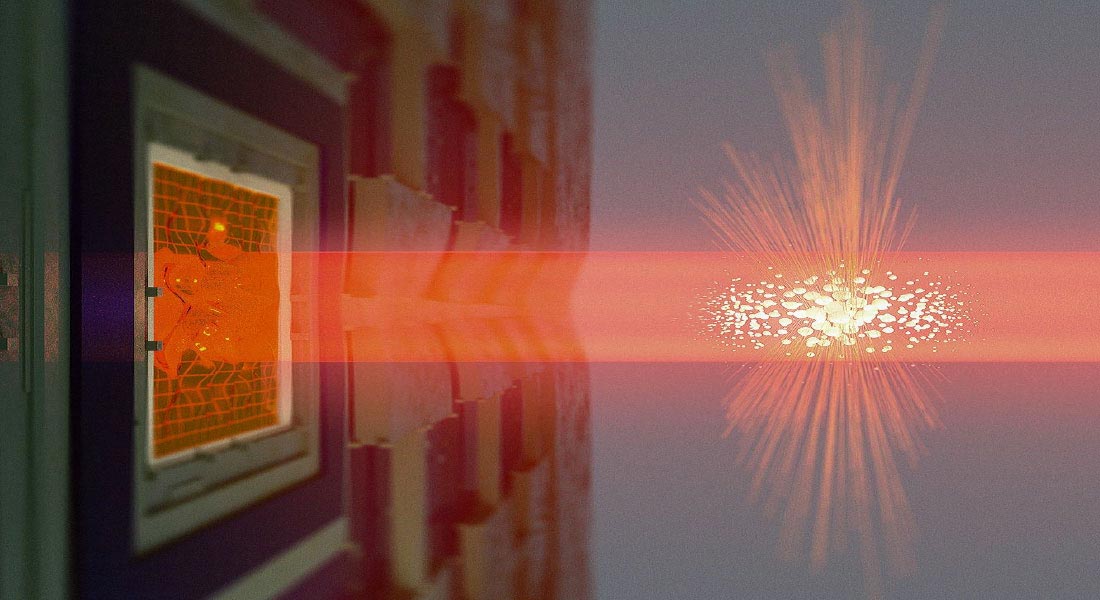
A team of researchers at the Niels Bohr Institute, University of Copenhagen, have succeeded in entangling two very different quantum objects. The result has several potential applications in ultra-precise sensing and quantum communication and is now published in Nature Physics.
Entanglement is the basis for quantum communication and quantum sensing. It can be understood as a quantum link between two objects which makes them behave as a single quantum object.
Now, researchers from the Niels Bohr Institute, University of Copenhagen, have succeeded in making entanglement between two distinctly different and distant objects. One is a mechanical oscillator, a vibrating dielectric membrane, and the other is a cloud of atoms, each acting as a tiny magnet – what physicists call spin. These very different entities have now become possible to entangle by connecting them with photons, particles of light. Atoms can be useful in processing quantum information and the membrane – or mechanical quantum systems in general – can be useful for storage of quantum information.
Professor Eugene Polzik, who led the effort, states that: “With this new technique, we are en route to pushing the boundaries of the possibilities of entanglement. The bigger the objects, the further apart they are, the more disparate they are, and the more interesting entanglement becomes from both fundamental and applied perspectives. With the new result, entanglement between very different objects has become possible.”
What is entanglement and how is it applied?
In order to understand the full reach of the new result, it is important to understand exactly what the concept of entanglement means:
Sticking to the example of spins entangled with a mechanical membrane, imagine the position of the vibrating membrane and the tilt of the total spin of all atoms, akin to a spinning top. If both objects move randomly, but we can observe that both of them move right or left at the same time, we call it a correlation. Such correlated motion is normally limited to the so-called zero-point motion – the residual, uncorrelated motion of all matter that occurs even at absolute zero temperature. This limits our knowledge about any of the systems. In their experiment, Eugene Polzik’s team has entangled the systems, which means that they move in a correlated way with a precision better than the zero-point motion. “Quantum mechanics is like a double-edged sword – it gives us wonderful new technologies, but also limits the precision of measurements which would seem just easy from a classical point of view” – says a team member, Michał Parniak. Entangled systems can remain perfectly correlated even if they are at a distance from each other – a feature that has puzzled researchers from the very birth of quantum mechanics more than 100 years ago.
PhD student Christoffer Østfeldt explains further: “Imagine the different ways of realizing quantum states as a kind of zoo of different realities or situations with very different qualities and potentials. If, for example, we wish to build a device of some sort, in order to exploit the different qualities they all possess and in which they perform different functions and solve a different task, it will be necessary to invent a language they are all able to speak. The quantum states need to be able to communicate, for us to use the full potential of the device. That’s what this entanglement between two elements in the zoo has shown we are now capable of.”
A specific example of perspectives of entangling different quantum objects is quantum sensing. Different objects possess sensitivity to different external forces. For example, mechanical oscillators are used as accelerometers and force sensors, whereas atomic spins are used in magnetometers. When only one of the two different entangled objects is subject to external perturbation, entanglement allows it to be measured with a sensitivity not limited by the object’s zero-point fluctuations.
The outlook for the future applications of the new technique
There is a fairly immediate possibility for application of the technique in sensing both for tiny oscillators and big ones. One of the biggest scientific pieces of news in recent years was the first detection of gravity waves, made by the Laser Interferometer Gravitational-wave Observatory (LIGO). LIGO senses and measures extremely faint waves caused by astronomical events in deep space, such as black hole mergers or neutron star mergers. The waves can be observed because they shake the mirrors of the interferometer. But even LIGO’s sensitivity is limited by quantum mechanics because the mirrors of the laser interferometer are also shaken by the zero-point fluctuations. Those fluctuations lead to noise preventing observation of the tiny motion of the mirrors caused by gravitational waves.
Limitless precision in measurements likely to be achievable
It is, in principle, possible to generate entanglement of the LIGO mirrors with an atomic cloud and thus cancel the zero-point noise of the mirrors in the same way as it does for the membrane noise in the present experiment. The perfect correlation between the mirrors and the atomic spins due to their entanglement can be used in such sensors to virtually erase uncertainty. It simply requires us to take information from one system and apply the knowledge to the other. In such a way, we could learn both about the position and the momentum of LIGO’s mirrors at the same time, entering a so-called quantum-mechanics-free subspace and taking a step towards limitless precision of measurements of motion. A model experiment demonstrating this principle is on the way at Eugene Polzik’s laboratory.
Reference: “Entanglement between distant macroscopic mechanical and spin systems” by Rodrigo A. Thomas, Michał Parniak, Christoffer Østfeldt, Christoffer B. Møller, Christian Bærentsen, Yeghishe Tsaturyan, Albert Schliesser, Jürgen Appel, Emil Zeuthen and Eugene S. Polzik, 21 September 2020, Nature Physics.
DOI: 10.1038/s41567-020-1031-5
Never miss a breakthrough: Join the SciTechDaily newsletter.
Follow us on Google and Google News.
7 Comments
… if a “Schrödinger’s cat” had a entangled electron it could sign that it is alive or in the case of signal absence, one would know that the cat is dead.
I just don’t know how the cat is going to be trained to answer the question. It might get a mobile phone, or some sensor of motion, though.
On the other hand if the cat is x-rayed it would be possible to estimate if a poor thing is alive!…
Yeah, entanglement can not be used in a communication, because it would break the rules relativity has, thus it is not possible to use it in communications. That was some AA answer to the issue. So, this must be a fake news or AA theory is … Oh gush!
… just one question how entanglement works, … sorry, sorry one more and how?
…Quantum Entanglement, a very strange phenomenon!
There is some claim that it is possible to have worm whole from one particle to another one, and for that time some physics law might be broken at those times, around that worm whole.
Interesting claim, though…
I had written a comment about the absurd essay of the cat analogý in
YouTube. I will repeat it :whose ever cat it is,It will be cocksure dead at radiation intensities around 5 Sieverts.
… yeah, that is pretty much true, and … why they don’t leave poor cat out of this stuff, and admit …
Well, it was a big mistake to kill of the God from all of the physics, unlike Albert Einstein Issac Newton had that option for the God’s work. …
Limitless precision … beyond the Planck length?
Quantum Entanglement for dummies: imagine two billiard balls hitting each other dead on and bouncing away. They bounce away at the same speed but opposite directions. If you know the speed of one of them, then you know the speed of the other one, and the same goes for the distance the ball has travelled. This is called “entanglement”; the information of one billiard ball is entangled to the other ball’s information, you can describe one by observing the other.
In Quantum entanglement, you add in the extra detail that when you interact with an entangled particle in any way, you can tell where it is, where it’s headed, which direction it’s spinning, etc. But as soon as you interact with it, you break the entanglement. Since you can’t see a photon or an electron, the only way you know what’s happening to it is to throw something else at it and see how it interacts, which means that it’s no longer entangled afterwards. However, at the point where you measured it, you can bet your butt the other entangled particle will be in exactly the opposite state, at a 100% certainty.
To use this for “limitless precision”, you simply imagine the atomic cloud as being entangled to the “noise” the other instrument has. If you know the noise, you can subtract it from your accelerometer’s reading and now you ONLY have your accelerometer reading, at a 100% precision.