
Close Menu
    Facebook X (Twitter) Instagram
    SciTechDaily
    • Biology
    • Chemistry
    • Earth
    • Health
    • Physics
    • Science
    • Space
    • Technology
    Facebook X (Twitter) Pinterest YouTube RSS
    SciTechDaily
    Home»Science»CERN Timepix Technology Helps Rediscover Lost Painting by the Great Renaissance Master, Raphael
    Science

    CERN Timepix Technology Helps Rediscover Lost Painting by the Great Renaissance Master, Raphael

    By CERNOctober 4, 2020No Comments3 Mins Read
    Facebook Twitter Pinterest Telegram LinkedIn WhatsApp Email Reddit
    Share
    Facebook Twitter LinkedIn Pinterest Telegram Email Reddit
    Raphael Lost Painting
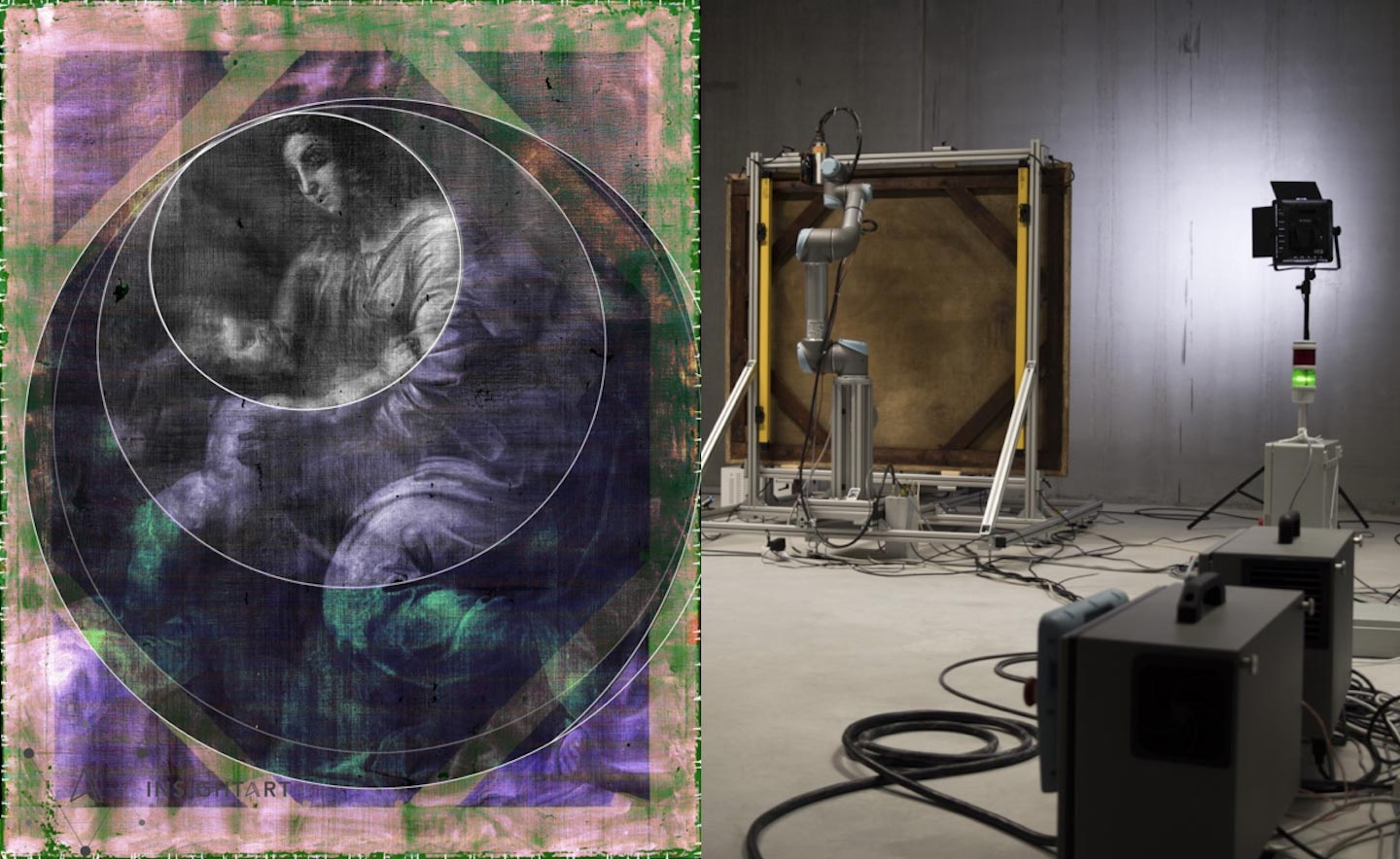
    Left: Graphic combining energy spectra measured by RToo scanner (© InsightART, 2019); Right: RToo scanning the painting Madonna and Child. Credit: © Jiří Lauterkranc, 2019, CERN

    CERN’s Timepix particle detectors, developed by the Medipix2 Collaboration, help unravel the secret of a long-lost painting by the great Renaissance master, Raphael.

    500 years ago, the Italian painter Raphael passed away, leaving behind him many works of art, paintings, frescoes, and engravings. Like his contemporaries Michelangelo and Leonardo da Vinci, Raphael’s work made the joy of imitators and the greed of counterfeiters, who bequeathed us many copies, pastiches, and forgeries of the great master of the Renaissance.

    For a long time, it was thought that The Madonna and Child, a painting on canvas from a private collection, was not created directly by the master himself. Property of Popes and later part of Napoleon’s war treasure, the painting changed hands several times before arriving in Prague during the 1930s. Due to its history and numerous inconclusive examinations, its authenticity was questioned for a long time. It has now been attributed to Raphael by a group of independent experts. One of the technologies that provided them with key information, was a robotic X-ray scanner using CERN-designed chips.
    Timepix3 Chip
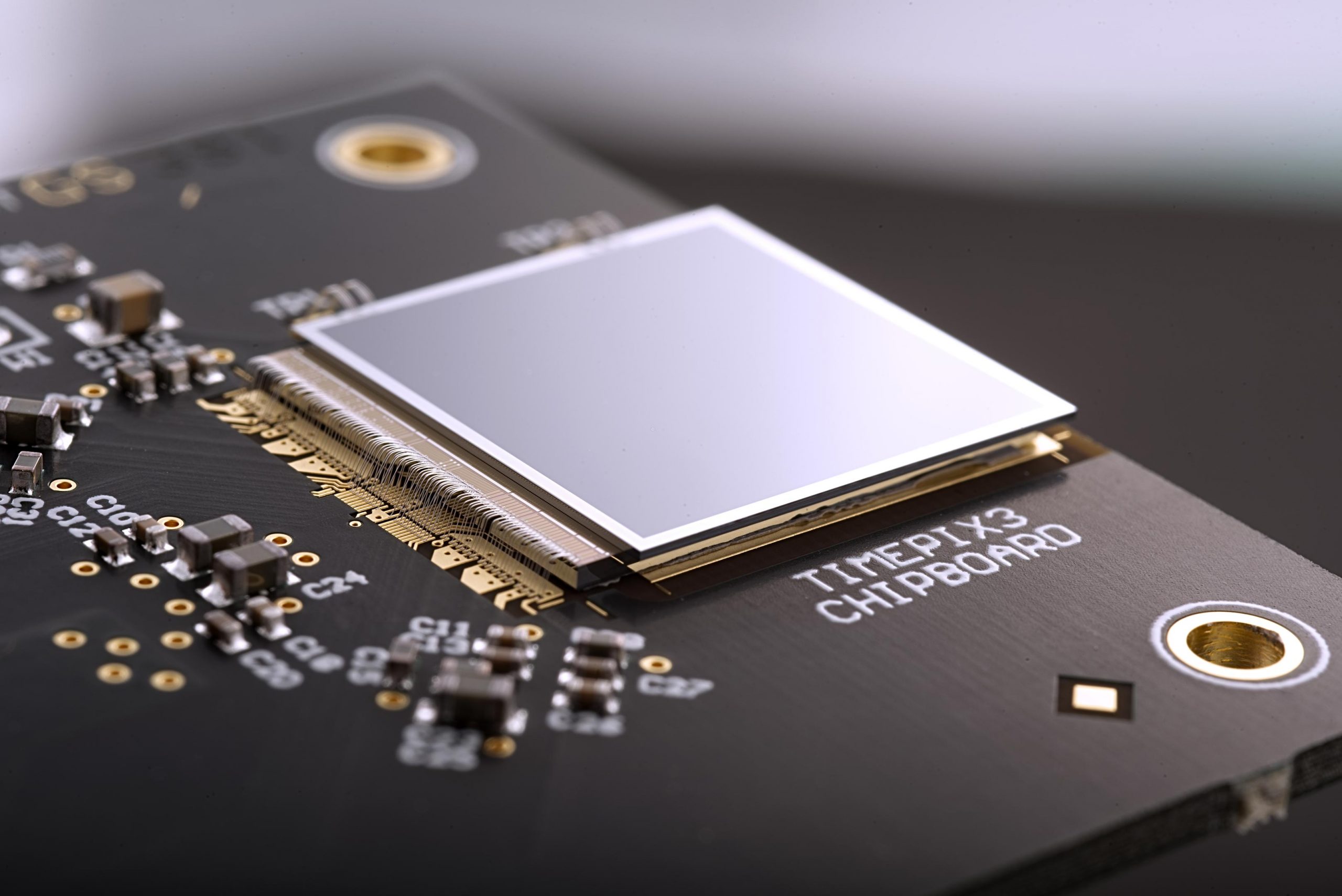
    The Timepix3 chip is a multipurpose hybrid pixel detector developed within the Medipix3 Collaborations, having applications within medical imaging, education, space dosimetry and material analysis. Credit: CERN

    Behind this feat lies InsightART, a Czech start-up, and RToo, its state-of-the-art X-ray scanner. The scanner is composed of an X-ray source, Timepix photon detectors capable of taking spectroscopic X-ray images, and a robotic platform. For three days, InsightART scanned the painting to obtain 11 very high-resolution images taken at different X-ray wavelengths. New high-resolution maps of the elemental composition of the paint were derived and these enabled the experts to get more precise information about the painting.

    Much more flexible and modular than the standard, flat panel systems, RToo is capable of analyzing large objects – the painting is 2m2 – as well as atypically shaped objects such as statues. According to physicist Josef Uher and CTO of InsightART, this type of imaging technology, specialized in artistic technological research, is set to become widespread in the future.

    Madonna Child Raphael
    The Madonna and Child. Credit: © Jiří Lauterkranc, 2019

    CERN’s Knowledge Transfer group has long experience in transferring the technology on which the Timepix photon detectors are based, the Medipix2 technology. These detectors are supplied under a licensing agreement between CERN (on behalf of Medipix2 Collaboration) and the Czech company ADVACAM s.r.o., InsightART’s parent company. In this respect, Aurélie Pezous, Knowledge Transfer Officer at CERN, stresses that: “High-resolution spectroscopic radiography allows us to make great advances in the history of art. It is one more proof that CERN technologies have a wide range of applications.”

    This joint achievement of physicists, restorers, and art historians has taught us so much about the painting and widened horizons bringing a more thorough understanding of the master´s practice. For this reason, the team hopes to further deepen its knowledge by analyzing the sibling painting of The Madonna and Child, called The Holy Family of Francis I, exhibited at the Louvre in Paris.

    Never miss a breakthrough: Join the SciTechDaily newsletter.
    Follow us on Google and Google News.

    Art CERN History
    Share. Facebook Twitter Pinterest LinkedIn Email Reddit

    Related Articles

    New Interactive Map Shows Devastating Impact of WWII Luftwaffe Air Strikes on Britain

    Celebrating 60 Years of NASA, Where Art and Science Meet

    Cave Site Reveals 78,000-Year-Old Record of Stone Age Innovation

    Scientists Discover Hidden Details in Picasso Blue Period Painting

    Next Generation International Linear Collider Ready for Construction

    Human Obsession With Orchids Goes As Far Back As Roman Times

    Explaining Sigma’s Role in Statistical Significance

    Skull From China May Be The Oldest Evidence Of Human Violence

    Da Vinci’s Last Supper Threatened By Air Pollution

    Leave A Reply Cancel Reply

    • Facebook
    • Twitter
    • Pinterest
    • YouTube

    Don't Miss a Discovery

    Subscribe for the Latest in Science & Tech!

    Trending News

    Chimpanzees Keep Throwing Stones at the Same Trees – Scientists Want To Know Why

    Coffee May Protect the Liver in More Ways Than Scientists Realized

    AI Just Uncovered a Hidden Secret Inside Water

    Scientists Catch a “Jumping Gene” Moving Between Species

    This Tiny-Bead Procedure Is Helping Patients Avoid Knee Replacement

    Neanderthals Nearly Vanished 75,000 Years Ago – Then One Group Repopulated Europe

    AI Detects Hidden Warning Signs Before Major Earthquakes

    Scientists Have Found Evidence That Dark Matter May Not Be Playing by the Rules

    Follow SciTechDaily
    • Facebook
    • Twitter
    • YouTube
    • Pinterest
    • Newsletter
    • RSS
    SciTech News
    • Biology News
    • Chemistry News
    • Earth News
    • Health News
    • Physics News
    • Science News
    • Space News
    • Technology News
    Recent Posts
    • 567-Million-Year-Old Fossils Suggest Animals Evolved Earlier Than We Thought
    • Scientists Discover a 5-Million-Year-Old Whale Graveyard Deep Beneath the Indian Ocean
    • Ancient DNA Reveals the Hidden Origins of China’s Mysterious Shimao Civilization
    • Scientists Finally Solve a 50-Year Mystery Hidden in Solid Nitrogen
    • Saturn’s Largest Moon May Hold the Resources for a Space Colony
    Copyright © 1998 - 2026 SciTechDaily. All Rights Reserved.
    • Science News
    • About
    • Contact
    • Editorial Board
    • Privacy Policy
    • Terms of Use

    Type above and press Enter to search. Press Esc to cancel.