
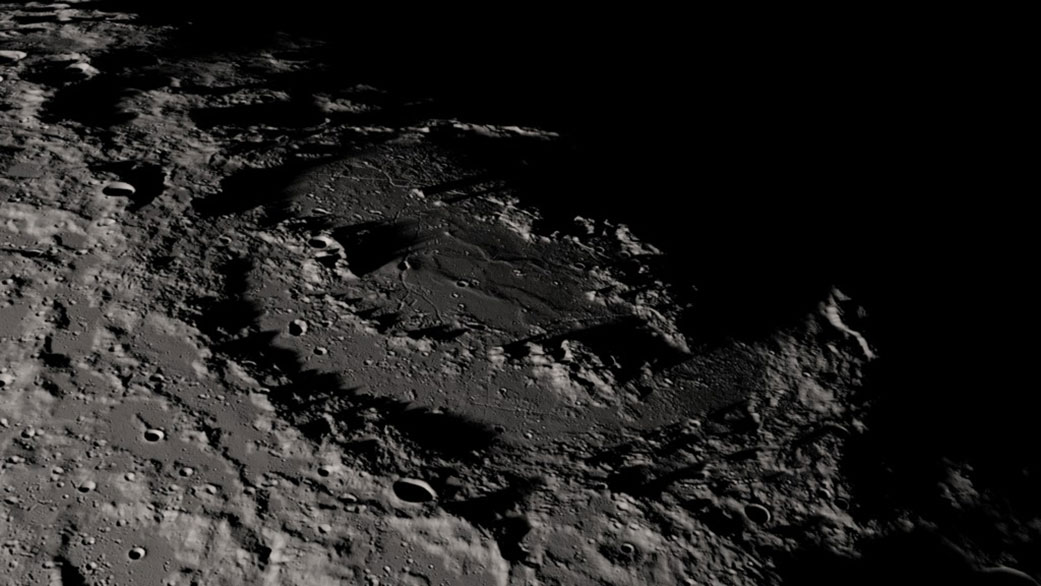
To celebrate NASA’s 60th anniversary this year, the agency partnered with the National Symphony Orchestra to present a concert in Washington entitled “NSO Pops: Space, the Next Frontier.” NASA mission images complemented performances of space-inspired music in the Kennedy Center’s concert hall, including Claude Debussy’s “Clair de Lune” (“Moonlight”), with a video of the Moon created by NASA science visualizer Ernie Wright.
At NASA’s Goddard Space Flight Center in Greenbelt, Maryland, Wright works in the Scientific Visualization Studio, using NASA data to create accurate visuals of celestial bodies. Wright made the lunar imagery accompanying “Clair de Lune” with data from the Lunar Reconnaissance Orbiter (LRO).
This visualization attempts to capture the mood of Claude Debussy’s best-known composition, Clair de Lune, along with visuals of the moon captured by NASA’s Lunar Reconnaissance Orbiter. Credit: NASA/LRO/Ernie Wright
Since its 2009 launch, LRO has harvested data on the Moon’s radiation, chemistry, temperature and topography. The shape of the lunar terrain is measured by LRO’s laser altimeter, LOLA (Lunar Orbiter Laser Altimeter). “The principle behind measuring the topography of the Moon is fairly straightforward,” said Noah Petro, LRO project scientist. “We fire a laser from the spacecraft to the surface of the Moon, and measure the time it takes that pulse to go from spacecraft to surface and back.”
The longer the laser takes to bounce back to LRO, the farther away the lunar surface. Over many years, a topographic map of the entire Moon is built up, creating the most accurate map of a celestial body’s topography ever created. Wright then uses this map and images of the Moon in the same 3D visualization software preferred by animators such as those at Pixar to make digital models. “What Ernie has done is that he drapes the images on top of the topography,” Petro said.
Topography was Wright’s biggest challenge. “The thing about the Moon is that the shadows are everything. If you don’t do that well, you’ve pretty much lost the game — there aren’t vibrant colors like on the Earth or Jupiter or Saturn,” Wright said.
Wright’s video displays breathtaking views of lunar landmarks, beginning with a sunrise dragging shadows across the surface and ending with sunsets lengthening the darkness along the same geography. The music, Wright said, is “melancholy, solitary and contemplative, as if you’re alone, walking through a garden in the moonlight.” The result, with serene music that breathes in time with crisp visuals, is a perspective on our Moon that Debussy could have only dreamed of when he tried to capture the essence of the body that dominates the night sky.
About Ernie Wright
Names of lunar landmarks are lightly penciled on one of Wright’s paper sheet music copies of “Clair de Lune” (or “Clair,” as he refers to it). Wright comes from a musical family, but he swears the gift passed him over. “I can barely read music,” Wright said, laughing. “And it wasn’t until I had listened to ‘Clair’ a few times before I thought, ‘Oh, I can follow that.’”
Wright’s job exists at the confluence of hard data and natural beauty. His formal background is in computer science, and he has his own backyard telescope. “I look at stuff, I read Sky & Telescope magazine,” he said.
For the past 10 years at Goddard, however, knowledge of astronomy and planetary and Earth sciences has become crucial for Wright. Communication with scientists is an integral part of the work being done by those in the Scientific Visualization Studio at Goddard.
“We have to speak to the scientists credibly and understand what they’re saying,” Wright said. “We need to reach up to their level of understanding and pull down what we need to convey to other people.”
Wright specializes in utilizing data from NASA missions, such as LRO, and representing them visually. Much of the work he does lies in organization of the data so that it can be understood by the 3D animation software he uses.
Wade Sisler, executive producer in Goddard’s Office of Communications, came to Wright with the proposal that visuals accompany the music for “Clair de Lune.” “Ernie’s work was legendary at NASA,” Sisler said. Wright had also crafted lunar visualizations for what would be Goddard’s viral “Tour of the Moon in 4K” video, so Sisler said that asking Wright to help “just seemed natural.” The video became “a moving Ansel Adams portrait. The richness of the tones and the dynamic range in the scenes made it so beautiful and so different,” Sisler said.
Wright’s work is not limited to pleasing visual displays. Ten years ago, one of Wright’s first projects at NASA involved the search for lunar water. LRO’s sister mission, the Lunar Crater Observation and Sensing Satellite (LCROSS), was a spacecraft designed to collide with the Moon. The impact had to be visible through Earth-based telescopes: astronomers would analyze the emitted light to look for the presence of water. Wright was called upon to help the observatories by visualizing potential impact sites, especially in shadowed regions where water ice could be found.
“They were making this decision as they were flying to the Moon,” Wright said. “They were relying a lot on LRO’s preliminary data to guide them to the best location. I was able to use that data to render the shadows at their candidate sites, and that played a role in their decision.”
Wright’s work, used for both artistry and research, is vital to improve our understanding of the Moon. There is an inescapable contrast between his cutting-edge methodology and the primordial nature of the 4.5 billion-year-old celestial body pictured. The Moon inspires tributes by those such as Claude Debussy and Ernie Wright, which in turn spark the imagination of those their works reach.
Never miss a breakthrough: Join the SciTechDaily newsletter.
Follow us on Google and Google News.