
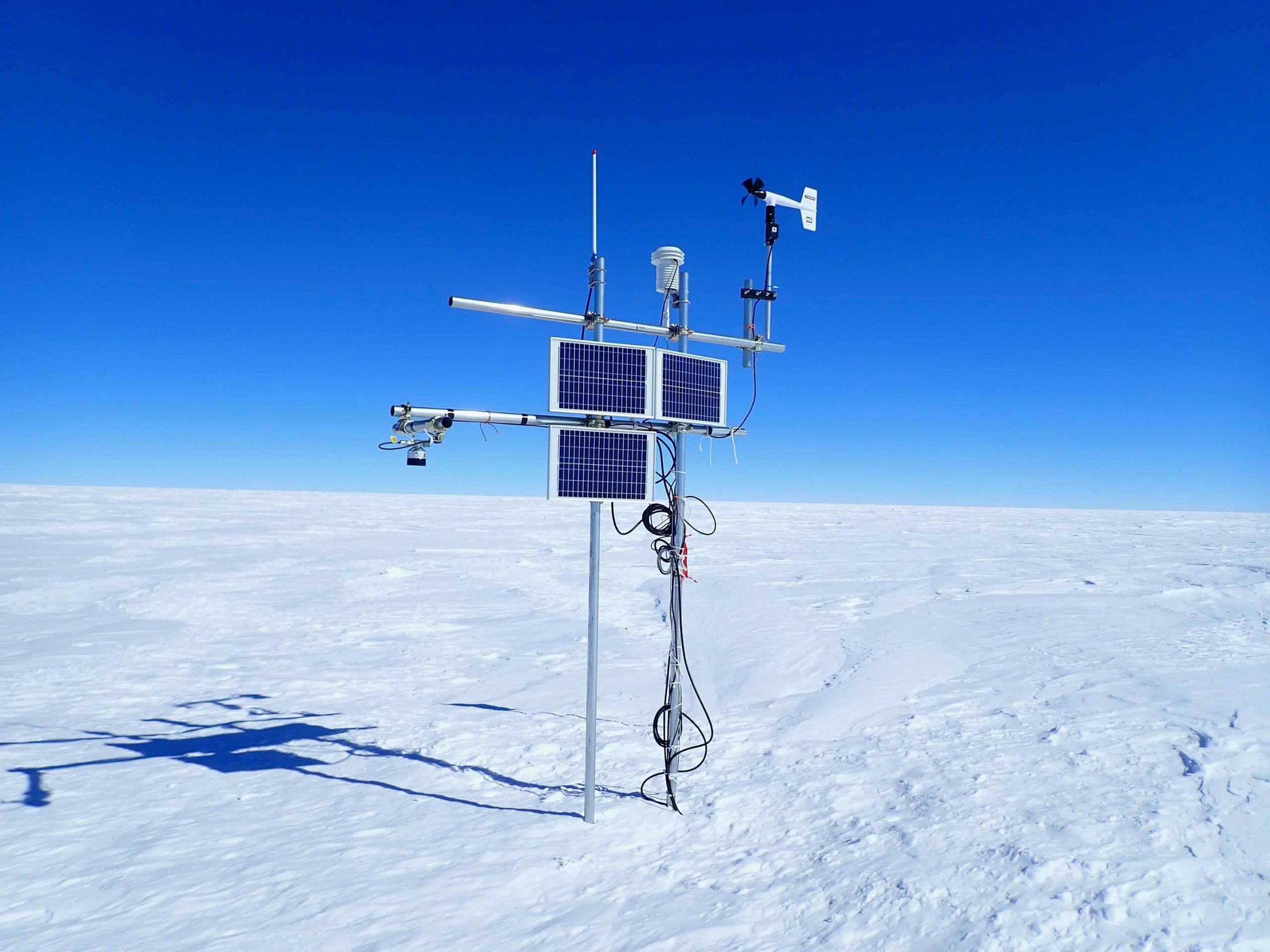
East Antarctica’s interior is warming at a startling pace, powered by shifting ocean conditions that drive warm air inland. Long overlooked, this icy heart may hold the key to future sea level rise.
East Antarctica’s Hidden Warming Trend
Scientists have discovered that the deep interior of East Antarctica is warming more quickly than its coastal regions, and they now know why. A 30-year investigation published in Nature Communications, led by Naoyuki Kurita of Nagoya University, traced the cause to shifts in the Southern Indian Ocean that send more warm air into the continent’s center. East Antarctica, long considered an observational “blind spot,” holds the majority of the planet’s glacial ice. This newly uncovered process suggests that current climate projections may be underestimating how fast Antarctic ice could be lost in the future.
Collecting Data in Earth’s Harshest Environment
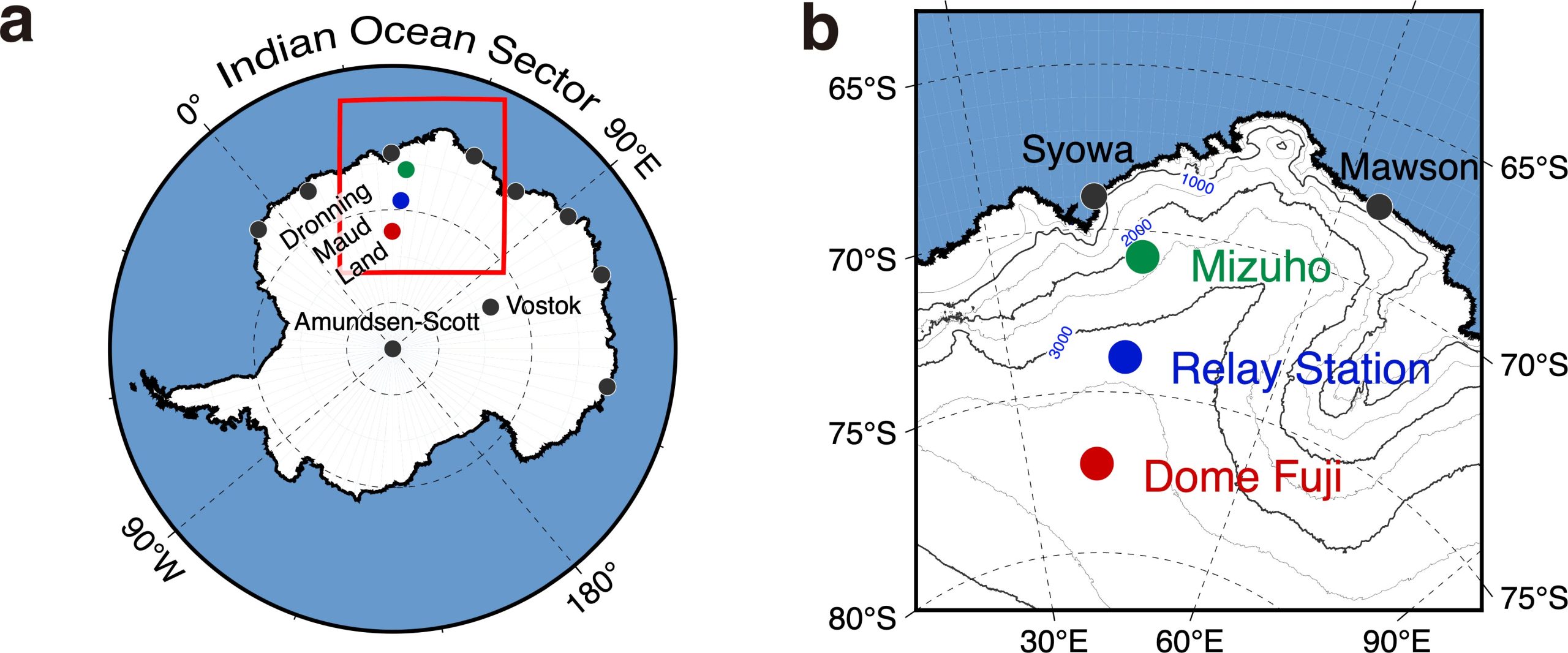
Antarctica is the coldest, driest, and windiest place on Earth, storing around 70% of the world’s freshwater in its immense ice sheets. Until now, most climate records from the region came from manned research stations situated along the coast. The continent’s interior has only four staffed bases, and only two of them provide long-term climate data: Amundsen-Scott Station (South Pole) and Vostok Station (East Antarctic Interior). As a result, much of what happens across the interior has remained poorly documented.
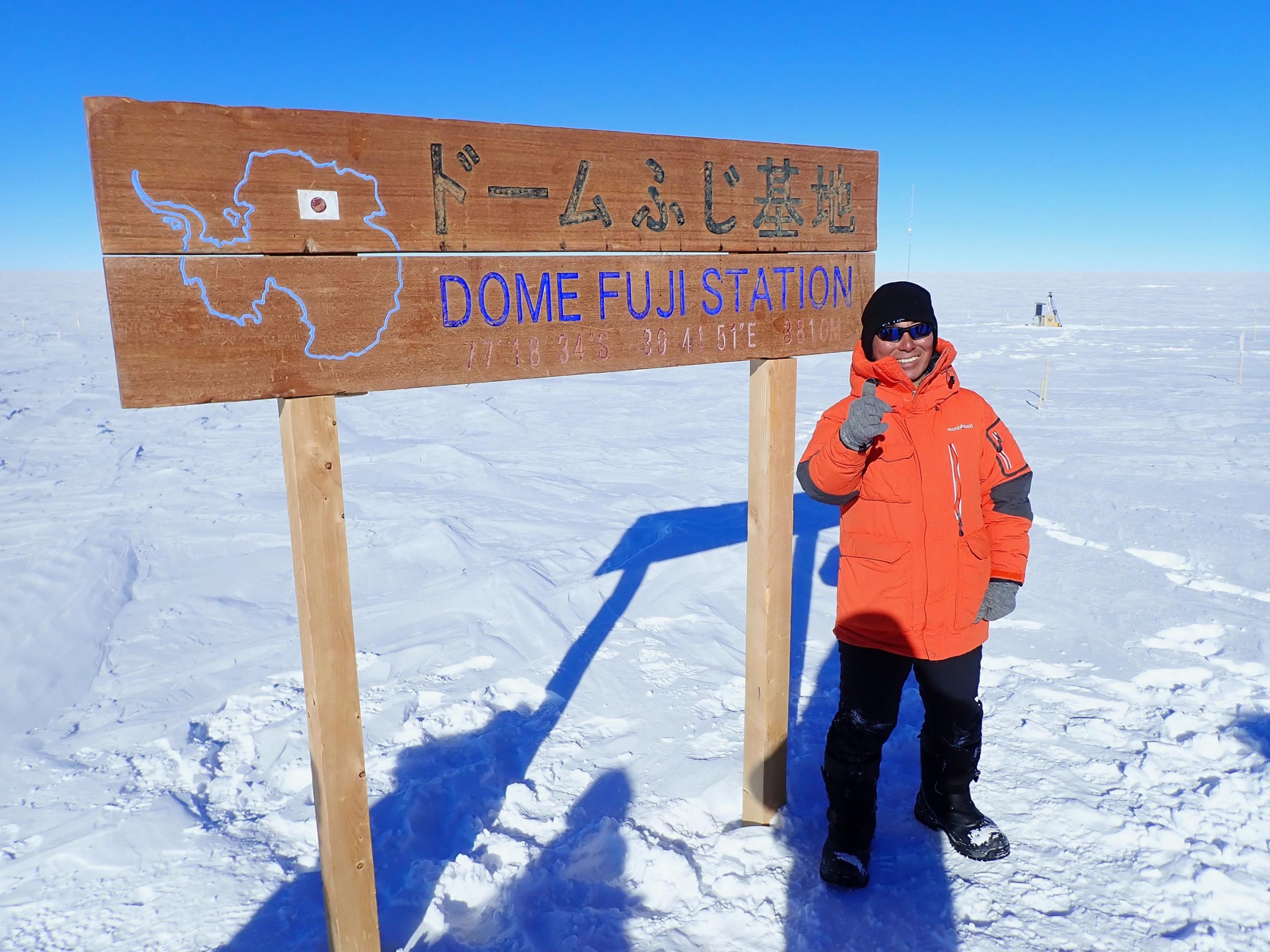
To address this gap, researchers turned to three unmanned weather stations in East Antarctica that have been running since the 1990s: Dome Fuji Station, Relay Station, and Mizuho Station. Using their records, the team created a monthly average temperature dataset spanning 1993 to 2022, providing scientists with the clearest view yet of how the continent’s hidden interior is changing.
Why Current Climate Models Fall Short
Annual average temperature changes showed that all three locations experienced temperature increases at a rate of 0.45-0.72°C per decade, faster than the global average. The researchers analyzed meteorological and oceanic data and traced this temperature rise to changes in the Southern Indian Ocean that alter atmospheric circulation patterns and transport warm air toward Antarctica’s interior.
Current climate models do not capture this warming process, so future projections of temperature for Antarctica may be underestimated. “While interior regions show rapid warming, coastal stations have not yet experienced statistically significant warming trends,” Professor Naoyuki Kurita from the Institute for Space-Earth Environmental Research at Nagoya University said. “However, the intensified warm air flow over 30 years suggests that detectable warming and surface melting could reach coastal areas like Syowa Station soon.”
The Southern Indian Ocean–East Antarctica Link
Ocean fronts—areas where warm and cold ocean waters meet—create sharp temperature boundaries in the Southern Indian Ocean. Because global warming heats ocean waters unevenly, it intensifies these temperature differences: stronger oceanic fronts lead to more storm activity and atmospheric changes that create a “dipole” pattern, with low pressure systems in mid-latitudes and high pressure over Antarctica. The high-pressure system over Antarctica pulls warm air southward and carries it deep into the continent.
Now, for the first time, scientists have comprehensive weather station data demonstrating that East Antarctica’s interior is warming faster than its coasts and have identified the major cause of this change. The study provides important insights into how quickly the world’s largest ice reservoir will respond to continued global warming.
Reference: “Summer warming in the East Antarctic interior triggered by southern Indian Ocean warming” by Naoyuki Kurita, David H. Bromwich, Takao Kameda, Hideaki Motoyama, Naohiko Hirasawa, David E. Mikolajczyk, Linda M. Keller and Matthew A. Lazzara, 22 July 2025, Nature Communications.
DOI: 10.1038/s41467-025-61919-3
Never miss a breakthrough: Join the SciTechDaily newsletter.
Follow us on Google and Google News.
3 Comments
“… that alter atmospheric circulation patterns and transport warm air toward Antarctica’s interior.”
The air it not “warm” by any stretch of the imagination. As the article mentions, currently there is little to no melting
Something that not all readers may be aware of, and isn’t mentioned explicitly, is that there will be no melting until the surface warms above 0 deg C; because of the Lapse Rate, the air cools as it rises and the interior elevation is about 10,000 feet. According to Wikipedia, “Antarctica experiences extreme temperatures, with winter temperatures ranging from about … -89.2°C to … -60°C in various regions. In contrast, summer temperatures … while the interior remains much colder, averaging around -43.5°C … annually.” Assuming that the behavior does not change in the future, it will take about 9 centuries before the interior even starts to experience melting in the East Antarctic interior Summers.
I would be surprised if humans don’t find an alternative to fossil fuels long before then, for the simple reason that even coal will probably only last about about half that time. This article, as is often the case, “is much ado about nothing.”
Clyde Spencer is right, of course. There are a few obvious facts: snow and ice do not form by water falling on a ‘cold’ earth, the water is already frozen when it falls to earth, where it will begin melting. If the air above Antarctica was completely dry, there would be no snow.
Glaciers move only by melting at the earth surface interface, and will continue to do so at a rate determined by the earth temperature; if their bulk is reducing, it is because precipitation is not keeping pace with melting.
There is a limit to the amount of moisture the atmosphere can hold; if most of it falls on temperate and tropical areas, precipitation in polar areas will be reduced. I refer readers to disastrous floods increasing in equatorial regions.
“…; if most of it falls on temperate and tropical areas, precipitation in polar areas will be reduced.”
Not necessarily. It is not a ‘zero sum game.’ The Clausius-Clapeyron relationship determines how much water vapor the air can hold for a given temperature. The globally available water is not dispersed uniformly. There is more available in the Tropics than at the Poles because of the higher temperatures. If an air mass should move polewards, it will cool and when it reaches a temperature at which the air is saturated, the water vapor will freeze and fall to the ground as snow. During the Winter, the poles, especially Antarctica, experience what is known as the circumpolar vortex. During that time, the polar air mass circulates around the pole with little influx from warmer latitudes. What is happening in the tropics and mid-latitudes is not communicated to the poles. The precipitation in the Tropics is pretty much the result of evaporation from the oceans in the Tropics.