
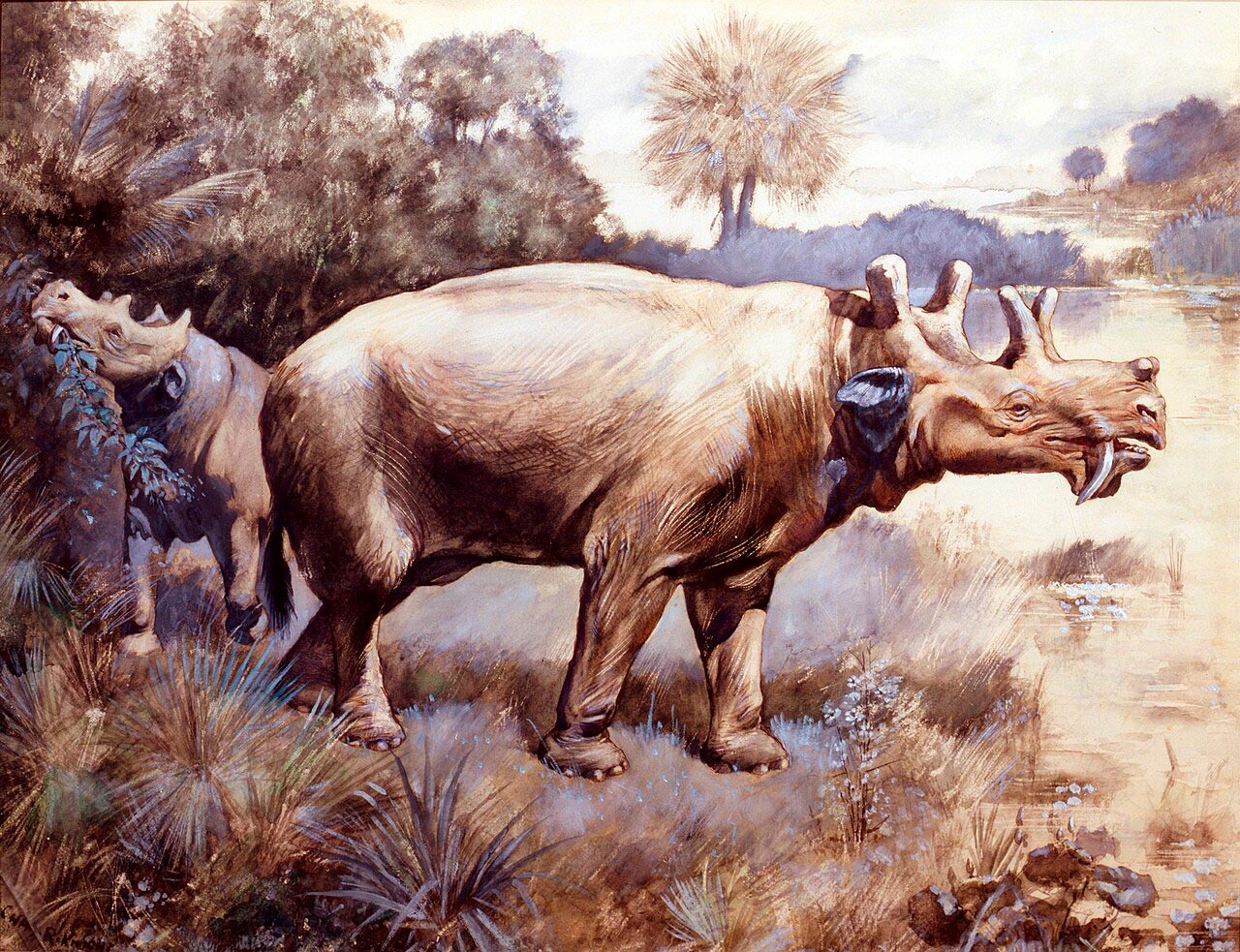
A surprising discovery about ancient horned mammals is challenging long-held ideas about sexual dimorphism.
For decades, scientists have pointed to a group of enormous, horned prehistoric mammals as a classic example of how dramatically males and females can differ in appearance. But a new analysis of fossil skulls suggests that one of paleontology’s most familiar examples of sexual dimorphism may rest on surprisingly weak evidence.
Researchers at the University of Kansas examined approximately 30 skulls belonging to the extinct species Uintatherium anceps. Their findings, published in PLOS One, challenge the longstanding assumption that males were substantially larger and possessed more prominent horns and canine teeth than females.
“Males have been interpreted as being much larger and possessing far more dramatic cranial features than females,” said study author Kevin Mulcahy, a doctoral student at the KU Biodiversity Institute & Natural History Museum.
A Broken Tooth Leads to an Unexpected Discovery
Uintatheres first appeared around 58 million years ago, less than 10 million years after the asteroid impact that wiped out the nonavian dinosaurs. These large mammals, distinguished by their imposing skulls, horns, and canine teeth, persisted in the fossil record for roughly 20 million years.
The investigation began when Mulcahy and his doctoral adviser, K. Christopher Beard, senior curator at the institute, attempted to identify a broken upper molar recovered during fieldwork in Montana. Suspecting that it belonged to a uintathere, they visited the American Museum of Natural History in New York to compare it with other fossils.
“We had a research visit at the American Museum of Natural History in New York, where our main goal was just to compare that tooth to teeth from other uintatheres and figure out what type of animal we had,” Mulcahy said. “They have this big collection — entire shelves occupied with these skulls, and each one of them is almost a meter long. These are famous specimens that are in the literature, and I was originally just looking at them to compare their teeth, and I noticed a ton of variation in a way that didn’t appear binary.”
The museum’s skulls, some approaching 1 meter (3.3 feet) in length, displayed substantial anatomical variation. However, the differences did not appear to separate neatly into the two groups expected if males and females had dramatically different physical characteristics.
The Skull Measurements Told a Different Story
Mulcahy began measuring the specimens to determine whether their anatomical differences followed the pattern expected from strong sexual dimorphism. In species where males and females differ substantially in size or anatomy, measurements may form two distinguishable statistical groups, known as a bimodal distribution. A unimodal distribution, by contrast, has a single dominant peak.
“I just, really hastily, with a ruler, gathered a bunch of measurements of the skulls while we were there,” Mulcahy said. “I started playing around with statistics, and there are ways you can look at different measurements to see if they’re best fit by a classic unimodal distribution, or if you were to think you’re dealing with something that exhibits strong sexual dimorphism, you’d see something with a bimodal distribution — that there are two means, one for males and one for females.”
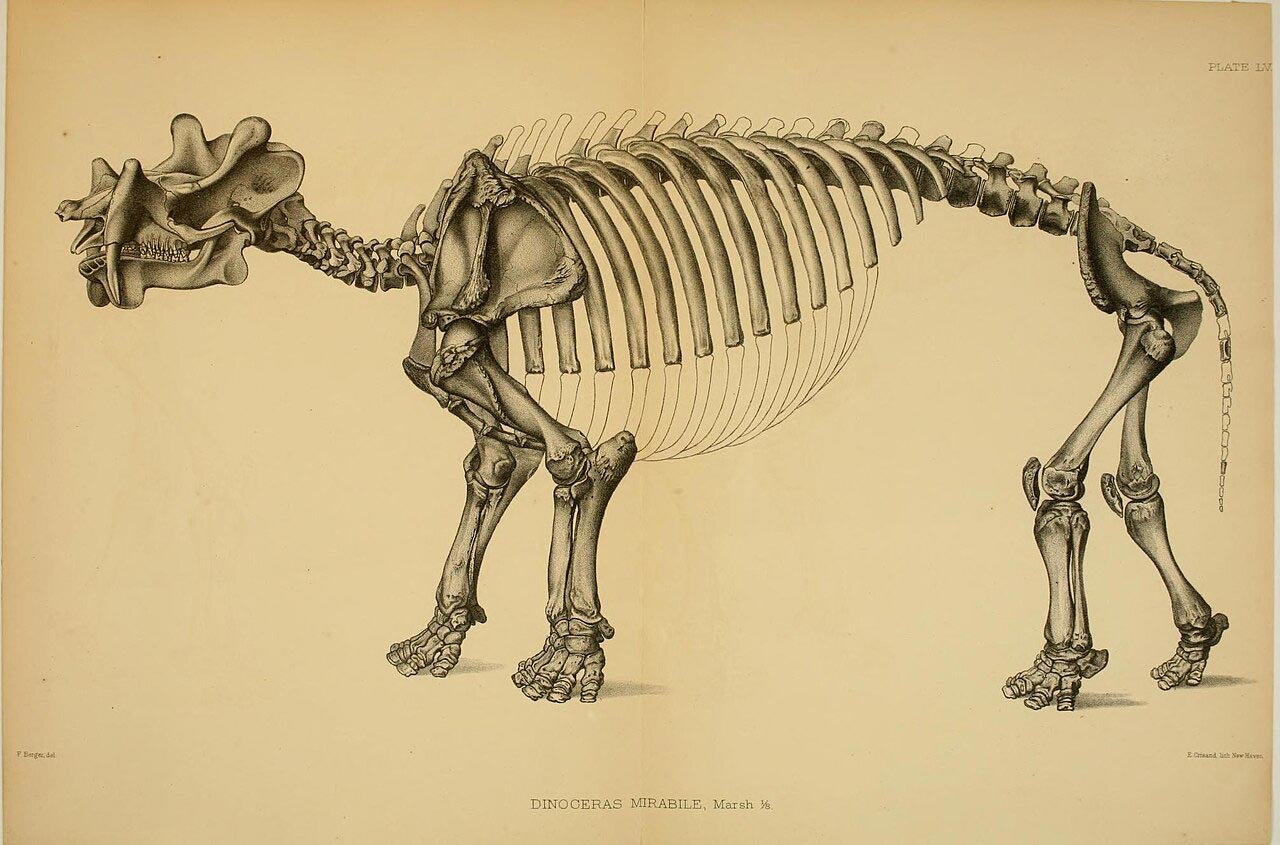
The preliminary results showed no clear separation. Mulcahy subsequently expanded the dataset with measurements from other institutions and applied additional statistical techniques, eventually examining approximately 30 Uintatherium anceps skulls.
“It wasn’t like there’s one group of specimens that look bigger than another, and then there’s another group that are smaller with smaller horns and canines,” he said. “So I was kind of interested — are these really good examples of sexual dimorphism after all? Is there actual evidence in the morphology of these skulls, in the distribution in particular of the ranges of morphology we’re seeing, that that’s what’s going on?”
Testing the Findings Against Modern Bison
Although the expanded analysis detected some possible signs of sexual dimorphism, the evidence remained inconclusive. Mulcahy considered whether the statistical methods themselves might be unable to detect genuine differences between males and females in fossil populations.
“Maybe there were some little signals of dimorphism here and there, but nothing really concrete,” he said. “I had an idea: Maybe it’s just that the techniques I’m using aren’t robust enough to actually measure sexual dimorphism. With fossil animals, you don’t actually know which specimens are males and which are females. You can guess and then test whether or not the ones you guess are males differ from the ones you guess are females, but that’s super circular, because you could just be picking the most extreme ones to be one sex and the least extreme to be the other. Of course they’re going to differ.”
To evaluate the reliability of his approach, he applied the same statistical techniques to modern bison, large horned herbivores with ecological similarities to those proposed for uintatheres. Unlike the fossil specimens, the bison could be classified by their known sex, allowing the analysis to be checked against actual male and female groups.
“When you’re dealing with living animals, you can just take the males, take the females and compare them,” he said. “Bison are another really big herbivore, with a similar sort of ecology that’s been proposed for uintatheres, and they also have big horns. What I noticed is that the signals of dimorphism I was picking up in bison were a lot clearer. When I was looking at the bison, it was almost perfect that all of the females were most similar to the females, and all the males were most similar to the males.”
How Historical Assumptions May Have Shaped Paleontology
The contrast suggested that the methods could detect pronounced sexual differences when they were present, strengthening the case that Uintatherium anceps did not exhibit the degree of dimorphism traditionally attributed to it. The results do not establish that males and females looked identical, but they provide little support for the previously assumed extreme differences.
Mulcahy also suggested that the conventional interpretation of uintathere fossils may partly reflect the scientific and cultural assumptions prevalent when these animals were first studied in the late 19th century. Early paleontologists frequently worked within a framework that expected males to be larger and more imposing than females.
“Back then, this is right when evolutionary theory, sexual selection, natural selection, all of that is kind of coming into play,” he said. “I think it’s really important to remember that these things were first discovered in the late 1800s by a bunch of male paleontologists working in a very Victorian-era mindset. The idea is basically assumed at that point that males are going to be bigger and scarier than females. It’s really interesting: When you step back and actually test that hypothesis, it doesn’t really hold up.”
Rethinking Sexual Dimorphism in Mammal Evolution
The findings also raise questions about other extinct mammals whose presumed sexual differences were inferred primarily from variations in fossil size and anatomy. Without independent evidence of a fossil animal’s sex, distinguishing sexual dimorphism from ordinary variation within a species remains difficult.
Mulcahy argues that pronounced male-biased sexual dimorphism may have evolved independently in different mammalian lineages rather than being an inherited characteristic of early mammals. He points to recent research on living mammals indicating that larger males are far from universal.
“Strong, big male-style sexual dimorphism was probably not ancestral at the root of the mammalian tree, and among the mammals where we do see this pattern today, it’s almost certainly shown up independently several times,” Mulcahy said. “It had long been assumed that sexual dimorphism is the norm, that most species show that males are bigger than females. But just a couple years ago, a paper came out showing that among living mammals, most species either don’t show any dimorphism or actually have larger females. The idea that males are always bigger than females is really just a choice of what animals were people looking at, what are the things that biologists in the past were interested in.”
Reference: “Linear morphometrics fail to support strong sexual dimorphism in Uintatherium anceps” by Kevin D. Mulcahy, 7 October 2026, PLOS ONE.
DOI: 10.1371/journal.pone.0345236
Never miss a breakthrough: Join the SciTechDaily newsletter.
Follow us on Google and Google News.