

Scientists have linked a fossilized elephant skull from Kashmir with another from Turkmenistan, identifying them as a distinct species of Palaeoloxodon. These findings could fill gaps in the understanding of elephant evolution during the Middle Pleistocene.
The giant fossil skull of an extinct elephant, discovered in northern India’s Kashmir Valley, has provided new insights into a poorly understood stage in elephant evolutionary history.
The skull was buried with 87 stone tools used by prehistoric humans, all of which were excavated in late 2000 under the leadership of Dr Ghulam Bhat at the University of Jammu.
Now, an international team of researchers has analyzed the skull to determine the age and evolutionary context of this megaherbivore.
The team, comprised of scientists from the Florida Museum of Natural History, the British Museum, the University of York, and the Natural History Museum (London), along with the University of Helsinki’s Dr Steven Zhang, detailed their findings in a new study published in the Journal of Vertebrate Paleontology.
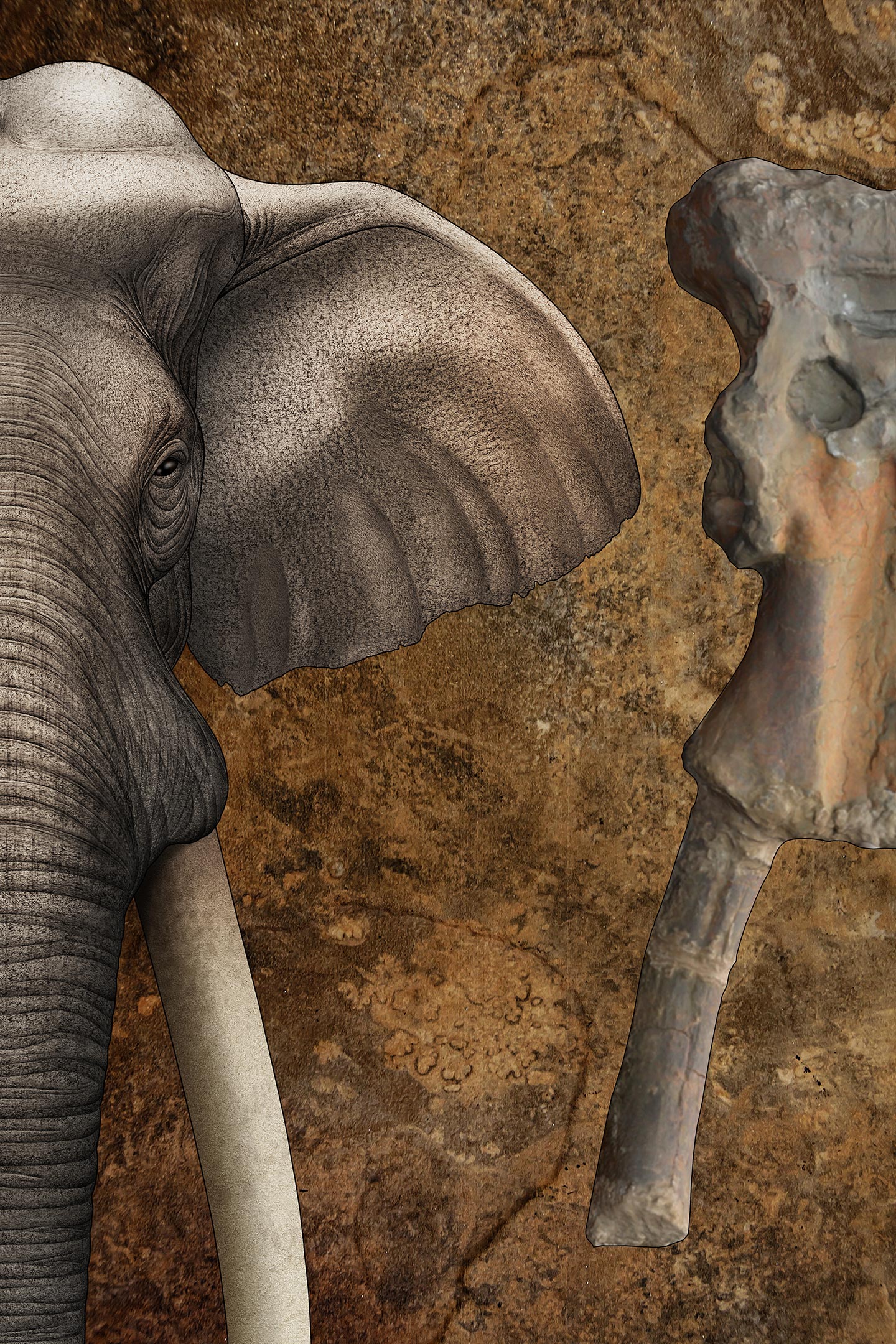
Evolutionary Significance of the Skull Features
“From the general shape of the skull, it’s quite apparent that the elephant belonged to Palaeoloxodon, or straight-tusked elephants, among the largest land mammals that ever lived. Full-grown adults easily stood around 4m tall at the shoulder and weighed 9-10 tonnes,” says Zhang, a paleontologist from the University of Helsinki’s Department of Geosciences and Geography.
“Yet what’s puzzled experts for some time is that the Kashmir skull lacks a thickened, forward-projecting crest at the skull roof which typifies other Palaeoloxodon skulls found in India.”
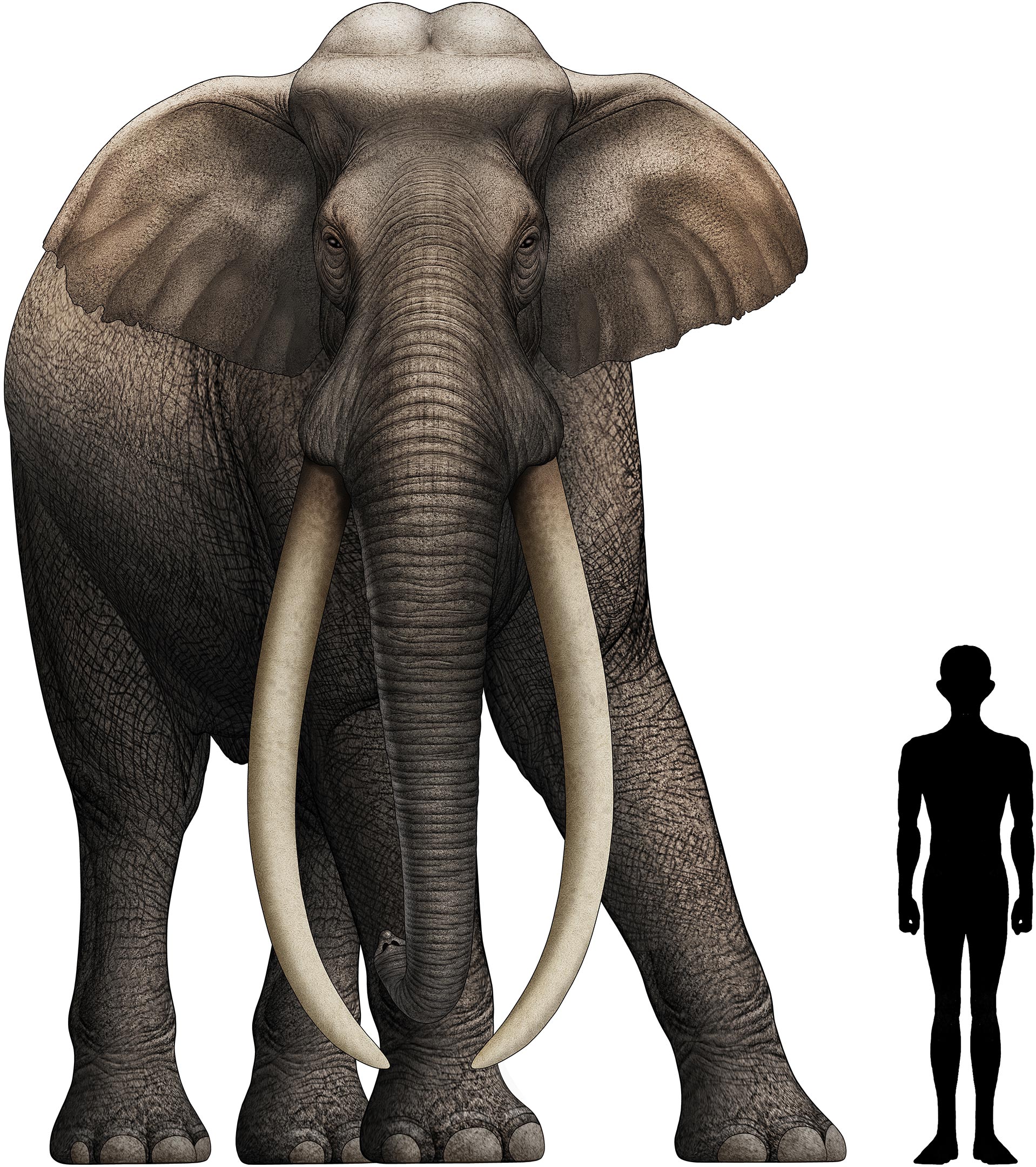
Insights from Comparative Analysis
Over recent decades, whether the developmental extent of this crest could tell apart different species of Palaeoloxodon and the relative position of these species on the evolutionary tree of elephants remained controversial. However, recent research concluded that the skull crest in these extinct elephants became more prominent with developmental and sexual maturity. This means that, once specimens can be aged by examining their teeth, it would be possible to compare skulls from individuals with similar levels of maturity.
“From the size, the wisdom teeth and a few other telltale features of the skull, it is evident that the animal was a majestic bull elephant in the prime of its life, but the lack of a well-developed skull crest, particularly in comparison with other mature male skulls from Europe and from India, tells us we have a different species on our hands here,” Zhang explained.
The Kashmir and Turkmen Skull Comparison
Instead, the research team noticed how the Kashmir skull’s features conform best with another obscure skull from Turkmenistan studied in the 1950s, which was proposed to represent a distinct species, Palaeoloxodon turkmenicus.
“What’s always been puzzling about the Turkmen skull is that besides the lack of a prominent crest at the skull roof, its other features are highly similar to the already well-known European species, P. antiquus. And this led a number of experts to suggest that the Turkmen specimen is simply an aberrant individual of the European species,” says Zhang.
“But with the Kashmir skull added to the mix, it becomes clear now that the two specimens can be theorized to represent a distinct species that we previously knew very little about, with a broad distribution from Central Asia to the northern Indian Subcontinent,” added Dr. Advait Jukar, the study’s lead author, currently based at the Florida Museum of Natural History.
Conclusions on the Palaeoloxodon Lineage
By measuring protein decomposition in the tooth enamel of the Kashmir Palaeoloxodon skull, and examining stone tools buried alongside the elephant remains, the team concluded that the Kashmir skull dates to the Middle Pleistocene period 300,000–400,000 years ago, very similar to the estimated age of the Turkmen skull. This supports the belief that the two skulls represent a species distinct from other Eurasian Palaeoloxodon.
Palaeoloxodon first evolved in Africa around 1 million years ago; this early African form had a narrow, convex forehead and underdevelopment of the skull crest. Later Palaeoloxodon, best known from fossils discovered in Europe and India, has a very wide, flattened forehead often associated with a thick crest that juts forward from the roof of the skull.
The team thus concluded that with a wide, flat forehead with only the faintest trace of a skull crest, P. turkmenicus may represent a poorly-known missing link that fills a gap in our understanding of how these prodigious prehistoric megaherbivores evolved.
Reference: “A remarkable Palaeoloxodon (Mammalia, Proboscidea) skull from the intermontane Kashmir Valley, India” by Advait M. Jukar, Ghulam Bhat, Simon Parfitt, Nick Ashton, Marc Dickinson, Hanwen Zhang, A. M. Dar, M. S. Lone, Bindra Thusu and Jonathan Craig, 11 October 2024, Journal of Vertebrate Paleontology.
DOI: 10.1080/02724634.2024.2396821
Never miss a breakthrough: Join the SciTechDaily newsletter.
Follow us on Google and Google News.