

A complete Mixodectes pungens skeleton reveals it was a leaf-eating, tree-dwelling mammal closely related to primates and colugos, refining its evolutionary position after over a century of mystery.
For over 140 years, Mixodectes pungens, a small mammal that lived in western North America during the early Paleocene, remained largely a mystery. Scientists had only fragmentary evidence to work with, primarily fossilized teeth and pieces of jawbone.
Now, a new study based on the most complete skeleton of the species ever discovered has shed significant light on this elusive animal. First described in 1883 by renowned paleontologist Edward Drinker Cope, Mixodectes pungens is no longer just a name with scant fossil evidence.
The research, co-authored by Yale anthropologist Eric Sargis, reveals that adult Mixodectes weighed about three pounds, lived in trees, and primarily fed on leaves. The findings also clarify the species’ place in the evolutionary tree, showing that mixodectids, an extinct group of tree-dwelling mammals, are relatively close evolutionary relatives of humans.
“A 62-million-year-old skeleton of this quality and completeness offers novel insights into mixodectids, including a much clearer picture of their evolutionary relationships,” said Sargis, professor of anthropology in Yale’s Faculty of Arts and Sciences, curator of vertebrate paleontology and mammalogy at Yale Peabody Museum, and the director of the Yale Institute for Biospheric Studies. “Our findings show that they are close relatives of primates and colugos — flying lemurs native to Southeast Asia — making them fairly close relatives of humans.”
Field Discovery and Fossil Details
The study was published on March 11 in the journal Scientific Reports. Stephen Chester, associate professor of anthropology at Brooklyn College, City University of New York, is its lead author.
The skeleton was collected in New Mexico’s San Juan Basin by co-author Thomas Williamson, curator of paleontology at the New Mexico Museum of Natural History & Science, under a permit from the federal Bureau of Land Management. It includes a partial skull with teeth, spinal column, rib cage, forelimbs, and hind limbs.
The researchers determined that the skeleton belonged to a mature adult that weighed about 1.3 kilograms, or 2.9 pounds. The anatomy of the animal’s limbs and claws indicate that it was arboreal and capable of vertically clinging to tree trunks and branches. Its molar teeth had crests to break down abrasive material, suggesting it was omnivorous and primarily ate leaves, the study showed.
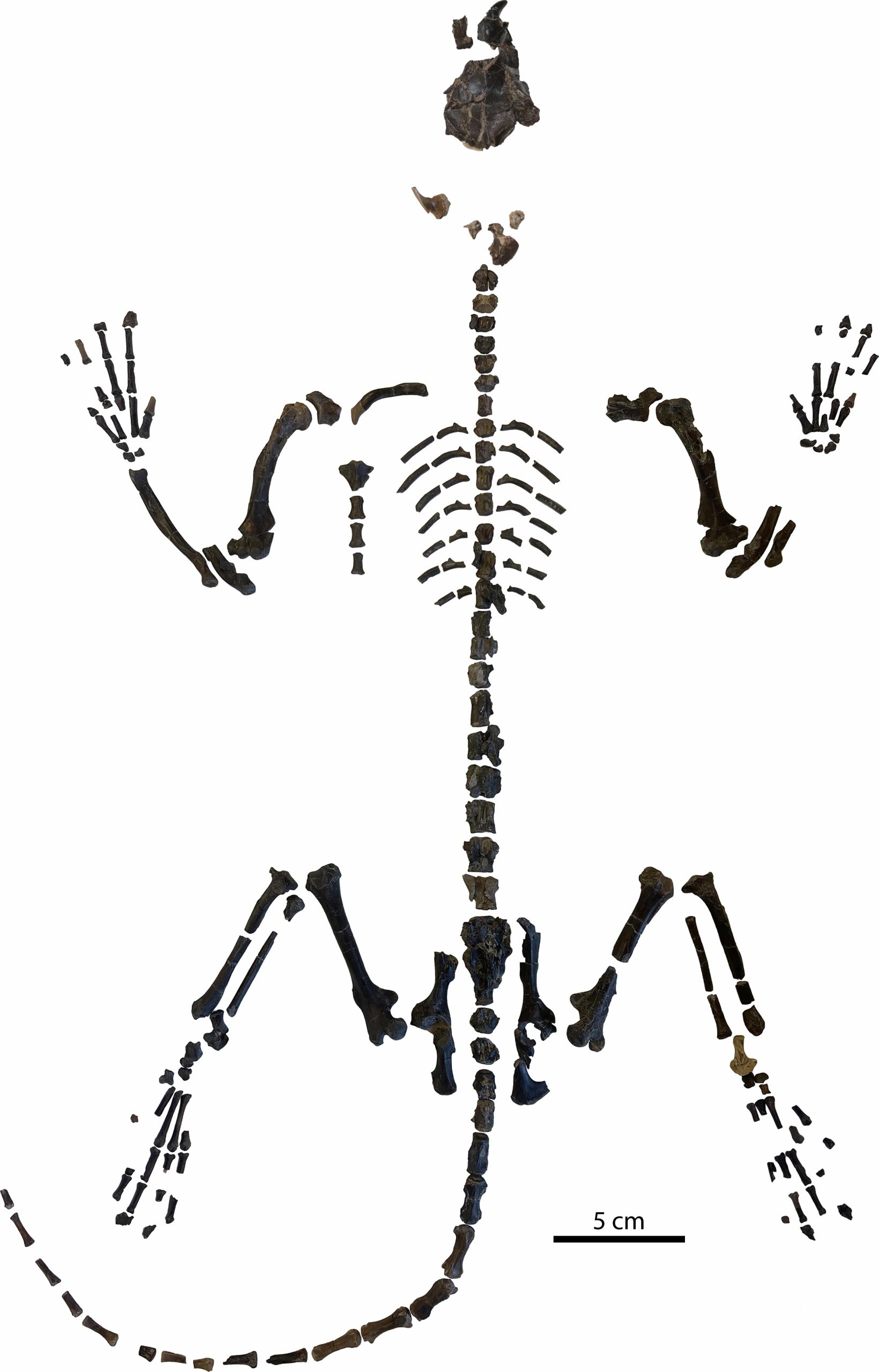
“This fossil skeleton provides new evidence concerning how placental mammals diversified ecologically following the extinction of the dinosaurs,” said Chester, a curatorial affiliate of vertebrate paleontology at the Yale Peabody Museum. “Characteristics such as a larger body mass and an increased reliance on leaves allowed Mixodectes to thrive in the same trees likely shared with other early primate relatives.”
Mixodectes was quite large for a tree-dwelling mammal in North America during the early Paleocene — the geological epoch that followed the Cretaceous-Paleogene extinction event that killed off non-avian dinosaurs 66 million years ago, the researchers noted.
For example, the Mixodectes skeleton is significantly larger than a partial skeleton of Torrejonia wilsoni, a small arboreal mammal from an extinct group of primates called plesiadapiforms, that was discovered alongside it. While Mixodectes subsisted on leaves, Torrejonia’s diet mostly consisted of fruit. These distinctions in size and diet suggest that mixodectids occupied a unique ecological niche in the early Paleocene that distinguished them from their tree-dwelling contemporaries, the researchers said.
Evolutionary Relationships Clarified
Two phylogenetic analyses performed to clarify the species’ evolutionary relationships confirmed that mixodectids were euarchontans, a group of mammals that consists of treeshrews, primates, and colugos. While one analysis supported that they were archaic primates, the other did not. However, the latter analysis verified that mixodectids are primatomorphans, a group within Euarchonta composed of primates and colugos, but not treeshrews, Sargis explained.
“While the study doesn’t entirely resolve the debate over where mixodectids belong on the evolutionary tree, it significantly narrows it,” he said.
Reference: “New remarkably complete skeleton of Mixodectes reveals arboreality in a large Paleocene primatomorphan mammal following the Cretaceous-Paleogene mass extinction” by Stephen G. B. Chester, Thomas E. Williamson, Jordan W. Crowell, Mary T. Silcox, Jonathan I. Bloch and Eric J. Sargis, 11 March 2025, Scientific Reports.
DOI: 10.1038/s41598-025-90203-z
The paper’s co-authors are Jordan Crowell of The Graduate Center at the City University of New York, Mary Silcox of the University of Toronto Scarborough, and Jonathan Bloch of the Florida Museum of Natural History at the University of Florida.
Never miss a breakthrough: Join the SciTechDaily newsletter.
Follow us on Google and Google News.
2 Comments
Just think how long animals didn’t have to put up with human beings. I lived by a through-fare once and noticed the pasture horses and squirrels and birds had one day without angry, caffeinated working guys driving their trucks, Sunday. When finally peace – and the soft morning.
thank you