

New discoveries shed light on an ancient human species and its evolutionary links to modern humans.
Stephen Chester, Associate Professor of Anthropology at Brooklyn College and the CUNY Graduate Center, along with a team of researchers, has uncovered important new insights about Mixodectes pungens, a little-understood mammal that lived in North America during the early Paleocene, shortly after the extinction of the dinosaurs.
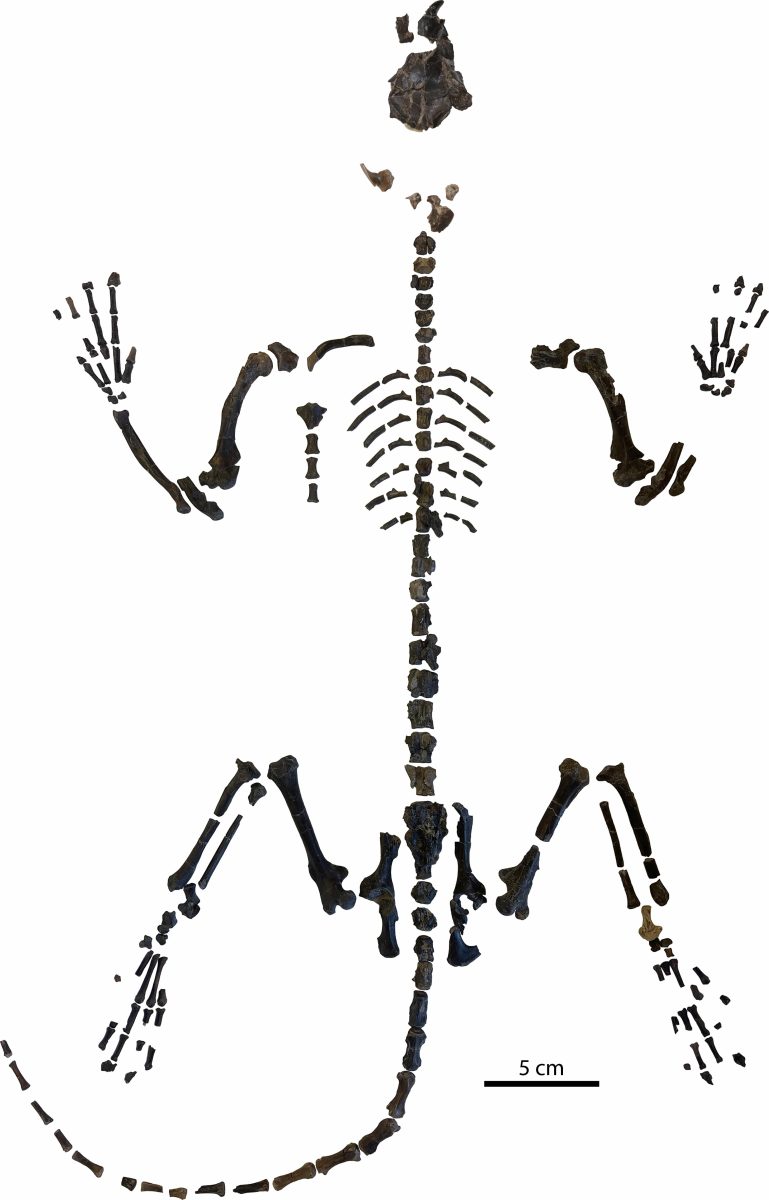
For more than 140 years, Mixodectes has been a mystery to paleontologists, known mostly from isolated teeth and jaw fragments. Now, a breakthrough study led by Chester has revealed the most complete skeleton of the species ever discovered. This find offers valuable information about the animal’s physical structure, how it lived, and, perhaps most notably, its evolutionary relationship to humans and other primates.
The study, for which Chester is the lead author, was published on March 11 in the journal Scientific Reports.
Life and Anatomy of Mixodectes
Originally described by famed paleontologist Edward Drinker Cope in 1883, Mixodectes pungens was a small, tree-dwelling mammal that lived about 62 million years ago. According to the new research, adult individuals weighed around three pounds, ate primarily leaves, and were well adapted to life in the trees. Remarkably, the study identifies Mixodectes as a close evolutionary relative of modern primates and flying lemurs, offering a new and exciting connection to the early history of our own lineage.
“This fossil skeleton provides new evidence concerning how placental mammals diversified ecologically following the extinction of the dinosaurs,” said Chester, who is also doctoral faculty at the CUNY Graduate Center. “Characteristics such as a larger body mass and an increased reliance on leaves allowed Mixodectes to thrive in the same trees likely shared with other early primate relatives.”
Co-author of the study and Yale University anthropologist Eric Sargis added: “A 62-million-year-old skeleton of this quality and completeness offers novel insights into mixodectids, including a much clearer picture of their evolutionary relationships. Our findings show that they are close relatives of primates and colugos — flying lemurs native to Southeast Asia — making them fairly close relatives of humans.”
A Window Into Mammalian Evolution
The newly revealed Mixodectes skeleton is more than just a remarkable fossil — it’s a window into a pivotal moment in mammalian evolution, offering scientists invaluable clues about the origins of some of today’s most fascinating species, including us. And it is just one of many fossils that Chester and his students — including co-author Jordan Crowell, a lecturer at Brooklyn College and Ph.D. candidate at the CUNY Graduate Center — have been studying to understand our evolutionary history.
The skeleton was discovered in New Mexico’s San Juan Basin by co-author Thomas Williamson, curator of paleontology at the New Mexico Museum of Natural History & Science, under a permit from the federal Bureau of Land Management. This rare find includes a partial skull, ribs, vertebral column, and both forelimbs and hind limbs, giving the team crucial insights into how this ancient mammal lived.
At a weight of just 2.9 pounds, Mixodectes was relatively large for a tree-dwelling mammal of its time. The structure of its limbs and claws suggests it was adept at clinging to tree trunks and branches, and its molars, evolved to break down plant material, show it primarily ate leaves.
Interestingly, Mixodectes was much larger than another small, tree-dwelling mammal — Torrejonia wilsoni — found at the same fossil locality. While Mixodectes had a more leafy diet, Torrejonia primarily ate fruit, hinting at a distinct ecological role for Mixodectes among its contemporaries.
In terms of evolutionary placement, two independent cladistic analyses were conducted to determine Mixodectes‘ relationships. The findings confirm that Mixodectes belongs to the group known as primatomorphans — a group that includes living primates and colugos.
Reference: “New remarkably complete skeleton of Mixodectes reveals arboreality in a large Paleocene primatomorphan mammal following the Cretaceous-Paleogene mass extinction” by Stephen G. B. Chester, Thomas E. Williamson, Jordan W. Crowell, Mary T. Silcox, Jonathan I. Bloch and Eric J. Sargis, 11 March 2025, Scientific Reports.
DOI: 10.1038/s41598-025-90203-z
Never miss a breakthrough: Join the SciTechDaily newsletter.
Follow us on Google and Google News.
7 Comments
“Couisin.”
The artist’s depiction makes it look more like a rodent or a mustelid rather than a lemur or any other kind of ape. I always wonder how science can flesh out these creatures without any soft tissue to work from.
I read somewhere that they use living animals that are closely related to the extinct one. The idea is that if the genes are similar, then the features would be too.
Don’t believe it. Nonsense. Keep trying to explain our existence the hard and impossible way. Humans don’t evolve like the animal kingdoms. Our dna won’t allow for it.
¡Caballero!
Los hombres vienen de Marte y la mujes, de Venus.
There’s a reason why we test on rodents and apes for disease. It’s because we are cousins to both. This further insight is proof of evolutionary changes in “human” DNA. If we weren’t part of the evolutionary cycle then we would have a different set of rules to live by for example humans are made up of animal cells therefore we evolve just like any other creature created by millions of years learning adapting and dare I say it EVOLVING.