
Close Menu
    Facebook X (Twitter) Instagram
    SciTechDaily
    • Biology
    • Chemistry
    • Earth
    • Health
    • Physics
    • Science
    • Space
    • Technology
    Facebook X (Twitter) Pinterest YouTube RSS
    SciTechDaily
    Home»Space»A Galactic Dance 160 Million Light-Years Away
    Space

    A Galactic Dance 160 Million Light-Years Away

    By Association of Universities for Research in Astronomy (AURA)December 13, 2019No Comments4 Mins Read
    Facebook Twitter Pinterest Telegram LinkedIn WhatsApp Email Reddit
    Share
    Facebook Twitter LinkedIn Pinterest Telegram Email Reddit
    Galactic Dance
    Image of the interacting galaxy pair NGC 5394/5 obtained with NSF’s National Optical-Infrared Astronomy Research Laboratory’s Gemini North 8-meter telescope on Hawai’i’s Maunakea using the Gemini Multi-Object Spectrograph in imaging mode. This four-color composite image has a total exposure time of 42 minutes. Credit: NSF’s National Optical-Infrared Astronomy Research Laboratory/Gemini Observatory/AURA

    “Everything is determined by forces over which we have no control… Human beings, vegetables, or cosmic dust, we all dance to a mysterious tune, intoned in the distance by an invisible piper.” — Albert Einstein

    Galaxies lead a graceful existence on cosmic timescales. Over millions of years, they can engage in elaborate dances that produce some of Nature’s most exquisite and striking grand designs. Few are as captivating as the galactic duo known as NGC 5394/5, sometimes nicknamed the Heron Galaxy. This image, obtained by the Gemini Observatory of NSF’s National Optical-Infrared Astronomy Research Laboratory, captures a snapshot of this compelling interacting pair.

    The existence of our Universe is dependent upon interactions — from the tiniest subatomic particles to the largest clusters of galaxies. At galactic scales, interactions can take millions of years to unfold, a process seen in this image of two galaxies released today by the Gemini Observatory. The new image captures the slow and intimate dance of a pair of galaxies some 160 million light-years distant and reveals the sparkle of subsequent star formation fueled by the pair’s interactions.


    This 10-second video zooms into the Gemini Observatory image of NGC 5394/5395, revealing the interaction of the galaxy pair. Credit: NSF’s National Optical-Infrared Astronomy Research Laboratory/Gemini Observatory/AURA

    The two galaxies, astronomers have concluded, have already “collided” at least once. However, galactic collisions can be a lengthy process of successive gravitational encounters, which over time can morph the galaxies into exotic, yet unrecognizable forms. These galaxies, as in all galactic collisions, are engaged in a ghostly dance as the distances between the stars in each galaxy preclude actual stellar collisions and their overall shapes are deformed only by each galaxy’s gravity.

    One byproduct of the turbulence caused by the interaction is the coalescence of hydrogen gas into regions of star formation. In this image, these stellar nurseries are revealed in the form of the reddish clumps scattered in a ring-like fashion in the larger galaxy (and a few in the smaller galaxy). Also visible is a dusty ring that is seen in silhouette against the backdrop of the larger galaxy. A similar ring structure is seen in a previous image from the Gemini Observatory (see below), likely the result of another interacting galactic pair.
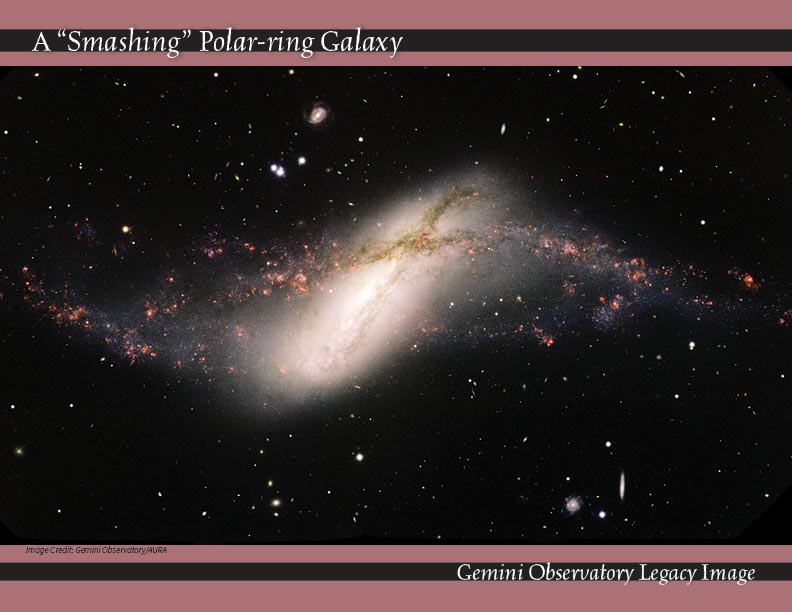
    Polar-Ring Galaxy NGC 660
    This Gemini North telescope image captures the “bloody” aftermath of one galaxy piercing the heart of another. All the action appears in a single frame, with the stunning polar-ring galaxy NGC 660 as the focus of attention. Credit: Gemini Observatory/AURA

    A well-known target for amateur astronomers, the light from NGC 5394/5 first piqued humanity’s interest when it was observed by William Herschel in 1787. Herschel used his giant 20-foot-long telescope to discover the two galaxies in the same year that he discovered two moons of Uranus. Many stargazers today imagine the two galaxies as a Heron. In this interpretation, the larger galaxy is the bird’s body and the smaller one is its head — with its beak preying upon a fish-like background galaxy!

    NGC 5394 [1] and NGC 5395, also known collectively known as Arp 84 or the Heron Galaxy, are interacting spiral galaxies 160 million light-years from Earth in the constellation of Canes Venatici. The larger galaxy, NGC 5395 (on the left), is 140,000 light-years across and the smaller one, NGC 5394, is 90,000 light-years across.

    Notes

    [1] NGC stands for the New General Catalog of astronomical objects.

    Never miss a breakthrough: Join the SciTechDaily newsletter.
    Follow us on Google and Google News.

    Astronomy Astrophysics AURA Gemini Observatory
    Share. Facebook Twitter Pinterest LinkedIn Email Reddit

    Related Articles

    Taffy Galaxies’ Collision Sculptures a Turbulent Bridge Devoid of Star Formation

    Cosmic Cannibalism: Astronomers Witness Star Devouring Planet in Possible Preview of Earth’s Ultimate Fate

    Crystal-Clear Images of Sidewinding Young Stellar Jets Captured by Gemini South Telescope’s Adaptive Optics System

    Gemini Catches a Glowing One-Winged Butterfly

    Ruins of Ancient Star Cluster Discovered at the Fringes of Our Galaxy

    Astronomers Discover Surprising Cause of a “Fizzled” Gamma-Ray Burst

    Are We Missing Other Earths? Dramatic New Evidence Uncovered by Astronomers

    Black Hole Pairs Found in Distant Merging Galaxies Provide Crucial Insight Into the Early Universe

    “Failed Stars” Caught Speeding: Astronomers Clock the Fastest-Spinning Brown Dwarfs

    Leave A Reply Cancel Reply

    • Facebook
    • Twitter
    • Pinterest
    • YouTube

    Don't Miss a Discovery

    Subscribe for the Latest in Science & Tech!

    Trending News

    Millions Take These IBS Drugs, But a New Study Finds Serious Risks

    Scientists Unlock Hidden Secrets of 2,300-Year-Old Mummies Using Cutting-Edge CT Scanner

    Bread Might Be Making You Gain Weight Even Without Eating More Calories

    Scientists Discover Massive Magma Reservoir Beneath Tuscany

    Europe’s Most Active Volcano Just Got Stranger – Here’s Why Scientists Are Rethinking It

    Alzheimer’s Symptoms May Start Outside the Brain, Study Finds

    Millions Take This Popular Supplement – Scientists Discover a Concerning Link to Heart Failure

    The Universe Is Expanding Too Fast and Scientists Can’t Explain Why

    Follow SciTechDaily
    • Facebook
    • Twitter
    • YouTube
    • Pinterest
    • Newsletter
    • RSS
    SciTech News
    • Biology News
    • Chemistry News
    • Earth News
    • Health News
    • Physics News
    • Science News
    • Space News
    • Technology News
    Recent Posts
    • Doctors Surprised by the Power of a Simple Drug Against Colon Cancer
    • Why Popular Diabetes Drugs Like Ozempic Don’t Work for Everyone: The “Genetic Glitch”
    • Scientists Create Improved Insulin Cells That Reverse Diabetes in Mice
    • Scientists Stunned After Finding Plant Thought Extinct for 60 Years
    • A Common Diabetes Drug May Hold the Key to Stopping HIV From Coming Back
    Copyright © 1998 - 2026 SciTechDaily. All Rights Reserved.
    • Science News
    • About
    • Contact
    • Editorial Board
    • Privacy Policy
    • Terms of Use

    Type above and press Enter to search. Press Esc to cancel.