
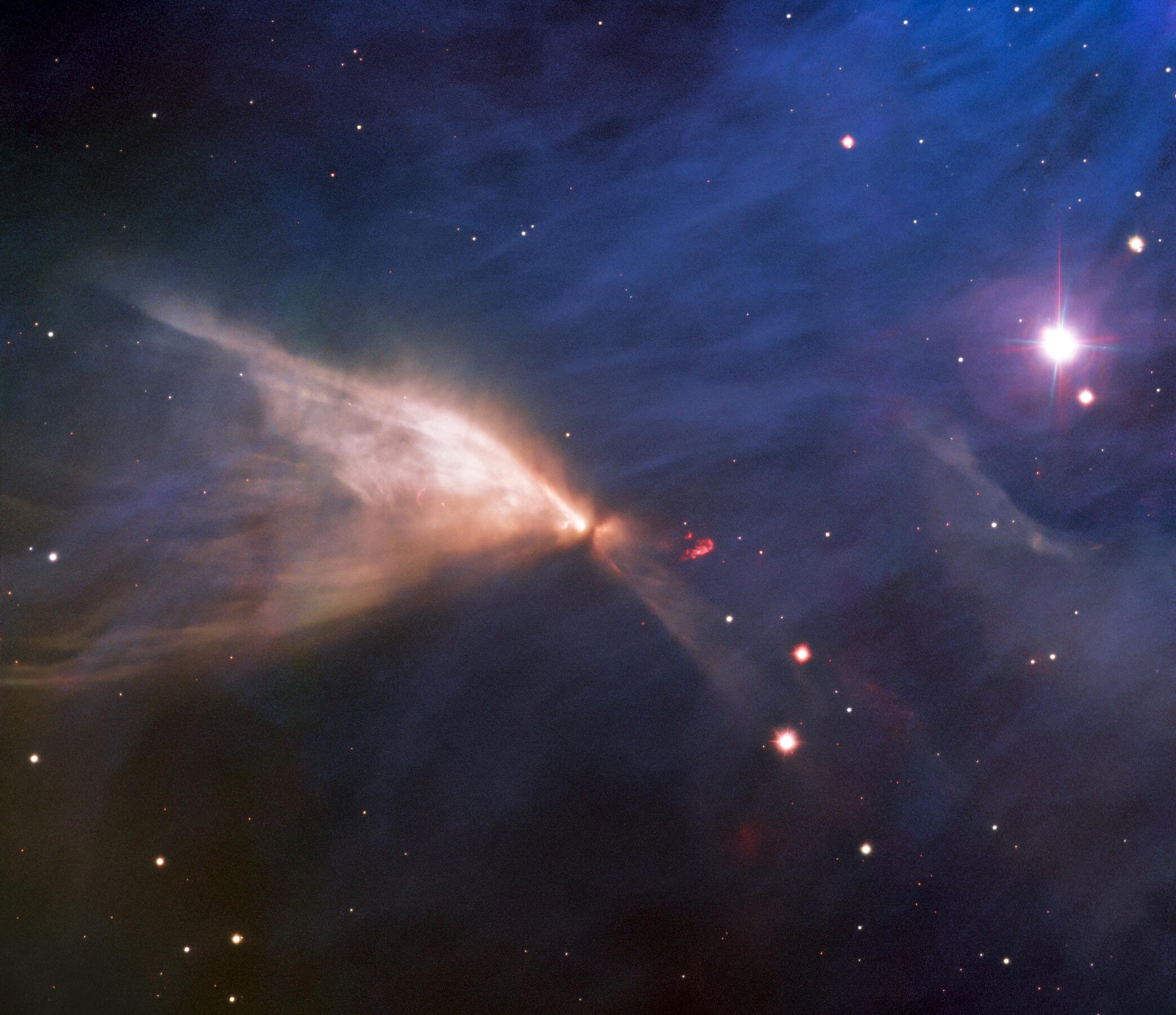
Captured by the Gemini South telescope, the Chamaeleon Infrared Nebula resembles a butterfly with only one wing, nestled in a star-forming cloud. It centers on a budding star surrounded by a potential planet-forming disk.
This ethereal image, captured from Chile by the international Gemini Observatory, a Program of NSF’s NOIRLab, looks as delicate as a butterfly’s wing. It is, however, a structure known as the Chamaeleon Infrared Nebula, which is located near the center of the mammoth Chamaeleon I dark cloud, one of the nearest star-forming regions in our Milky Way.
This breathtaking visible-light image, taken with the Gemini South telescope, looks as though it is ready to flutter off the screen. This apparently wispy object is an outflow of gas known as the Chamaeleon Infrared Nebula — so named because it is bright at some infrared wavelengths of light, although it can also be seen in visible light, as in this view. Hidden at the core of this reflection nebula, and at the center of this image, is the engine of the nebula, a low-mass star (less massive than our Sun) that is eclipsed by a dark vertical band. Even though it is concealed from view, this young, cool star emits streams of fast-moving gas that have carved a tunnel through the interstellar cloud from which the young star formed. Infrared and visible light emitted by the star escapes along this tunnel and scatters off its walls, giving rise to the wispy reflection nebula.
The bright red object to the right of the image center marks where some of the fast-moving stream of gas lights up after colliding with slower-moving gas in the nebula. It is known as a Herbig-Haro (HH) object and has the designation HH 909A. Other Herbig-Haro objects have been found along the axis of the star’s outflow beyond the edges of the image to the right and left.
Astronomers have suggested that the dark band at the center of the Chamaeleon Infrared Nebula is a circumstellar disk — a reservoir of gas and dust orbiting the star. Circumstellar disks are typically associated with young stars and provide the materials needed to build planets. The reason the disk appears as a band rather than a circle in this image is because it is edge-on, only revealing one edge to observers here on Earth. Astronomers believe that the nebula’s central star is a young stellar object embedded within the disk.
The background nebulosity, appearing in blue in this image, is reflecting light from a nearby star located outside the frame.
The Chamaeleon Infrared Nebula resides within the larger Chamaeleon I dark cloud, which is neighbored by the Chamaeleon II and Chamaeleon III dark clouds. These three dark clouds collectively comprise the Chamaeleon Complex, a large area of star formation that occupies almost the entirety of the constellation Chamaeleon in the southern sky.
The gorgeous detail in this image is thanks to the southern edition of the twin Gemini Multi-Object Spectrographs (GMOS), located atop Cerro Pachón in Chile at Gemini South, part of the international Gemini Observatory, a Program of NSF’s NOIRLab. GMOS has imaging capabilities in addition to being a spectrograph,[1] which makes it a very versatile instrument.
“GMOS-South is the perfect instrument to make this observation, because of its field of view, which can nicely capture the whole nebula, and because of its ability to capture the emission from the nebula’s ionized gas,” said NOIRLab instrument scientist German Gimeno.
The image was produced by NOIRLab’s Communication, Education & Engagement team as part of the NOIRLab Legacy Imaging Program.
Notes
- GMOS — the instrument used to capture this image — is a spectrograph. Spectrographs work by splitting light according to its wavelength (imagine a prism splitting sunlight into a rainbow of colors, but much more precisely). This allows astronomers to interpret characteristics such as the chemical composition of celestial objects. This image, however, was not made from spectroscopic data but created using an observing technique called imaging, in which the light from a celestial object is recorded by a charge-coupled device (CCD). Different filters can isolate different wavelength ranges of light, allowing a detailed, multicolor composite image to be constructed.
NSF’s NOIRLab (National Optical-Infrared Astronomy Research Laboratory), the US center for ground-based optical-infrared astronomy, operates the international Gemini Observatory (a facility of NSF, NRC–Canada, ANID–Chile, MCTIC–Brazil, MINCyT–Argentina, and KASI–Republic of Korea), Kitt Peak National Observatory (KPNO), Cerro Tololo Inter-American Observatory (CTIO), the Community Science and Data Center (CSDC), and Vera C. Rubin Observatory (operated in cooperation with the Department of Energy’s SLAC National Accelerator Laboratory). It is managed by the Association of Universities for Research in Astronomy (AURA) under a cooperative agreement with NSF and is headquartered in Tucson, Arizona. The astronomical community is honored to have the opportunity to conduct astronomical research on Iolkam Du’ag (Kitt Peak) in Arizona, on Maunakea in Hawai‘i, and on Cerro Tololo and Cerro Pachón in Chile. We recognize and acknowledge the very significant cultural role and reverence that these sites have to the Tohono O’odham Nation, to the Native Hawaiian community, and to the local communities in Chile, respectively.
Never miss a breakthrough: Join the SciTechDaily newsletter.
Follow us on Google and Google News.
3 Comments
I’ve been working for this company online for 2 years now and i never been happier…
Visit following page for more information…
Have these people never seen a resting butterfly who rests with wings folded? It is certainly a beautiful shot of the Universe.
good day, chief blog on unctuous loss. equivalent helped.