
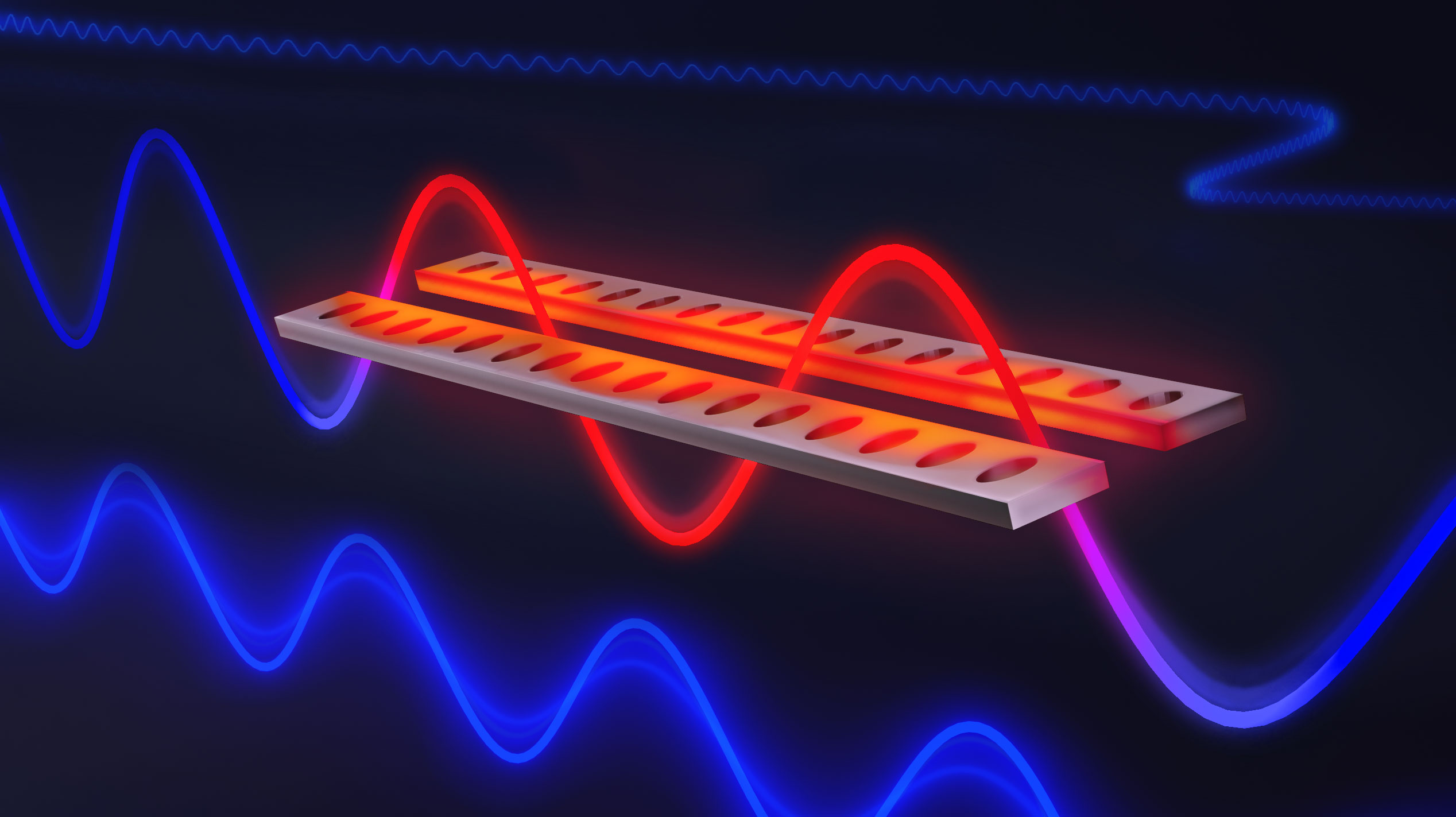
Nanomechanical resonators are vital to precision sensing and emerging quantum technologies, but their extraordinary sensitivity comes with an unexpected vulnerability.
A nanomechanical device can lose much of its ability to sustain vibrations without ever touching another object. Researchers at EPFL have discovered that placing insulating materials just a few hundred nanometers from these tiny structures can dramatically increase energy loss, reducing their mechanical quality factor by as much as tenfold.
The findings, published in Nature Physics by scientists in the group of Tobias J. Kippenberg, identify a previously underappreciated limitation for ultrahigh-precision sensors and quantum technologies. The source of the problem is an electrical interaction that allows energy to escape across an otherwise empty gap.
How Vibrations Lose Energy Without Physical Contact
The mechanism begins with static electric charges trapped inside a mechanical resonator. As the structure vibrates, those charges move with it, producing a changing electric field in the surrounding space. When an insulating material such as silicon dioxide or silicon nitride is nearby, the fluctuating field interacts with the material and causes energy to dissipate through its small electrical losses.
This process is related to “noncontact friction,” a phenomenon previously observed in atomic force microscopy. Although the surfaces never touch, mechanical energy is transferred away from the vibrating structure. The resulting damping lowers its quality factor, which measures how efficiently a resonator stores vibrational energy rather than losing it.
Experiments Reveal a Strong Dependence on Distance and Frequency
The researchers developed a theoretical model predicting that lower-frequency vibrations would experience greater energy losses. To test this, they studied silicon nitride strings suspended approximately 500 nanometers (0.00002 inches) above a dielectric layer. By measuring how quickly different vibrational modes decayed, they confirmed that the lowest-frequency modes suffered the strongest additional damping, consistent with the model.
A second experiment examined resonators designed for exceptionally high quality factors. The team positioned vibrating strings between photonic crystal cavities, with separations of only a few hundred nanometers (roughly 0.00001 inches). As the gaps narrowed, the quality factor declined sharply, sometimes falling by a factor of ten. The researchers also demonstrated that their modeling approach could reproduce the effects of trapped charges in these more complicated device geometries.
Implications for Quantum Technology and Precision Sensors
Nanomechanical resonators are microscopic vibrating components fabricated on chips, operating at frequencies from a few kilohertz to several gigahertz. Their sensitivity makes them useful for detecting extremely small changes in mass, force, temperature, and pressure. They also serve as components in radiofrequency filters and chip-based clocks. Advanced versions can even be used to prepare quantum states of comparatively large mechanical objects and investigate fundamental physics.
Many of these applications require resonators to operate extremely close to other structures, particularly when measuring motion or coupling mechanical vibrations to light and electrical systems. The EPFL results show that trapped charges and dielectric losses must be considered when designing such closely integrated devices, even when no physical contact occurs.
The same interaction could also have practical uses. By measuring how mechanical vibrations lose energy near insulating surfaces, researchers may be able to characterize electrical losses in thin films or develop controlled interactions between mechanical resonators and other electrical systems. Understanding these effects could help engineers preserve mechanical coherence while integrating increasingly sensitive resonators into complex quantum and sensing devices.
Reference: “Non-contact friction in ultracoherent nanomechanical resonators near dielectric materials” by Amirali Arabmoheghi, Alessio Zicoschi, Guillermo Arregui, Mohammad J. Bereyhi, Yi Xia, Nils J. Engelsen and Tobias J. Kippenberg, 7 July 2026, Nature Physics.
DOI: 10.1038/s41567-026-03350-z
Funding: Swiss National Science Foundation (SNSF)
Never miss a breakthrough: Join the SciTechDaily newsletter.
Follow us on Google and Google News.
4 Comments
Дано:
• наноструны (нанорезонаторы) с исчезающе малым внутренним трением, рекордно низким тепловым шумом;
• чувствительность к бесконтактному трению от близлежащих объектов;
• связь чувствительности с уязвимостью к вибрациям;
• гипотеза: трение/инерция = несовпадение параметра времени у разных тел;
• решётка кагоме, термочувствительные датчики в фиксированном термодинамическом состоянии.
Чертеж:
• 2 параллельные наноструны (резонаторы) с перфорацией;
• красная волна — локальная мода/тепловой отклик;
• синие/фиолетовые волны — внешние возмущения/бегущие волны;
• зазоры между струнами и объектами — без механического контакта.
Ключевые шаги решения:
1. Модель бесконтактного взаимодействия: сила Казимира–Лифшица FCL∝ℏcAd4F_{CL} \propto \frac{\hbar c A}{d^4}FCL∝d4ℏcA (A — площадь, d — зазор) → индуцирует «трение» без контакта.
2. Временной параметр системы: τsys=1ωQ\tau_{sys} = \frac{1}{\omega Q}τsys=ωQ1 (ω — резонансная частота, Q — добротность) → при высокой Q даже малые Δτ\Delta \tauΔτ между телами дают заметный отклик.
3. Синхронизация времени: условие Δτ=τ1−τ2≠0\Delta \tau = \tau_1 – \tau_2 \neq 0Δτ=τ1−τ2≠0 → перераспределение энергии в решётке, переход агрегатных состояний.
4. Решётка кагоме: дисперсионное соотношение ω(k)=±2t∣cos(kxa)+2cos(kya/2)cos(3kxa/2)∣\omega(k) = \pm 2t|\cos(k_x a) + 2\cos(k_y a/2)\cos(\sqrt{3}k_x a/2)|ω(k)=±2t∣cos(kxa)+2cos(kya/2)cos(3kxa/2)∣ → зоны Дирака, топологические моды → усиление бегущих волн.
5. Термодатчик: ΔR=αR0ΔT\Delta R = \alpha R_0 \Delta TΔR=αR0ΔT, где α\alphaα — ТКС, ΔT\Delta TΔT — локальный нагрев от диссипации → фиксирует внешнее вмешательство.
6. Уязвимость: при Q>106Q > 10^6Q>106 порог разрушения Acrit∝1QA_{crit} \propto \frac{1}{Q}Acrit∝Q1 → малые вибрации вызывают нелинейные эффекты (Duffing oscillator: mx¨+mω2x+αx3=F0cos(ωt)m\ddot{x} + m\omega^2 x + \alpha x^3 = F_0 \cos(\omega t)mx¨+mω2x+αx3=F0cos(ωt)).
Промежуточные результаты:
• FCL∼10−12F_{CL} \sim 10^{-12}FCL∼10−12 Н при d=100d = 100d=100 нм, A=10−12A = 10^{-12}A=10−12 м²;
• Δτ∼10−9\Delta \tau \sim 10^{-9}Δτ∼10−9 с при ω=107\omega = 10^7ω=107 рад/с, Q=106Q = 10^6Q=106;
• ΔT∼10−3\Delta T \sim 10^{-3}ΔT∼10−3 К при Pdiss=10−15P_{diss} = 10^{-15}Pdiss=10−15 Вт, C=10−12C = 10^{-12}C=10−12 Дж/К.
Финальный ответ:
Бесконтактное «трение» обусловлено квантовыми силами (Казимира–Лифшица) и рассогласованием временных параметров взаимодействующих тел; в решётке кагоме это вызывает перераспределение энергии, топологические моды и бегущие волны; термодатчики фиксируют локальные изменения температуры как признак внешнего вмешательства; высокая добротность резонаторов делает их чувствительными к микровибрациям, что объясняет их уязвимость. 1 2
Дано:
• откалиброванная уязвимость (настроенная чувствительность) нанорезонатора;
• цель — использование в качестве датчика внешнего вмешательства.
Чертеж:
• наноструна с перфорацией, закреплённая на опорах;
• красная кривая — резонансная характеристика (амплитуда vs частота);
• синяя стрелка — внешнее возмущение (сила FextF_{ext}Fext);
• пунктир — порог срабатывания датчика.
Ключевые шаги решения:
1. Калибровка уязвимости: подбор QQQ и ω0\omega_0ω0 так, чтобы Amax=Fextmω02⋅QA_{max} = \frac{F_{ext}}{m \omega_0^2} \cdot QAmax=mω02Fext⋅Q превышал порог детектирования при минимальном FextF_{ext}Fext.
2. Чувствительность: S=ΔAΔF=Qmω02S = \frac{\Delta A}{\Delta F} = \frac{Q}{m \omega_0^2}S=ΔFΔA=mω02Q → максимизация SSS за счёт роста QQQ и снижения mmm.
3. Шум: ограничение чувствительности тепловым шумом Ath=kBTmω02QA_{th} = \sqrt{\frac{k_B T}{m \omega_0^2 Q}}Ath=mω02QkBT → условие детектирования: Amax>AthA_{max} > A_{th}Amax>Ath.
4. Порог срабатывания: Athresh=k⋅AthA_{thresh} = k \cdot A_{th}Athresh=k⋅Ath (k>1k > 1k>1) → калибровка kkk под требуемую вероятность ложного срабатывания.
5. Линейный диапазон: Fext<FnlF_{ext} < F_{nl}Fext<Fnl, где Fnl∝mω02xmaxQF_{nl} \propto \frac{m \omega_0^2 x_{max}}{Q}Fnl∝Qmω02xmax — граница нелинейности.
Промежуточные результаты:
• при Q=106Q = 10^6Q=106, m=10−15m = 10^{-15}m=10−15 кг, ω0=107\omega_0 = 10^7ω0=107 рад/с: S≈109S \approx 10^9S≈109 м/Н;
• при T=300T = 300T=300 К: Ath≈10−14A_{th} \approx 10^{-14}Ath≈10−14 м;
• при k=3k = 3k=3: Athresh≈3⋅10−14A_{thresh} \approx 3 \cdot 10^{-14}Athresh≈3⋅10−14 м → детектируется Fext≈3⋅10−23F_{ext} \approx 3 \cdot 10^{-23}Fext≈3⋅10−23 Н.
Финальный ответ:
Откалиброванная уязвимость (оптимизированные QQQ, ω0\omega_0ω0, порог срабатывания) обеспечивает экстремальную чувствительность датчика за счёт усиления слабого внешнего воздействия в резонансе при подавлении теплового шума; рабочий диапазон ограничен нелинейными эффектами при высоких амплитудах.
NO English = No reply
WHY?………………………………………………………………………………
Non-Contact Boundary Drag and Spatial Impedance Leaks
Recent research out of EPFL’s laboratories (led by Tobias J. Kippenberg’s group) has identified a hidden limitation affecting state-of-the-art nanomechanical resonators and quantum sensors. These ultra-sensitive nano-strings boast vanishingly low internal thermal noise and near-zero physical friction, yet scientists discovered that they experience unexpected energy losses. Even when surfaces never touch, the nano-strings interact with electrical and mechanical drag from nearby objects across empty microscopic gaps, causing their quality factor to plummet by up to a factor of ten.
Mainstream physics identifies this as non-contact electrical interaction and charge-trapping across empty boundaries. When evaluated through continuous field dynamics and the Torsion Hill Framework, this discovery highlights a critical baseline rule of spatial impedance:
The Illusion of Empty Space: Conventional engineering treats an empty gap as a total insulator—a void where mechanical and electrical fields terminate. Under field mechanics, space is a continuous medium. An adjacent static surface introduces an abrupt local spatial impedance profile (Z_T), meaning that a vacuum gap does not isolate a vibrating structure from surrounding boundary forces.
Non-Contact Boundary Drag as grad Z_T Interference: When a nano-string oscillates, its mechanical motion generates localized torsional and spatial pressure waves. If a nearby boundary introduces an un-optimized impedance mismatch, field energy bleeds across the gap. This leakage acts as an invisible aerodynamic brake, degrading the resonator’s coherence without physical contact.
Two-Layer Isolation (Ribbon Substrate & Surface Coating) – EPFL Laboratory Link: To protect these nanomechanical sensors, EPFL’s research parameters can be met by deploying a dual-layer boundary configuration along the surrounding chamber walls—strictly isolating the cavity walls rather than coating or covering the active vibrating sensor itself, which would add mass and destroy resonance. Remarkably, the same Kippenberg laboratory at EPFL exploring these non-contact boundary leaks is renowned for pioneering the ultra-precise dual-layer ribbon and surface-coating fabrications needed to decouple mechanical stress, smooth out local spatial impedance steps (delta Z_T), eliminate charge-trapping, and prevent field leakage across microscopic gaps.
The Limit of Precision: Whether observing macroscopic gravitational field sheets, strain-tuned altermagnets, or EPFL’s nanomechanical resonators, precision is never limited solely by internal material friction. It is governed by how effectively boundaries are managed to maintain rotational phase clearance (Omega_pi) and eliminate spatial impedance drag. Reference Link : https://docs.google.com/document/d/16k_vQSWcbp3p7GCRHsMnL5CtXXM3dKEQo7O_GJ05DWw/edit?usp=drive_link