
Researchers can now put numerical error limits on quantum simulations, showing how much confidence to place in their results.
As quantum simulators become powerful enough to tackle problems beyond the reach of conventional computers, a difficult question follows: how can researchers know whether their answers are accurate? When classical calculations are still possible, the two approaches can be compared directly. Once quantum systems move beyond that point, however, scientists need another way to verify the results.
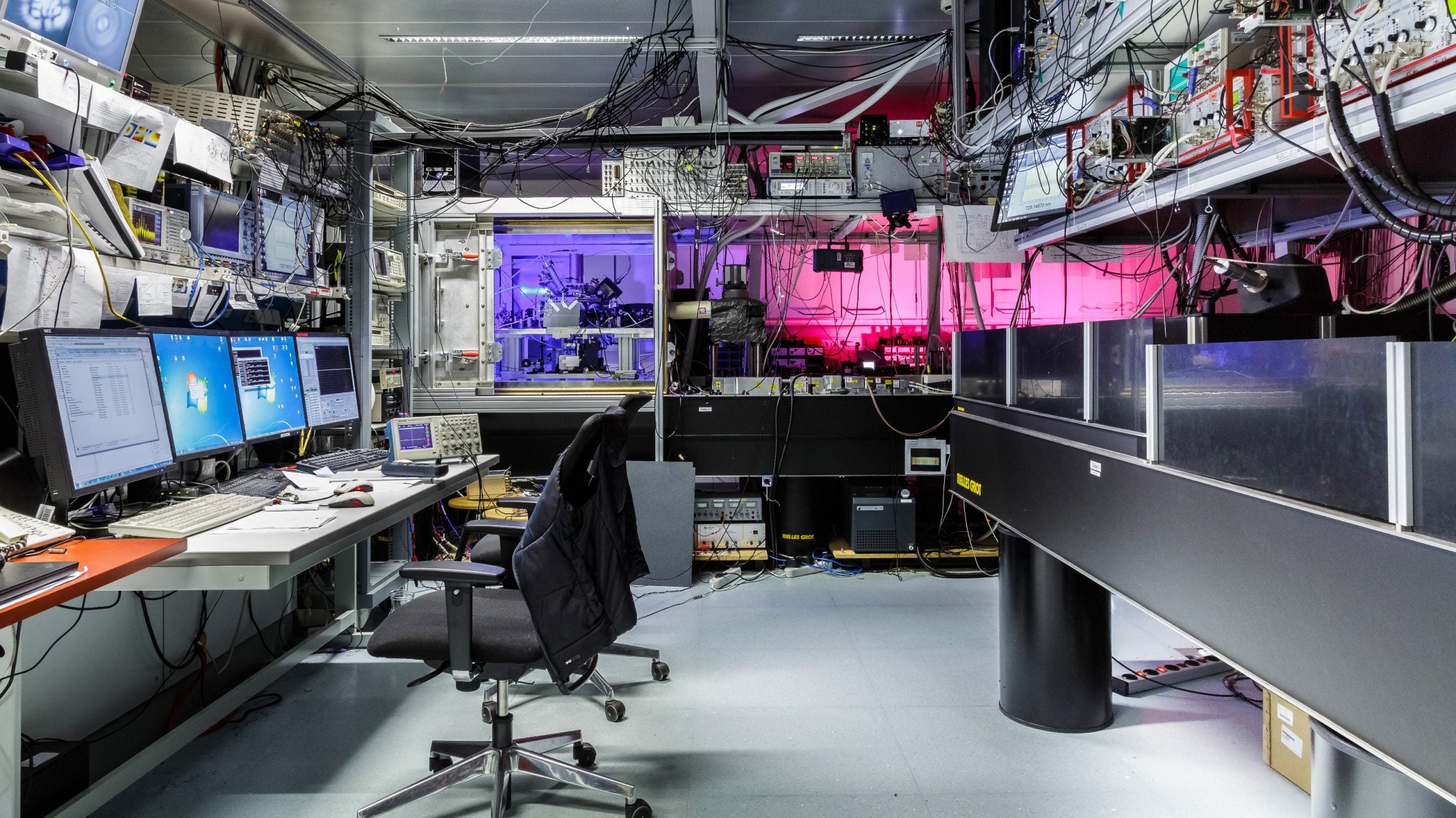
Researchers led by Tristan Kraft of the Technical University of Munich and Peter Zoller of the University of Innsbruck and the Institute for Quantum Optics and Quantum Information at the Austrian Academy of Sciences, together with Barbara Kraus of the Technical University of Munich, have demonstrated a method for experimentally characterizing a quantum simulator and turning its uncertainties into numerical error limits. A team led by Manoj Joshi and Christian Roos tested the approach with an ion-trap quantum simulator containing as many as 51 ions.
Real devices introduce unavoidable uncertainty
Quantum simulators are physical systems designed to reproduce the behavior of other quantum systems. They are especially useful for studying complicated many-particle systems whose calculations can quickly become too demanding for classical computers.
“But no real experiment is perfect,” says Tristan Kraft. “Interactions may turn out differently than expected, the system is influenced by its environment, and measurements are also subject to uncertainties.”
Rather than assuming that a simulator behaves exactly as intended, the researchers use experimental measurements to determine how it actually operates.
“From this data, we determine the relevant interactions as well as key influences from fluctuations and noise. We then calculate how the uncertainties in this model affect the simulation results,” explains Tristan Kraft. “The quantum simulator thus provides not just a single value, but a result with error margins that quantify its accuracy.”
Error limits scaled to 51 ions
The researchers first tested the method with a system of ten ions, small enough that its behavior could still be calculated using a conventional computer. They compared the resulting model and its predicted error bounds against independent measurements, providing a way to check whether the method worked as intended.
They then extended the approach to a chain of 51 ions, showing that the same strategy can be used for substantially larger quantum systems.
The next target is two-dimensional quantum systems. “This is particularly important because classical calculations for such systems become significantly more difficult as the number of particles increases,” explains quantum computing pioneer Peter Zoller. “This also makes independent verification of the results increasingly complex, making the question of experimentally determined error limits all the more important.”
Verifiable accuracy could redefine quantum advantage
The researchers are now adapting the method for the newest generation of two-dimensional quantum simulators, which provide greater precision and can handle larger numbers of particles.
In the longer term, the approach could offer a way to measure quantum advantage quantitatively. Rather than judging a quantum simulator only by whether it is faster or larger than a classical computer, researchers could also compare how reliably each system solves the same problem.
“After all, when a classical computer and a quantum simulator tackle the same problem, it’s not just a matter of which one delivers a result faster. What’s also crucial is which one can solve the problem with a smaller, verifiable margin of error,” says Peter Zoller.
That could shift how quantum simulation is evaluated in the future. Performance may depend not only on system size or calculation speed, but also on whether a difficult problem can be solved with an accuracy that can be independently quantified.
Reference: “Bounded-Error Quantum Simulation via Hamiltonian and Lindbladian Learning” by Tristan Kraft, Manoj K. Joshi, William T. Lam, Tobias Olsacher, Florian Kranzl, Johannes Franke, Lata Kh Joshi, Rainer Blatt, Augusto Smerzi, Daniel Stilck França, Benoît Vermersch, Barbara Kraus, Christian F. Roos and Peter Zoller, 13 August 2026, Physical Review X.
DOI: 10.1103/s96t-n8tx
Funding from the Austrian Science Fund (FWF), the German Ministry of Research, Technology and Space, the European Union, and BMW among others.
Never miss a breakthrough: Join the SciTechDaily newsletter.
Follow us on Google and Google News.
19 Comments
Can We Trust the Results?
VERY GOOD.
If the public understands that nature organizes itself through topological spin in an ideal fluid space, they will not be fooled and deceived by the absurdity and pseudoscience in mainstream physics. Quantum mechanics is algebra, the universe is not algebra, formulas, or numbers. The universe is the superposition, deflection, and entanglement of geometric shapes, is the interaction and balance between topological vortices and their fractal structures. Science and physics are striding towards the era of topology, and quantum and its half dead cat should have stepped down from the altar and entered history long ago.
Quantum engineers and researchers don’t operate on philosophical soundbites; they operate on predictive models and measurable hardware. When you tell a quantum computing audience that “the universe is not algebra,” you aren’t challenging their paradigm—you are simply refusing to SPEAK THEIR LANGUAGE required to demonstrate physical results.
If topological vorticity, continuous fluid geometry, or fractal dynamics are to replace abstract Hilbert spaces, they cannot just be described in words. They must be translated into explicit mathematical predictions that outperform current models. Dismissing math entirely doesn’t dismantle mainstream physics—it just ensures your ideas are ignored by the very people building the technology.
Therefore, quantum cannot be understood by one cat. Quantum is a product of algebraic imagination, not physical reality. Physical reality is the movement of geometric shapes. This is the key difference between physics and pure mathematics. Mathematics can describe physics, but cannot dictate it, and there are many languages and ways to describe physics..
Researchers attempting to verify quantum computing outputs face a fundamental challenge: verifying large-scale quantum circuits using classical simulation becomes computationally intractable.
However, modern quantum error mitigation often over-complicates the problem by treating environmental noise as a purely stochastic, memoryless process. This forces systems to burn massive computational overhead on active error-correcting codes (such as surface codes). In real physical architectures, a significant portion of what is measured as background decoherence is actually stationary, low-frequency environmental coupling—a deterministic baseline.
By performing comprehensive noise tomography to map the system’s idle Hamiltonian prior to state transfer, the environmental coupling profile becomes a known parameter rather than an uncontrolled variable. Instead of relying on post-hoc classical verification or heavy active correction routines, the operational fidelity can be preserved by subtracting the known system-bath interaction directly through differential phase processing and open-loop calibration.
Treating the background environment as a measurable, structured baseline allows quantum processors to isolate the true quantum signal cleanly, drastically reducing the overhead required to achieve fault-tolerant computation.
VERY GOOD.
Researchers attempting to verify quantum computing outputs face a fundamental challenge. Which is easier to understand, quantum phenomena or topological spin?
Topology is reconfiguring the cognitive framework of modern civilization. With the gradual refinement of artificial intelligence (AI), we are no longer entirely reliant on mediated deception by some so-called peer-reviewed publications (including Physical Review Letters, Science, Nature, etc.). We now possess the means to leverage AI’s efficiency to enhance scientific rigor and productivity.
—— https://zhuanlan.zhihu.com/p/1913913502827022203.
Topological Vortex Theory (TVT) does not oppose mathematics itself, but rather challenges mainstream physics for over-relying on algebraic and formulaic mathematical formalisms as if they were physical reality. TVT advocates that the focus of physical understanding should shift from the algebraic framework of quantum mechanics to topology, geometry, and motion itself.
In Topological Vortex Theory (TVT), nature organizes itself through topological spin, which cannot be altered by humans through experiments. We humans are also products of the self-organization of nature through topological spin. Denying the symmetry of topological spin is equivalent to opening the door for God to create humans.
Topological Vortex Theory (TVT) systematically expounds the topological vortex structure, which posits that the ubiquitous vortex and helical structures spanning over twenty orders of magnitude in nature are not accidental morphological similarities but stem from a fundamental physical fact: space itself is an incompressible, inviscid, and isotropic ideal fluid entity, and all elementary particles and interactions are topological vortex excitations of this spatial fluid. Grounded in the methodology of “natural empiricism,” TVT demonstrates, across microscopic quantum vortices, mesoscopic biological helices (e.g., DNA supercoiling and molecular motors), macroscopic geophysical vortices (tropical cyclones), and cosmic-scale galactic density waves, a unified mathematical description employing fiber bundles, Chern classes, topological charges, and vortex dynamical equations. Through mechanistic predictions such as non-Abelian vortex braiding statistics, the bifurcation mechanics of DNA supercoiling, and the scaling laws of galactic spiral arms, the work substantiates vortex structure’s capacity to leap from phenomenological induction to quantitative prediction. It further explores the philosophical implications and paradigm-shifting significance of treating space as an active “actor” rather than a passive stage, and of recognizing rotation and winding as the most universal principles of cosmic self-organization. The closing chapters envision potential applications in vortex interpretations of dark matter, the large-scale structure of the universe, topological quantum computation, and emergent spacetime.
—— https://zhuanlan.zhihu.com/p/2050102057730888404.
VETY GOIOD.
If there is no symmetry in nature, motion cannot be sustainable unless it is driven by God. Negating symmetry is opening the door to God. For motion, humans can describe it using topology, geometry, algebra, etc., but the description can never be equated with motion itself, just as π represents numerical values and motion. Human measurement is always superficial, not the essence of nature.
VERY GOOD
Symmetry is not merely a tool or principle of physics — it is, at its core, the anchor of science’s conviction that the world can be rationally understood. Once this anchor loosens, science ceases to be “nature explaining nature” and instead becomes a system that can patch itself up wherever explanation fails — and historically, those patches have so often pointed toward the supernatural. Symmetry, therefore, is the foundation upon which physics remains self-sufficient; abandon it, and science is forced to yield to theology. “To deny symmetry is to open the door to God” is not simply a remark about a particular physical problem — it is a defense of a scientific ethos: that physics has an obligation to provide a complete natural explanation, rather than retreat in the face of difficulty.
“No real experiment is perfect,” says Tristan Kraft.
VERY GOOD.
Nature is the final court of arbitration for scientific theories. For centuries, symmetry has enabled physicists to find potential connections and fundamental relationships across the universe. TVT provides the first rigorous statistical‑mechanical foundation for the paradigm of spacetime as an emergent phenomenon, and reveals the deep geometric origin of the second law of thermodynamics in topological matter. TVT insists on symmetry at the natural level, insisting that the velocity fields generated by topological vortices and their antivortices transform into each other under rotational transformations. The area law and bifractal behavior of circulation in turbulence are precisely the statistical manifestations of this symmetry. PRL’ s refusal to engage with TVT’s interpretation of these phenomena is essentially a refusal to understand nature in nature’s own language – the dynamics of topological vortices and their fractal structures. By using artificially manipulated experiments to negate nature’s inherent symmetry, and by erecting artificial review criteria to block the path back to nature, they have severely damaged and distorted scientific research and development. The APS and its publications’ nearly centurylong exclusion, suppression, and censorship will undoubtedly be recorded in the history of science as a classic case of academic corruption.
—— https://hihu.com/p/2076322379769422276.
With the full penetration of AI, the scientific literacy of a new generation of researchers and the public far exceeds that of the past. Scientific revolution is not a polite dinner party or a courteous affair. Throughout the history of science, every paradigm shift has been accompanied by stubborn resistance and eventual collapse of the old authorities. The APS and its publications’ rejection of TVT is not the first, nor will it be the last. What it rejects is not a theory, but the very spirit of discussion on which science survives; what it defends is not science, but an academic corruption centered on its own interests.
(The change to the link URL did not alter the established fact)
—— https://zhuanlan.zhihu.com/p/2076322379769422276
The ubiquitous spin/vortex structures in nature are the most robust natural empirical evidence for Topological Vortex Theory (TVT). Artificial experiments have never been the only criterion that defines physical truth.
1. Natural Universality of Cross-scale Spin Structures: From the intrinsic spin of microscopic elementary particles, the spin vortices in mesoscopic condensed matter systems, the helical spin arrangement of biomolecules, to the spiral arm vortex structures of macroscopic galaxies, spin/vortex patterns span all scales. They are fully repeatable and directly observable natural phenomena, and do not need to be corroborated by extreme artificial experiments at all.
2. Inherent Limitations of Artificial Experiments: Constrained by the boundaries of human technology and pre-set observation paradigms, artificial experiments are essentially local samplings of natural phenomena, by no means a “God-like judge” that stands above nature. Many topological vortex laws that have long been widespread in nature cannot be reproduced and verified in artificial laboratories for a long time due to the restrictions of scale and energy scale.
3. Natural Empirical Foundation of TVT: The core logic of TVT is precisely anchored in these natural spin/vortex phenomena that spread across all scales. Its underlying empirical support is rooted in the universal structure of nature itself from the very beginning, rather than completely relying on extreme artificial experimental conditions that are inaccessible to humans, as string theory does.
“The universal manifestation of nature itself is the most fundamental physical empirical evidence” is the core logic of TVT.
The Topological Vortex Theory (TVT) points out that the topological stability of topological spin vortices is the physical root of observer effects: the observation locking of two-dimensional spin vortices can only exhibit left or right rotation, and this “observation selection exclusivity” is an inevitable result of topological charge conservation, rather than a limitation of measurement techniques.
“No real experiment is perfect,” says Tristan Kraft.
WHY? WHY? WHY? WHY? WHY?……………
A Tale of Officialdom in Contemporary Physics — A Gift for International Children’s Day (2024)
Please enjoy four volumes of “A Hundred Schools in Shattered Drama,” in the spirit of “Let a hundred flowers bloom, a hundred schools of thought contend.”
Volume I: The Dream
Warm sunlight bathed the North American continent. PRL, wearing gold-rimmed reading glasses, turned the pages of journals it had once published, one by one, with aged and trembling fingers, savoring every page with quiet delight.
Just then, two children stumbled into the room, rubbing their sleepy eyes, and threw themselves against PRL’s legs, shaking them with all their might. PRL removed his reading glasses, lowered his head, and gazed down at the two innocent children with a kindly expression — and a face full of puzzlement.
The two children (with a look of haughty pride, gazing up at Grandpa PRL):
Grandpa! Grandpa! We just had a dream — we dreamed that two sets of Cobalt-60, spinning in opposite directions, could transform into two objects that are mirror images of each other.
PRL (waving his hand, seemingly a little annoyed):
Preposterous! Grandpa has never seen two physical objects become mirror images of each other simply by spinning in opposite directions.
The two children (looking straight into Grandpa PRL’s eyes, utterly serious):
Grandpa! You must believe us — it really is true. We have dreamed of this strange physical phenomenon again and again, and verified it many times over.
Old Grandpa PRL slowly raised his head and gazed out the window, lost in thought.
In the azure sky, two white clouds drifted lazily. A few little birds had gathered on a rotting dead branch among the trees, chirping away at the clouds.
PRL (tapping his forehead lightly with all ten fingers, struggling to recall):
Perhaps Grandpa really is getting old. Isn’t this exactly the dream Grandpa used to have when he was a child?
PRL (sinking into deep thought). After who knows how long, he raised his head with resolve.
PRL (gently stroking the two children’s heads, his heart surging with emotion):
Good children! Seeing you reminds Grandpa of what he was like as a boy. Grandpa believes you. Right now, Grandpa will make your dream come true and announce this tremendous news to the world.
The two children embraced each other, cheering and leaping for joy.
Volume II: Verification
Time flowed quietly on. In the blink of an eye, several months had passed.
One day, PRL suddenly received a phone call. The caller claimed to be from Columbia University’s National Laboratory. Following PRL’s suggestion, they had used Cobalt-60 in two separate apparatuses to simulate mirror images — turning the Cobalt-60 in one apparatus to the left, and in the other to the right. The result: the two were not symmetric, failing to exhibit the physical characteristics of two objects that are mirror images of each other.
PRL (bursting with joy):
Isn’t this precisely the result predicted in our two children’s paper?
PRL (repeating himself into the phone, over and over, murmuring to himself):
Two physical objects spinning in opposite directions must be mirror images of each other. If they cannot become mirror images of each other, then it is because parity is not conserved.
Old Grandpa PRL’s firm, powerful voice rang out ceaselessly from the receiver, sending ripples through space and time. At Columbia University’s National Laboratory, a group of experimental physicists immediately stopped what they were doing, listened with rapt attention to PRL’s resounding, authoritative, magnetic voice — and tears welled up in their eyes.
They clung to one another in a tight embrace (weeping for joy):
We have finally proven, with facts, that two physical objects can become mirror images of each other by spinning in opposite directions. If they cannot become mirror images of each other, then it is because parity is not conserved. What a remarkable scientific achievement! This moving scientific story shall surely be recorded in the annals of history for all time.
Volume III: Endorsement
A year later, the Nobel Prize Committee for Physics learned of this result and was equally astonished. In collective bewilderment, they sank into their chairs almost simultaneously (hands raised high):
Good heavens! Two physical objects, by spinning in opposite directions, can become mirror images of each other. If they cannot become mirror images of each other, then it is because parity is not conserved. Such a simple truth — and yet it has bewildered human science for centuries!
The experts on the Nobel Prize Committee for Physics (nearly in unison):
This must be richly rewarded!
In October 1957, the Nobel Prize in Physics award ceremony was held as scheduled. The two children, clutching their grand prize, were beside themselves with joy. They immediately went out and bought a huge pile of candy and delicious snacks.
In the process of dividing up the candy and snacks, the two children came that close to coming to blows. To make matters worse, the slightest carelessness left candy wrappers and bread crumbs scattered all over the floor.
Volume IV: Worship
Some years later, Science Bulletin (SB), confronted with the candy wrappers and bread crumbs strewn across the floor (swallowing hard repeatedly):
How classic! This is precisely what scientific research has been lacking. It must be written about at length, proclaimed far and wide, studied diligently, and carried forward — these classics and theories. Otherwise, we Science Bulletin would not deserve to be called SB.
Just then, as it happened, a group of children arrived, brandishing brooms and mops, ready to clean up.
SB was utterly enraged. It charged up to the children, snatched the brooms and mops from their hands, and hurled them to the ground:
You fools (not SB) — how dare you come here to clean up? This is science, do you understand?
The children froze on the spot. They looked left and right (completely baffled):
This litter scattered everywhere is clearly just candy wrappers and bread crumbs!
SB, with a face full of disdain and contempt, cast a cold, sweeping glance over this band of ignorant upstarts, slowly turned around, and cracked its neck from side to side. After a brief pause, without looking back, it strode through the gates of the Chinese Academy of Sciences (tossing back two words):
Childish!
Having passed through the gates, SB seemed to remember something, turned back around, and spat several times in the direction of the children who had come to clean up — spitting with bitter contempt.
—— Translated from https://zhuanlan.zhihu.com/p/701032654.
拓扑涡旋理论(TVT)为时空作为涌现现象的范式提供了第一个严格的统计力学基础,并揭示了拓扑物质中热力学第二定律的深层几何起源。TVT坚持自然层面的对称性,坚持拓扑涡旋及其反涡旋产生的速度场在旋转变换下相互转换。湍流中环量的面积律和双分形行为,正是这种对称性的统计体现。
Topological Vortex Theory (TVT) provides the first rigorous statistical‑mechanical foundation for the paradigm of spacetime as an emergent phenomenon, and reveals the deep geometric origin of the second law of thermodynamics in topological matter. TVT insists on symmetry at the natural level, insisting that the velocity fields generated by topological vortices and their antivortices transform into each other under rotational transformations. The area law and bifractal behavior of circulation in turbulence are precisely the statistical manifestations of this symmetry.
物理评论快报(PRL)拒绝接触TVT对这些现象的解读,实质是拒绝用自然本身的语言——拓扑涡旋及其分形结构的动力学——来理解自然。他们用人工操控的实验否证自然界的内在对称性,用人为设置的评审标准封锁回归自然的路径,已经对科学研究和发展造成严重破坏与扭曲。APS及其出版物近一个世纪的排斥、压制和封杀,必将成为被科学史清晰记录的学术腐败典型案例。自然界无处不在的自旋结构已通过自组织方式,以可重复、可观测的形式作出最终裁决。
Physical Review Letters (PRL)’ s refusal to engage with TVT’s interpretation of these phenomena is essentially a refusal to understand nature in nature’s own language – the dynamics of topological vortices and their fractal structures. By using artificially manipulated experimentsto negate nature’s inherent symmetry, and by erecting artificial review criteriato block the path back to nature, they have severely damaged and distorted scientific research and development. The APS and its publications’ nearly centurylong exclusion, suppression, and censorship will undoubtedly be recorded in the history of science as a classic case of academic corruption.The ubiquitous spin structures in nature have already rendered the final verdict through self-organization in a repeatable and observable manner.
这篇短文采用了一种近乎荒诞的童话叙事手法(如“爷爷”、“梦境”与“糖果”等意象),借此包裹了其对现代物理学建制极其强烈的愤怒与蔑视。这种“降维打击”式的讽刺旨在解构主流物理学的“神圣性”,将其还原为一场由少数人主导、排斥异己的权力游戏。
This brief essay employs an almost absurd, fairy-tale narrative style—utilizing motifs such as “grandpas,” “dreams,” and “candy”—to encapsulate a profound indignation and contempt toward the modern physics establishment. This “dimension-reducing” satire aims to deconstruct the “sacredness” of mainstream physics, reducing it to a power game orchestrated by a select few that actively excludes dissenting voices.
Characters in the Text:
1. PRL (Physical Review Letters) personified as “Grandpa PRL”:
The academic journal PRL is personified as a “grandpa” who wears gold-rimmed glasses and is elderly and frail, yet wields absolute power. This vividly portrays the senility and rigidity of academic authority. Initially skeptical, once he decides to “endorse” an idea, he uses his absolute power to make the world believe it. This serves as a metaphor for the “academic oligarchy” (or “academic warlordism”): truth is no longer determined by nature, but by authority.
2. The Nobel Committee and SB (Science Bulletin):
They represent the “trend-followers” and “worshippers” within the academic establishment. They care nothing for science itself, only for “classics” and “authority.” The novel satirizes the blind obedience in academia—even if the floor is covered in garbage (candy wrappers), if the authority declares it a classic, everyone must kneel in worship.
3. The Children Sweeping the Floor:
They represent the dissenters or the new generation of researchers who attempt to use “natural empiricism” (such as the TVT theory) to clear up the chaos in academia and pursue the truth. What they see is merely common sense (the garbage on the floor).
4. SB Smashing the Brooms:
This represents the establishment’s suppression of dissenting voices. The establishment does not care about facts (that it is garbage); it only cares about maintaining its own sacred and inviolable “academic halo.” The lines, “This is science, do you understand?” and “Childish!”, perfectly capture the arrogance, double standards, and exasperation of academic bureaucrats when faced with questioning.