

Could there be a new kind of light in the universe? Since the late 19th century, scientists have understood that, when heated, all materials emit light in a predictable spectrum of wavelengths. Research published today in Nature Scientific Reports presents a material that emits light when heated that appears to exceed the limits set by that natural law.
In 1900, Max Planck first mathematically described a pattern of radiation and ushered in the quantum era with the assumption that energy can only exist in discrete values. Just as a fireplace poker glows red hot, increasing heat causes all materials to emit more intense radiation, with the peak of the emitted spectrum shifting to shorter wavelengths as heat rises. In keeping with Planck’s Law, nothing can emit more radiation than a hypothetical object that absorbs energy perfectly, a so-called “blackbody.”
The new material discovered by Shawn Yu Lin, lead author and a professor of physics at Rensselaer Polytechnic Institute, defies the limits of Planck’s law, emitting a coherent light similar to that produced by lasers or LEDs, but without the costly structure needed to produce the stimulated emission of those technologies. In addition to the spectroscopy study just published in Nature Scientific Reports, Lin previously published an imaging study in IEEE Photonics Journal. Both show a spike in radiation at about 1.7 microns, which is the near-infrared portion of the electromagnetic spectrum.
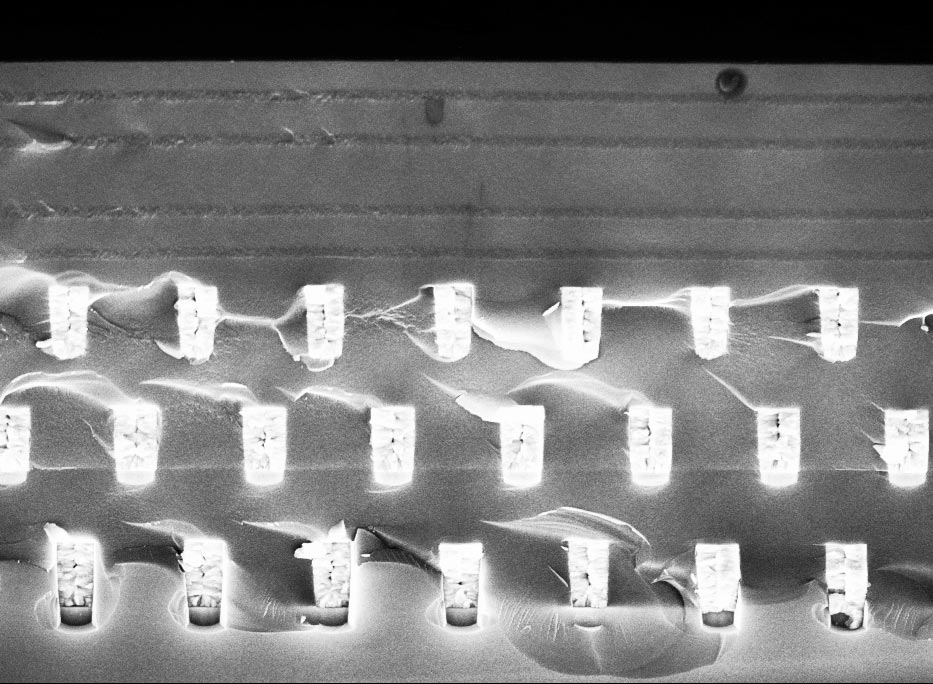
“These two papers offer the most convincing evidence of ‘super-Planckian’ radiation in the far-field,” said Lin. “This doesn’t violate Planck’s law. It’s a new way to generate thermal emission, a new underlying principle. This material, and the method that it represents, opens a new path to realize super-intense, tunable LED-like infrared emitters for thermophotovoltaics and efficient energy applications.”
For his research, Lin built a three-dimensional tungsten photonic crystal — a material that can control the properties of a photon — with six offset layers, in a configuration similar to a diamond crystal, and topped with an optical cavity that further refines the light. The photonic crystal shrinks the spectrum of light that is emitted from the material to a span of about 1 micrometer. The cavity continues to squeeze the energy into a span of roughly 0.07 micrometers.
Lin has been working to establish this advance for 17 years, since he created the first all-metallic photonic crystal in 2002, and the two papers represent the most rigorous tests he has conducted.
“Experimentally, this is very solid, and as an experimentalist, I stand by my data. From a theoretical perspective, no one yet has a theory to fully explain my discovery,” Lin said.
In both the imaging and spectroscopy study, Lin prepared his sample and a blackbody control — a coating of vertically aligned nanotubes on top of the material — side by side on a single piece of silicon substrate, eliminating the possibility of changes between testing the sample and control that could compromise the results. In an experimental vacuum chamber, the sample and control were heated to 600 degrees Kelvin, about 620 degrees Fahrenheit.
In Nature Scientific Reports, Lin presents spectral analysis taken in five positions as the aperture of an infrared spectrometer moves from a view filled with the blackbody to one of the materials. Peak emission, with an intensity of 8 times greater than the blackbody reference, occurs at 1.7 micrometers.
The IEEE Photonics Journal paper presented images taken with a near-infrared conventional charge-coupled device, a camera that can capture the expected radiation emission of the material.
Recent unrelated research has shown a similar effect at a distance of less than 2 thermal wavelengths from the sample, but Lin’s is the first material to display super-Planckian radiation when measured from 30 centimeters distance (about 200,000 wavelengths), a result showing the light has completely escaped from the surface of the material.
Although theory does not fully explain the effect, Lin hypothesizes that the offsets between the layers of photonic crystal allow light to emerge from within the many spaces inside the crystal. The emitted light bounces back and forth within the confines of the crystal structure, which alters the property of the light as it travels to the surface to meet the optical cavity.
“We believe the light is coming from within the crystal, but there are so many planes within the structure, so many surfaces acting as oscillators, so much excitation, that it behaves almost like an artificial laser material,” Lin said. “It’s just not a conventional surface.”
The new material could be used in applications like energy harvesting, military infrared-based object tracking and identification, producing high-efficiency optical sources in the infrared driven by waste heat or local heaters, research requiring environmental and atmospheric, and chemical spectroscopy in the infrared, and in optical physics as a laser-like thermal emitter.
“This exciting and unexpected discovery emphasizes the importance of conducting paradigm-shifting fundamental research that can move the boundaries of knowledge in physics and material science” said Curt Breneman, Dean of the Rensselaer School of Science. “We are very proud of Professor Lin and his team for leading the way toward the development of new and transformative technologies.”
Reference: “An In-situ and Direct Confirmation of Super-Planckian Thermal Radiation Emitted From a Metallic Photonic-Crystal at Optical Wavelengths” by Shawn-Yu Lin, Mei-Li Hsieh, Sajeev John, B. Frey, James A. Bur, Ting-Shan Luk, Xuanjie Wang and Shankar Narayanan, 23 March 2020, Scientific Reports.
DOI: 10.1038/s41598-020-62063-2
“An In-situ and Direct Confirmation of Super-Planckian Thermal Radiation Emitted From a Metallic Photonic-Crystal at Optical Wavelength” was supported by NSF under award ECCS-1840673-NOA (device characterization and modeling) and DOE Office of Science under award DE-FG02-06ER46347 (device fabrication). At Rensselaer, Lin was joined by Mei-Li Hsieh, B. Frey, James A. Bur, Xuanjie Wang, and Shankar Narayanan, as well as Sajeev John of the University of Toronto, and Ting-Shan Luk of Sandia National Laboratory.
Never miss a breakthrough: Join the SciTechDaily newsletter.
Follow us on Google and Google News.
7 Comments
“with the peak of the emitted spectrum shifting to longer wavelengths as heat rises”
It should say short wavelengths as heat rises. Increases of heat push black body radiation from radio waves into the visible spectrum and then to the UV spectrum if lets say a piece of iron is heated up. You mention the reverse of what happens.
The peak of radiation intensity shifts to shorter wavelengths as heat increases. “White hot” is hotter than “red hot”, blue flames are hotter than yellow flames, blue stars are hotter than red stars, etc. A science magazine should hire writers with some comprehension of science. The content of SciTechDaily is pretty inconsistent.
I noticed the “longer wavelengths” and I am just an amateur. Popularization is great, but it has its hazards. Book publishers always had proofreaders and editorial oversight.
Hmmm.. At thermal equalibrium, Emmisivity must equal absorbtivity, otherwise the material would cool (or heat ) itself spontaneously relative to the environment it is placed in (which would allow the generation of free useable energy violating 2nd law of thermodynamics. Therefore, a super emitter would require greater than 100% absorbtivity, meaning it absorbs more energy than is being radiated on it, in order to sit at the same temperature as its environment.
For this to be true, the material would have to absorb more energy than is classically possible from the environment.
The above statement are only true for equilibrium conditions. Perhaps it only super emmits when powered ins some way?
The title of this article is deceptive: there is no “new kind of light”. It is simply EM radiation that does not fit into Planck’s black-body radiation curve.
Interesting. I’d like to see it retested.
I wonder if this ”NEW kind of light” breaks the speed-of-light, forbidden with the advent of special relativity.
@Marcus. T [et al]: “It should say short wavelengths as heat rises. Increases of heat push black body radiation from radio waves into the visible spectrum and then to the UV spectrum if lets say a piece of iron is heated up. You mention the reverse of what happens.”
@Dr. Lindemann: “The above statement are only true for equilibrium conditions. Perhaps it only super emmits when powered ins some way?”
You are all correct. In fact, the press release has been amended in some other places. [Say, https://phys.org/news/2020-03-advanced-super-planckian-material-led-like.html .]
The shift seems to be to the coherent emission peak wavelength. It looks like an IR laser, which pumps the black body radiation into a narrow wavelength, narrow lobe far field emission. This is shown in an older paper: https://www.physi…PHOT.pdf . See fig. 1 for the design as well as the normal black body peak shift towards shorter wavelengths, and fig. 2 for the suppressed black body (as well as an overtone peak confirming resonance in some manner). That the coherent emission is located at a shorter wavelength or higher frequency (photon energies) is perhaps a coincidence, but it certainly help their experiments as well as the operation (get the heat out).
The abstract points out that this is non-equilibrium (non-black body) operation. Curious, but no laws broken. Regarding shoehorning it into an interpretation of equilibrium black body operation, they confirm that it looks odd: “This discovery is in sharp contrast to the conventional knowledge that a blackbody has a unity absorptance, a unity emittance and should emit the strongest radiation at any given temperature.”