

Close Menu
    Facebook X (Twitter) Instagram
    SciTechDaily
    • Biology
    • Chemistry
    • Earth
    • Health
    • Physics
    • Science
    • Space
    • Technology
    Facebook X (Twitter) Pinterest YouTube RSS
    SciTechDaily
    Home»Physics»Ultra-Fast Magnetic Switching Could Transform Fiber Optic Communications & Expand the Capacity of the Internet
    Physics

    Ultra-Fast Magnetic Switching Could Transform Fiber Optic Communications & Expand the Capacity of the Internet

    By Trinity College DublinSeptember 18, 20201 Comment4 Mins Read
    Facebook Twitter Pinterest Telegram LinkedIn WhatsApp Email Reddit
    Share
    Facebook Twitter LinkedIn Pinterest Telegram Email Reddit
    Fast Intenet Fiber Optics Concept
    Researchers found a new material that acts as a super-fast magnetic switch. It can increase the global fiber optic cable network capacity tenfold when exposed to successive ultra-short laser pulses.

    Researchers at CRANN and Trinity’s School of Physics have discovered that a new material can act as a super-fast magnetic switch.

    When struck by successive ultra-short laser pulses it exhibits “toggle switching” that could increase the capacity of the global fiber optic cable network by an order of magnitude.

    Expanding the capacity of the internet

    Switching between two states – 0 and 1 – is the basis of digital technology and the backbone of the internet. The vast majority of all the data we download is stored magnetically in huge data centers across the world, linked by a network of optical fibers.

    Obstacles to further progress with the internet are three-fold, specifically the speed and energy consumption of the semiconducting or magnetic switches that process and store our data and the capacity of the fiber optic network to handle it.
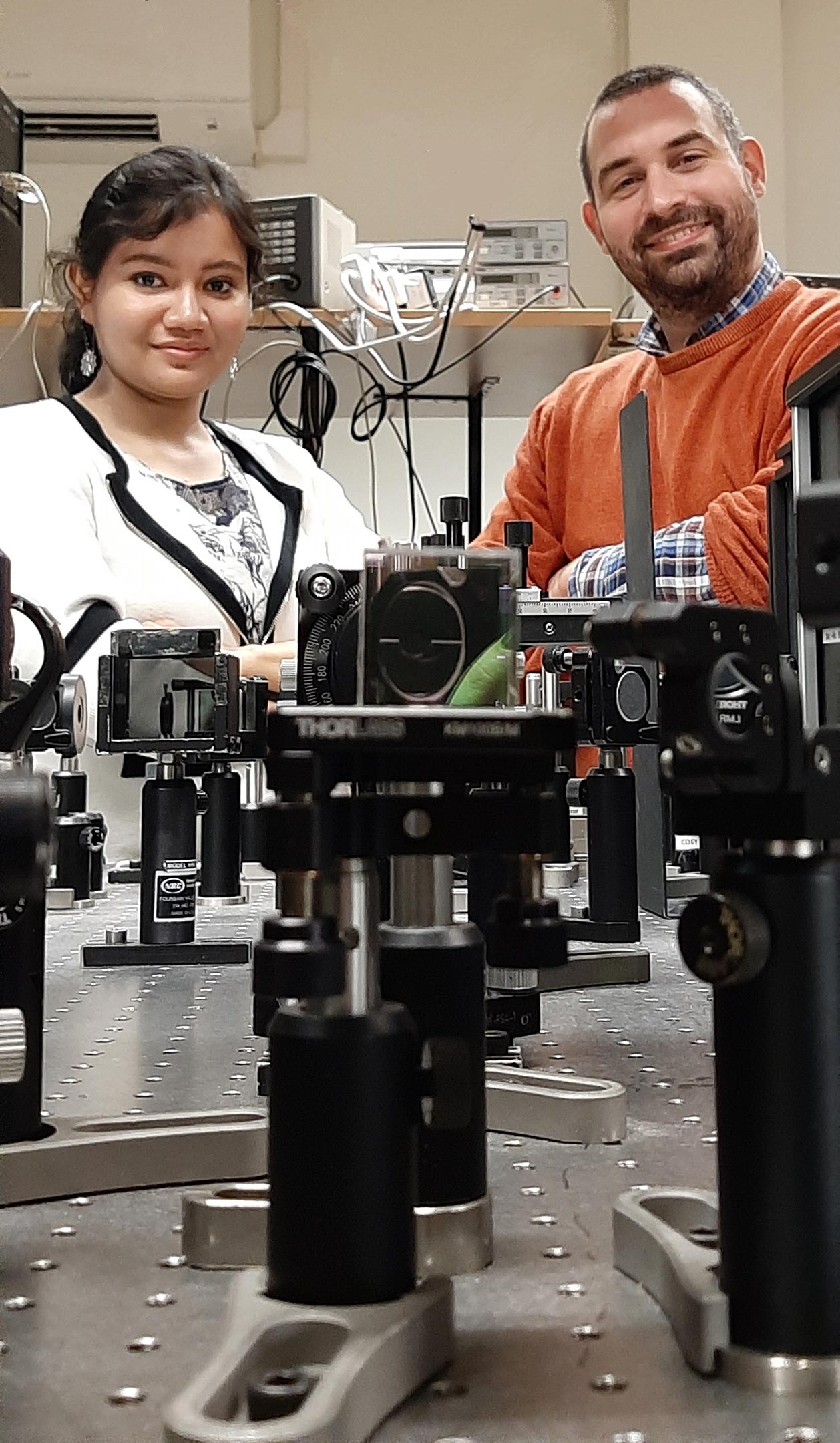
    Super Fast Magnetic Switch
    Researchers at CRANN and Trinity College Dublin’s School of Physics have discovered that a new material can act as a super-fast magnetic switch. Credit: CRANN, and Trinity College Dublin

    The new discovery of ultra-fast toggle switching using laser light on mirror-like films of an alloy of manganese, ruthenium, and gallium known as MRG could help with all three problems.

    Not only does light offer a great advantage when it comes to speed but magnetic switches need no power to maintain their state. More importantly, they now offer the prospect of rapid time-domain multiplexing of the existing fiber network, which could enable it to handle ten times as much data.

    The science behind magnetic switching

    Working in the photonics laboratory at CRANN, Trinity’s nanoscience research center, Dr. Chandrima Banerjee, and Dr. Jean Besbas used ultra-fast laser pulses lasting just a hundred femtoseconds (one ten thousand billionths of a second) to switch the magnetization of thin films of MRG back and forth. The direction of magnetization can point either in or out of the film.

    With every successive laser pulse, it abruptly flips its direction. Each pulse is thought to momentarily heat the electrons in MRG by about 1,000 degrees, which leads to a flip of its magnetization. The discovery of ultra-fast toggle switching of MRG has just been published in leading international journal, Nature Communications.

    Dr. Karsten Rode, Senior Research Fellow in the ‘Magnetism and Spin Electronics Group’ in Trinity’s School of Physics, suggests that the discovery just marks the beginning of an exciting new research direction.

    Dr. Rode said:

    “We have a lot of work to do to fully understand the behavior of the atoms and electrons in a solid that is far from equilibrium on a femtosecond timescale. In particular, how can magnetism change so quickly while obeying the fundamental law of physics that says that angular momentum must be conserved?

    “In the spirit of our spintronics team, we will now gather data from new pulsed-laser experiments on MRG, and other materials, to better understand these dynamics and link the ultra-fast optical response with electronic transport. We plan experiments with ultra-fast electronic pulses to test the hypothesis that the origin of the toggle switching is purely thermal.”

    Next year Chandrima will continue her work at the University of Haifa, Israel, with a group that can generate even shorter laser pulses. The Trinity researchers, led by Karsten, plan a new joint project with collaborators in the Netherlands, France, Norway, and Switzerland, aimed at proving the concept of ultra-fast, time-domain multiplexing of fiber-optic channels.

    Reference: “Single pulse all-optical toggle switching of magnetization without gadolinium in the ferrimagnet Mn2RuxGa” by C. Banerjee, N. Teichert, K. E. Siewierska, Z. Gercsi, G. Y. P. Atcheson, P. Stamenov, K. Rode, J. M. D. Coey & J. Besbas, 7 September 2020, Nature Communications.
    DOI: 10.1038/s41467-020-18340-9

    The work that made the discovery possible was supported by Science Foundation Ireland, the Irish Research Council and the European Commission.

    Never miss a breakthrough: Join the SciTechDaily newsletter.
    Follow us on Google and Google News.

    Electrical Engineering Fiber Optics Materials Science Optics Popular Telecommunications Trinity College Dublin
    Share. Facebook Twitter Pinterest LinkedIn Email Reddit

    Related Articles

    Studying Chaos Phenomena With One of the World’s Fastest Cameras

    An International Team of Scientists Uncovered Exotic Quantum Properties Hidden in Magnetite

    Physics Process Yielding Nanolasers in 2D Semiconductors Could Be Game-Changer for High Speed Communications

    A New Kind of Light in the Universe? “Super-Planckian” Material Emits Light That Exceeds Limits of Natural Law

    Using Light to Put a Twist on Electrons – Inducing Asymmetrical Patterns in Exotic Materials

    Multi-Dimensional Quantum Communications With Twisted Light Across Optical Fiber Networks

    Record-Breaking Terahertz Laser Beam Turns Air Into Glowing Plasma

    Using Extremely Fast Lasers to Develop Perovskite Solar Cells That Can Harvest More Electricity

    Harvesting Hot Electrons Without Tricks Could Increase Solar Panel Efficiency

    1 Comment

    1. Beebee Imstrong on September 21, 2020 12:10 am

      Hello,I’m the person with the Magnet Soul.If you wan’t any info don’t hesitate to email me….Email address [email protected]

      Reply
    Leave A Reply Cancel Reply

    • Facebook
    • Twitter
    • Pinterest
    • YouTube

    Don't Miss a Discovery

    Subscribe for the Latest in Science & Tech!

    Trending News

    Popular GLP-1 Weight-Loss Drugs Linked to 30% Lower Breast Cancer Risk

    A Deadly Fungus Has Found the Perfect Hiding Place: Human Hair Follicles

    Ancient Neanderthal DNA May Give Some People More Muscle

    How a Low-Fat Vegan Diet Helped People Lose Weight Without Counting Calories

    MIT Physicists Zapped a Quantum Crystal With Lasers – and Discovered Something Surprising

    Mushroom Mystery: The Fungus That Makes People See Tiny Humans

    Popular Erectile Dysfunction Drug Linked to Vision-Threatening Eye Disease

    Scientists Find a Smarter Way To Turn Used Coffee Grounds Into Clean Fuel

    Follow SciTechDaily
    • Facebook
    • Twitter
    • YouTube
    • Pinterest
    • Newsletter
    • RSS
    SciTech News
    • Biology News
    • Chemistry News
    • Earth News
    • Health News
    • Physics News
    • Science News
    • Space News
    • Technology News
    Recent Posts
    • Popular Fertility Drug May Raise Miscarriage Risk Without Improving Live Birth Odds
    • This Flesh-Eating Fly Is Back in the U.S. – Scientists Are Tracking Where It Could Strike Next
    • Scientists Survey Mount Ararat’s Mysterious Glacier for the First Time
    • Scientists Turn One of the World’s Hardest-To-Recycle Plastics Into Engine Oil
    • Scientists Have Uncovered a Troubling New Pattern Hidden in America’s Rivers
    Copyright © 1998 - 2026 SciTechDaily. All Rights Reserved.
    • Science News
    • About
    • Contact
    • Editorial Board
    • Privacy Policy
    • Terms of Use

    Type above and press Enter to search. Press Esc to cancel.