
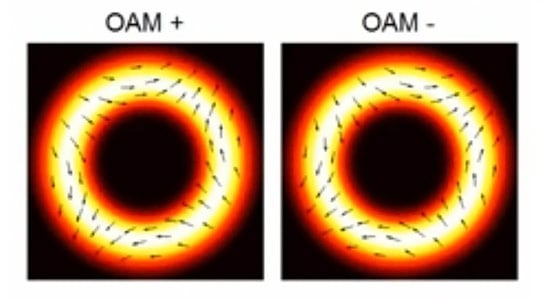
New fiber optic technology from researchers at Boston University and the University of Southern California could ease Internet congestion and boost Internet bandwidth.
As rapidly increasing demand for bandwidth strains the Internet’s capacity, a team of engineers has devised a new fiber optic technology that promises to increase bandwidth dramatically. The new technology could enable Internet providers to offer much greater connectivity – from decreased network congestion to on-demand video streaming.
Described in the June 28 issue of the journal Science, the technology centers on donut-shaped laser light beams called optical vortices, in which the light twists like a tornado as it moves along the beam path, rather than in a straight line.
Widely studied in molecular biology, atomic physics, and quantum optics, optical vortices (also known as orbital angular momentum, or OAM, beams) were thought to be unstable in fiber, until BU Engineering Professor Siddharth Ramachandran recently designed an optical fiber that can propagate them. In the paper, he and Alan Willner of USC demonstrate not only the stability of the beams in optical fiber but also their potential to boost Internet bandwidth.
“For several decades since optical fibers were deployed, the conventional assumption has been that OAM-carrying beams are inherently unstable in fibers,” said Ramachandran. “Our discovery, of design classes in which they are stable, has profound implications for a variety of scientific and technological fields that have exploited the unique properties of OAM-carrying light, including the use of such beams for enhancing data capacity in fibers.”
The reported research represents a close collaboration between optical fiber experts at BU and optical communication systems experts at USC. “Siddharth’s fiber represents a very unique and valuable innovation. It was great to work together to demonstrate a terabit-per-second capacity transmission link,” said Willner, electrical engineering professor at the USC Viterbi School of Engineering.
Ramachandran and Willner collaborated with OFS-Fitel, a fiber optics company in Denmark, and Tel Aviv University.
Funded by the Defense Advanced Research Projects Agency, the technology could not come at a better time, as one of the main strategies to boost Internet bandwidth is running into roadblocks just as mobile devices fuel rapidly growing demands on the Internet. Traditionally, bandwidth has been enhanced by increasing the number of colors, or wavelengths of data-carrying laser signals—essentially streams of 1s and 0s—sent down an optical fiber, where the signals are processed according to color. Increasing the number of colors has worked well since the 1990s when the method was introduced, but now that number is reaching physical limits.
An emerging strategy to boost bandwidth is to send the light through a fiber along distinctive paths, or modes, each carrying a cache of data from one end of the fiber to the other. Unlike the colors, however, data streams of 1s and 0s from different modes mix together; determining which data stream came from which source requires computationally intensive and energy-hungry digital signal processing algorithms.
Ramachandran’s and Willner’s approach combines both strategies, packing several colors into each mode, and using multiple modes. Unlike in conventional fibers, OAM modes in these specially designed fibers can carry data streams across an optical fiber while remaining separate at the receiving end. In experiments appearing in the Science paper, Ramachandran created an OAM fiber with four modes (an optical fiber typically has two), and he and Willner showed that for each OAM mode, they could send data through a one-kilometer fiber in 10 different colors, resulting in a transmission capacity of 1.6 terabits per second, the equivalent of transmitting eight Blu-RayTM DVDs every second.
Reference: “Terabit-Scale Orbital Angular Momentum Mode Division Multiplexing in Fibers” by Nenad Bozinovic, Yang Yue, Yongxiong Ren, Moshe Tur, Poul Kristensen, Hao Huang, Alan E. Willner and Siddharth Ramachandran, 28 June 2013, Science.
DOI: 10.1126/science.1237861
Never miss a breakthrough: Join the SciTechDaily newsletter.
Follow us on Google and Google News.
6 Comments
Interesting how Vortex Technologies can expand or (enhance) the applications of many linear technologies. An example in Fluid dynamics is that Heat Transfer in Tube Type Heat Exchangers can be improved significantly at the expense of a little higher pressure drop.
On the outside of the exchanger tube,is there a laminar or turbulent flow,or is the second fluid static,with only convection?Is the outside surface smooth,or configured for better heat-transferance?A tube wall might have an optimum grain stucture or internal pattern for optimum transfer rate.Also,a composite material stucture might give significantly better heat transfer rates-for example,graphene pathways.
I just wanted to add this photo of the Vortex Cork-Screw Antenna for this OAM Technology:
https://www.facebook.com/photo.php?fbid=577533388935883&set=a.577456698943552.1073741841.100000376827032&type=1&theater
Still a better drawing of this Vortex Cork-Screw Antenna Technology:
http://ej.iop.org/images/1367-2630/14/3/033001/Full/nj400111fA6_online.jpg
What happens when holographic recordings are stacked in one thin layer after another?Can they be used to encrypt or pass data with more bandwidth?How about a “bucket brigade” of temporary holograms?Can the reflective inner layer of optical cable be holographic?If,as maintained,different colors can be utilized holographically,can this be used to maintain multiple channels?Can a math function be specifically tailored to derive a second file from the negative of a holographic image?
This article is a few years old, yet its always good to look back. We have made many advances today In Fibre optics even to the extent we are now using OM4 cable capable of easily handeling “even greater packs of information” Thanks for the article I enjoyed think about 2013.