
Electrostatic forces enable low-voltage actuation without relying on rare earth materials.
Nearly every electric motor in modern life, from the fan on your desk to the motor in an electric vehicle, relies on magnetism. For more than a century, magnetic fields have dominated motor design because electrostatic forces were considered too weak for practical machines.
That assumption is now being challenged by a surprising class of materials known as ferroelectric fluids. These unusual liquids respond exceptionally strongly to electric fields, revealing effects that scientists once dismissed as too small to matter.
Most people think of electricity creating motion through the attraction between opposite charges. While this electrostatic force does exist, it generally lacks the strength needed to power everyday machines. As a result, engineers turned to electromagnetic motors, which use electricity to generate magnetic fields that produce rotational motion.
But electric fields can do more than pull. They can also create a subtle sideways force that acts perpendicular to the applied voltage. In ordinary materials, this effect is so weak that it has attracted little attention. New experiments suggest that in ferroelectric fluids, however, the force can become surprisingly powerful, strong enough to move liquid against gravity and even drive a prototype motor without magnets or metal rotors.
Why this matters
The key advance in this research is that it experimentally shows this overlooked sideways electrostatic force can become unexpectedly powerful under the right conditions.
Specially Appointed Professor Suzushi Nishimura and his team at Institute of Science Tokyo (Science Tokyo) studied ferroelectric fluids and took a closer look at the sideways force. They placed the liquid between two electrodes spaced only a few millimeters apart, then applied voltage. The result was clear: the liquid moved sideways by nearly 10 centimeters, even while working against gravity. Conventional liquids tested in the same setup did not move this way. The effect appeared only in the ferroelectric fluid.

The way the force grew was also unusual. In ordinary materials, raising the voltage does not usually produce a large increase in force. With the ferroelectric fluid, a small voltage increase produced a proportional rise in force. Electricity behaves in a fundamentally different way in this material.
A detailed analysis showed that the electric field causes molecules in the liquid to line up in an ordered arrangement, creating the sideways push. That finding led to a new question: if the force can push, could it also make something rotate?
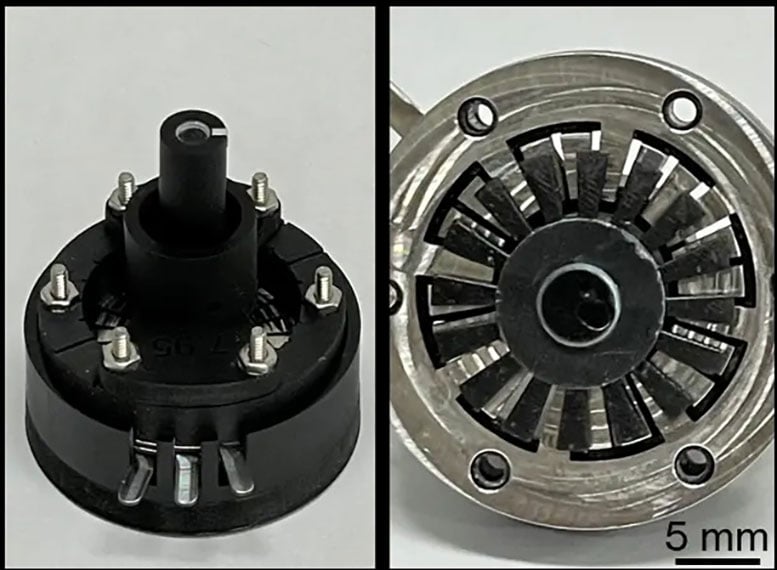
Using this principle, the team built a prototype motor that does not need magnets or a metal rotor. Tests confirmed that the motor could rotate by using this newly controlled force.
What’s next
The discovery expands how motors and actuation systems can be designed. Most electromagnetic motors today depend on magnets and copper coils. This new approach can create motion without magnets or rare earth metals, which could be valuable in a world where material resources are limited.
The design could also be lighter and simpler. Since the rotating component can be made from resin instead of metal, devices may become lighter and faster to respond. That could help in robotics, compact machines, and precision systems.
Because the motor does not depend on magnetic fields, it may also work well in places where magnetic noise causes problems, including medical equipment and data storage devices. It also runs at much lower voltages than conventional electrostatic devices, which could make it safer and more practical.
Comment from the researcher
“Our experiments suggested that a motor rotor might no longer need to be made of metal. That idea seemed difficult to accept at first. But when we trusted the data and made a rotor entirely from plastic, it really did rotate,” says Suzushi Nishimura.
He concludes, “This force was theoretically predicted more than 100 years ago, but no one had directly seen it with the naked eye. Being the first to observe it was an incredibly exciting moment. That is one of the great rewards of being a researcher. Science is fun!”
Reference: “Huge transverse Maxwell stress in ferroelectric fluids and prototyping of new ferroelectric motors” by Tatsuhiro Tsukamoto, and Suzushi Nishimura, 19 November 2025, Communications Engineering.
DOI: 10.1038/s44172-025-00530-2
Never miss a breakthrough: Join the SciTechDaily newsletter.
Follow us on Google and Google News.
1 Comment
woah dude, spot on