
The world’s first rechargeable edible battery has been created at the Istituto Italiano di Tecnologia. This innovative technology can be used for health diagnostics, monitoring food quality, and even in the creation of edible soft robotics.
Researchers at the Italian Institute of Technology have made a breakthrough by developing the first fully edible and rechargeable battery. The battery cell, which is constructed using materials commonly consumed in our daily diets, has been documented in a recently published paper in the journal Advanced Materials. This innovative technology has the potential to be used in health diagnostics, food quality monitoring, and even the creation of edible soft robotics.
The research was conducted by the team led by Mario Caironi, coordinator of the Printed and Molecular Electronics Laboratory at the IIT Center in Milan, Italy. Caironi has been dedicated to investigating the electronic properties of food and its by-products, with the goal of combining them with edible materials to create new, cutting-edge edible electronic materials. In recognition of his work, Caironi was awarded a 2-million-euro ERC consolidator grant for the ELFO Project in 2019, which focuses on advancing the field of edible electronics.
Edible electronics is a recently growing field that could have a great impact on the diagnosis and treatment of gastrointestinal tract diseases, as well as on food quality monitoring. One of the most interesting challenges in the development of future edible electronic systems is to realize edible power sources.
Innovative Battery Design Inspired by Biology
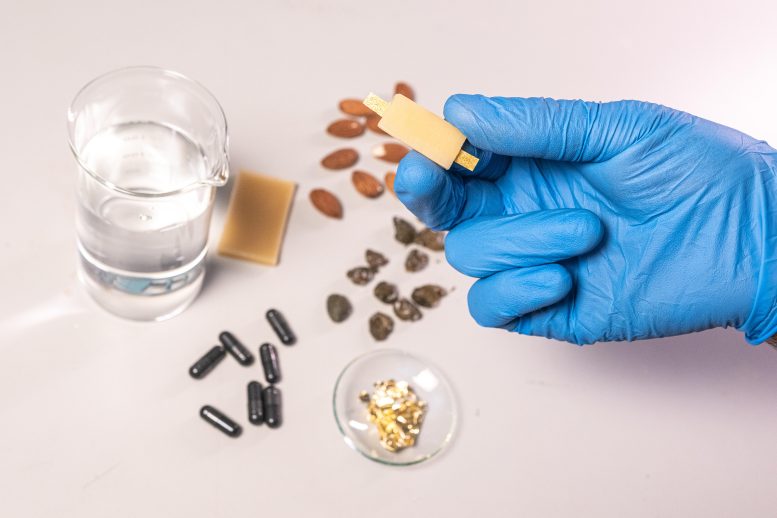
The IIT’s research group took inspiration from the biochemical redox reactions that happen in all living beings, and developed a battery that utilizes riboflavin (vitamin B2, found for example in almonds) as anode and quercetin (a food supplement and ingredient, present in capers, among others) as a cathode. Activated charcoal (a widespread over-the-counter medication) was used to increase electrical conductivity, while the electrolyte was water-based. The separator, needed in every battery to avoid short circuits, was made from nori seaweed, the kind found in sushi. Then, electrodes were encapsulated in beeswax from which two food-grade gold contacts (the foil used by pastry chefs) on a cellulose-derived support come out.
The battery cell operates at 0.65 V, a voltage low enough not to create problems in the human body when ingested. It can provide a current of 48 μA for 12 minutes, or a few microamps for more than an hour, enough to supply power to small electronic devices, such as low-power LEDs, for a limited time.
This example of fully edible rechargeable battery, the first one ever made, would open the doors to new edible electronic applications.
Future Applications of Edible Electronics
“Future potential uses range from edible circuits and sensors that can monitor health conditions to the powering of sensors for monitoring food storage conditions. Moreover, given the level of safety of these batteries, they could be used in children’s toys, where there is a high risk of ingestion. Actually, we are already developing devices with greater capacity and reducing the overall size. These developments will be tested in the future also for powering edible soft robots,” pointed out the research coordinator Mario Caironi.
“This edible battery is also very interesting for the energy storage community. Building safer batteries, without the usage of toxic materials, is a challenge we face as battery demand soars. While our edible batteries won’t power electric cars, they are proof that batteries can be made from safer materials than current Li-ion batteries. We believe they will inspire other scientists to build safer batteries for a truly sustainable future,” added Ivan Ilic, coauthor of the study.
Reference: “An Edible Rechargeable Battery” by Ivan K. Ilic, Valerio Galli, Leonardo Lamanna, Pietro Cataldi, Lea Pasquale, Valerio F. Annese, Athanassia Athanassiou and Mario Caironi, 15 March 2023, Advanced Materials.
DOI: 10.1002/adma.202211400
The study was funded by the European Research Council.
Never miss a breakthrough: Join the SciTechDaily newsletter.
Follow us on Google and Google News.