
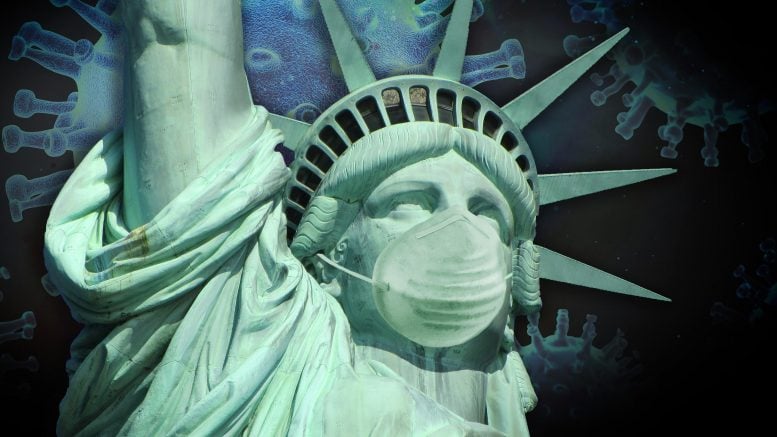
COVID-19 is now the third leading cause of death in the United States. The U.S. accounts for about 25 percent of COVID-19 cases (4.4 million) and deaths (170,000) in the world today while comprising less than 5 percent of the population.
In a commentary published ahead of print in The American Journal of Medicine, researchers from Florida Atlantic University’s Schmidt College of Medicine and a collaborator, compare responses to the pandemic from two democratic republics: South Korea and the U.S., demonstrating stark differences in public health strategies, which have led to alarming differences in cases and deaths from COVID-19. After adjusting for the 6.5-fold differences in populations, the U.S. has suffered 47 times more cases and 79 times more deaths than South Korea.
At the beginning of the pandemic, South Korea had more COVID-19 cases than anywhere else in the world outside of China. Today, they have approximately 14,269 cases and 300 deaths. Ironically, the public health methods they employed closely followed those developed and introduced by the U.S. Centers for Disease Control and Prevention (CDC), which formerly served as a scientific beacon for such activities worldwide. South Korea instituted effective containment and mitigation strategies, which they maintained in place until new cases and deaths were practically nonexistent.
In contrast to South Korea, the U.S. government mounted a delayed and fragmented response, which they maintained only until a “flattening of the curve,” according to the researchers. Further, containment and mitigation strategies were piecemeal and resulted from individual responses of individual states. Ironically, following the 2013 prediction of an impending pandemic by the Gates Foundation, it was the U.S. government that created a Pandemic Emergency Response Task Force, placing the U.S. as No. 1 worldwide by the World Health Organization (WHO) in their ability to contain and mitigate any future pandemics. This task force was disbanded in 2017, and today the U.S. in the No. 1 spot worldwide in COVID-19 cases and deaths.
In addition, the U.S. government has removed the CDC from its decades-long functions of receiving and providing analyses of surveillance data on COVID-19. The authors note that this continues a longstanding trend of politicization of the CDC, which is producing continuing harm to its longstanding reputation of worldwide respect and admiration.
“The anticipated number of deaths from COVID-19 may become comparable to the most lethal epidemic of influenza in U.S. history, which occurred from 1918 to 1919 when approximately 675,000 Americans died,” said Charles H. Hennekens, M.D., Dr.PH, senior author and the first Sir Richard Doll Professor and senior academic advisor in FAU’s Schmidt College of Medicine. “In stark contrast to both the current U.S. epidemic of COVID-19 and the Spanish Flu of 1918-19, the 2018-19 flu season affected about 42.9 million Americans, of which 647,000 were hospitalized and about 61,200 died.”
The authors raise the specter that, if the current numbers of cases and deaths and their trajectories in the U.S. continue, a coordinated national shutdown of sufficient duration, which was not achieved previously, may become necessary. For example, the continued exponential growth of the virus in the U.S. is reflected by the markedly decreasing number of days to achieve each million cases from 97 to 44 to 28 to 15 days.
The U.S. remains the epicenter of the pandemic worldwide, due, at least in part, to the massive surge in cases in Florida, California, Arizona, and Texas. Moreover, only California and Texas have issued statewide mask mandates. The authors further state that the failure to mitigate COVID-19 in the U.S. will paralyze the healthcare delivery system as well as decrease the ability to provide lifesaving measures for patients with COVID-19 or other serious conditions. They further state that it is more imperative than ever that the U.S. abandon “pandemic politics” and focus solely on effective public health strategies.
Measures such as those employed by South Korea, especially widespread, free, and rapid, point-of-care testing, meticulous tracing and quarantine of all contacts as well as masking, social distancing, crowd avoidance, and frequent hand and face washing, are likely to be at least as effective as any safe vaccine that may be developed and approved for widespread use by the general public in the U.S. and worldwide.
“In the U.S., there is an urgent need for a unified national approach for the implementation of effective public health mitigation strategies including social distancing, masking, avoidance of crowds, as well as frequent hand and face washing,” said Joshua Solano, M.D., first author and an assistant professor of integrated medical science and director of quality improvement and patient safety in FAU’s Schmidt College of Medicine.
South Korea is not alone in serving as a model for the world for COVID-19 as similar successes have been achieved in New Zealand, Australia, Canada, Germany, Iceland, the United Arab Emirates, Greece, and Argentina.
Reference: “Public Health Strategies Contain and Mitigate COVID-19: A Tale of Two Democracies” by Joshua J. Solano, MD; Dennis G. Maki, MD; Terry A. Adirim, MD, MPH, MBA; Richard D. Shih, MD and Charles H. Hennekens, MD, DrPH, 15 August 2020, The American Journal of Medicine.
DOI: 10.1016/j.amjmed.2020.08.001
Co-authors of the commentary are Terry Adirim, M.D., M.P.H., M.B.A., professor and chair of the Department of Integrated Medical Sciences and senior associate dean for clinical affairs, FAU’s Schmidt College of Medicine; Richard D. Shih, M.D., professor of integrated medical science and division director of emergency medicine, FAU’s Schmidt College of Medicine; and Dennis G. Maki, M.D., professor of medicine, University of Wisconsin School of Medicine and Public Health, and an internationally renowned infectious disease clinician and epidemiologist. Maki and Hennekens served together for two years as lieutenant commanders in the U.S. Public Health Service as epidemic intelligence service officers with the CDC.
Never miss a breakthrough: Join the SciTechDaily newsletter.
Follow us on Google and Google News.
2 Comments
skyBOX – Credit Card Size Wireless SSD Storage.Organize, share & edit on-the-go | One-touch back up | Up to 2200MB/s read & write speed | Up to 4TB storage.
https://skybox-credit-card-size.kckb.st/d9bdfbcf
UVMask: 99.99% Active UV-C Sterilization Face Mask.
https://uvmask-inactivate-9999-of-all.kckb.st/d1f5e417